Question
Discuss chemical properties of lanthanoids.

Answer

$\rightarrow$ In their chemical behaviour, in general, the earlier members of the series are quite reactive similar to calcium but, with increasing atomic number, they behave more like aluminium.
$\rightarrow$ The value of $E ^0$ of half reaction
$\operatorname{Ln}_{( aq )}^{3+}+3 e ^{-} \longrightarrow Ln ( s ) \text { range from }-2.21$
to $2.4 V $except for $Eu$ that has $-2.0 V .$
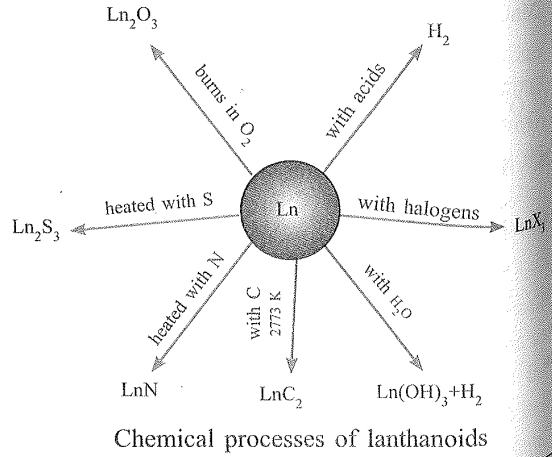
Image
$\rightarrow$ Lanthanoids heated with carbon forms carbides $\ce{Ln_3C, Ln_2C_3}$ and $\ce{LnC_2}$
$\rightarrow$ Lanthanoids form trihalides $\ce{LnX_3}$ with halogen and liberates hydrogen gas when treated with dilute acids.
$\rightarrow$ These metals combine with oxygen to form oxides of type $\ce{Ln_2O_3}$
$\rightarrow$ Oxides are basic in nature and when dissloved in water they form hydroxide $\ce{Ln(OH)_3}.$

Need a full question paper?

Generate a complete, print-ready paper with questions like this in minutes — across 16+ boards, with answer keys.
Start Generating Free

Similar questions

The rate of a reaction becomes four times when the temperature changes from $293 K$ to $313K.$ Calculate the energy of activation $(E_a)$ of the reaction assuming that it does not change with temperature. $\ce{[R=8.314 JK^{-1} MOL^{-1}, \log 4=0.6021]}$
How many gram of $Al$ metal will be obtained at the cathode by passing $0.1$ Faraday electric current in $\text{AlCl} _3$ solution? $($Atomic mass of $Al =27)$
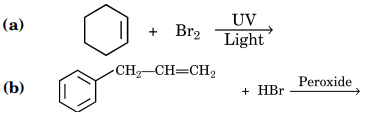
Write the major monohalo product(s) in each of the following reactions :
Image
Calculate the molarity of each of the following solutions:
  1. $30\ g$ of $Co(NO_3)_2.\ 6H_2O$ in $4.3\ L$ of solution.
  2. $30\ mL$ of $0.5\ M\ H_2SO_4$ diluted to $500\ mL.$
An organic compound $(A)$ has characteristic odour. On treatment with $\ce{NaOH},$ it forms compounds $(B)$ and $(C).$ Compound $(B)$ has molecular formula $\ce{C_7H_8O}$ which on oxidation gives back $(A).$ The compound $(C)$ is a sodium salt of an acid. When $(C)$ is treated with soda$-$lime, it yields an aromatic compound $(D).$ Deduce the structures of $(A), (B), (C)$ and $(D).$ Write the sequence of reactions involved.
Write the $\text{IUPAC}$ names of the following coordination compounds:
  1. $\ce{[Cr(NH_3)_3cl_3]}$
  2. $\ce{K3[Fe(CN)_6]}$
  3. $\ce{[CoBr_2(em)_2]}^+, ($en $=$ ethylenediamine$)$
Answer the following questions:
In the titration of $\ce{FeSO_4}$ with $\ce{KMnO_4}$ in the acidic medium, why is dil. $\ce{H_2SO_4}$ used instead of dil. $\text{HCl}$?
Write a note on halide compounds of Transition elements.
Write a note on Sandmeyer reaction.
Calculate the mass of a non-volatile solute $($molar mass $40\ g\ mol^{–1})$ which should be dissolved in $114 g$ octane to reduce its vapour pressure to $80\%.$