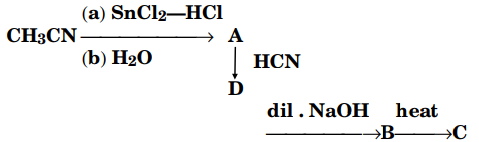
Question
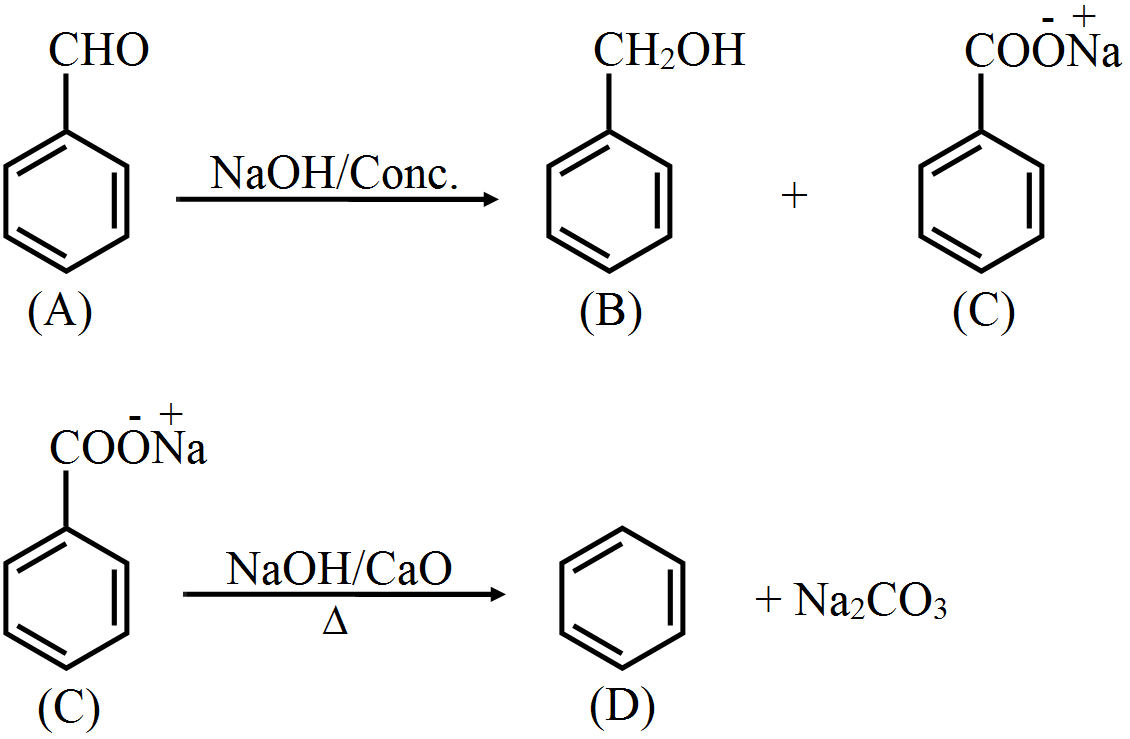
An organic compound $(A)$ has characteristic odour. On treatment with $\ce{NaOH},$ it forms compounds $(B)$ and $(C).$ Compound $(B)$ has molecular formula $\ce{C_7H_8O}$ which on oxidation gives back $(A).$ The compound $(C)$ is a sodium salt of an acid. When $(C)$ is treated with soda$-$lime, it yields an aromatic compound $(D).$ Deduce the structures of $(A), (B), (C)$ and $(D).$ Write the sequence of reactions involved.
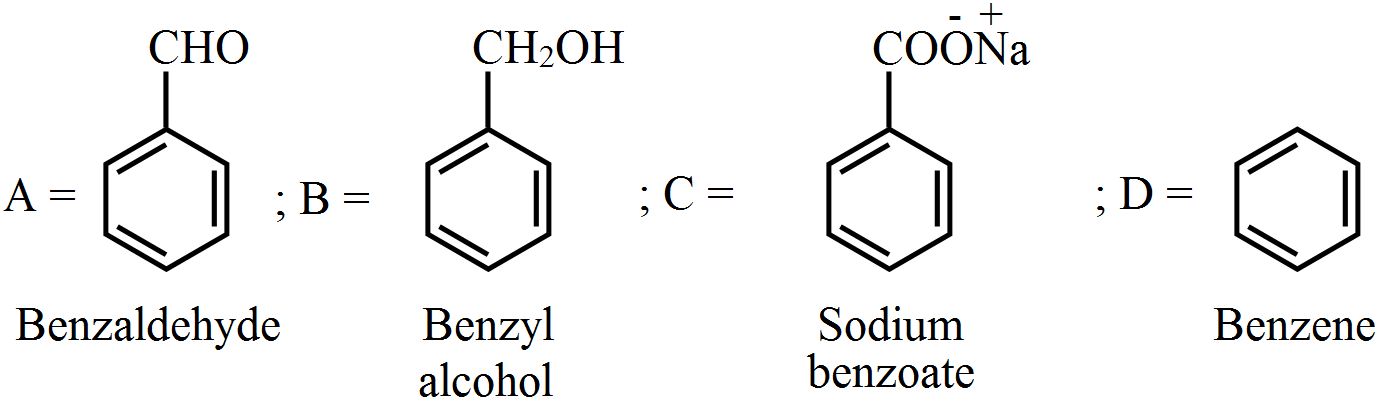
Answer


Reaction involved are:

Need a full question paper?

Generate a complete, print-ready paper with questions like this in minutes — across 16+ boards, with answer keys.

Start Generating Free

Similar questions

Write down the $\text{IUPAC}$ name for the following complex and indicate the oxidation state, electronic configuration and coordination number. Also give stereochemistry and magnetic moment of the complex:
$\ce{K[Cr(H_2O)_2(C_2O_4)_2].3H_2O}$
Explain the structure and function of salt bridge of molten galvanic cell.
How would you account for the following:
  1. Many of the transition elements and their compounds can act as good catalysts.
  2. The metallic radii of the third (5d) series of transition elements are virtually the same as those of the corresponding members of the second series.
  3. There is a greater range of oxidation states among the actinoids than among the lanthanoids.
When a chromite ore (A) is fused with sodium carbonate in free excess of air and the product is dissolved in water, a yellow solution of compound (B) is obtained. After treatment of this yellow solution with sulphuric acid,compound (C) can be crystallised from the solution. When compound (C) is treated with KCl, orange crystals of compound (D) crystallise out. Identify A to D and also explain the reactions.
Giving a suitable example for each, explain the following:
  1. Crystal field splitting.
  2. Linkage isomerism.
  3. Ambidentate ligand.
Write the $\text{IUPAC}$ names of the following coordination compounds:
  1. $\ce{[Cr(NH_3)_3cl_3]}$
  2. $\ce{K3[Fe(CN)_6]}$
  3. $\ce{[CoBr_2(em)_2]}^+, ($en $=$ ethylenediamine$)$
Write the structures of A, B, C and D in the following reactions :
Image
Explain Van't Hoff factor.
Explain optical isomerism in co$-$ordination compound.
The decomposition of A into product has value of k as $4.5\times10^{3}s^{-1}$ at $10^{\circ}C$ and energy of activation $60~kJ~mol^{-1}$. At what temperature would k be $1.5\times10^{10}s^{-1}$?