Question
Discuss the Einstien's explanation for the photoelectric effect.

Answer

$\rightarrow$ In $1905,$ Einstien gave a historical explanation of the photoelectric effect.
For which he was awarded the Nobel prize in physics in $1921$.
$\rightarrow$ Einstein accepted Max Planck's concept of radiation.
$\rightarrow$ According to this concept, the energy of radiation is not continuous.
Radiation is composed of discrete units of energy, $($Bundles of energy$)$
These units of energy are called quanta or photons.
Each quantum (photon) has energy $E =h v$.
Where, $h=$ Planck's constant
$h=6.625 \times 10^{-34} J s$
$v=$ Frequency of radiation
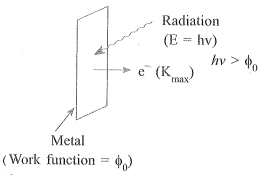
$\rightarrow$ When radiation is incident on a metal surface, the electrons in the metal interact with the quanta of the radiation.
If the energy of quantum $(h v)$ is greater than the work function $\left(\phi_0\right)$ of a given metal, the electron absorbs this quantum. i.e. the full energy of the quantum $(h v)$ is absorbed and is emitted from the metal with a maximum kinetic energy $K _{\max }$.
Thus, $K _{ max }=h v-\phi_0$
$\rightarrow$ This equation is called Einstein's equation of photoelectric effect.
Image
$\rightarrow$ If a photon interacts with an strongly bound electron than electron requires more energy to be ejected.
So it is emitted with less energy than $K _{\max }$.

Need a full question paper?

Generate a complete, print-ready paper with questions like this in minutes — across 16+ boards, with answer keys.
Start Generating Free

Similar questions

A small object is embedded in a glass sphere $(\mu=1.5)$ of radius 5.0cm at a distance 1.5cm left to the centre. Locate the image of the object as seen by an observer standing.
  1. To the left of the sphere.
  2. To the right of the sphere.

The field of a hollow wire with constant current is homageneous.
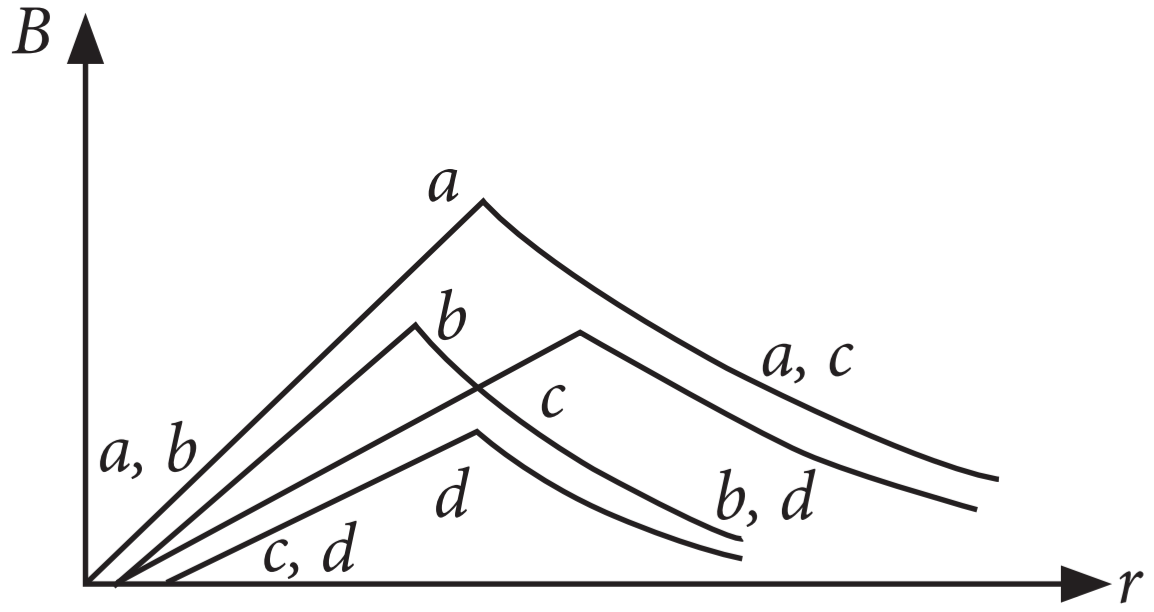
Curves in the graph shown give, as functions of radius distance r, the magnitude B of the magnetic field inside and outside four long wires a, b, c and d, carrying currents that are uniformly distributed across the cross sections of the wires. Overlapping portions of the plots are indicated by double labels.
  1. Which wire has the greatest magnitude of the magnetic field on the surface?
  1. a
  2. b
  3. c
  4. d
  1. The current density in a wire a is:
  1. Greater than in wire c.
  2. Less than in wire c.
  3. Equal to that in wire c.
  4. Not comparable to that of in wire c due to lack of information.
  1. Which wire has the greatest radius?
  1. a
  2. b
  3. c
  4. d
  1. A direct current I flows along the length of an infinitely long straight thin walled pipe, then the magnetic field is:
  1. Uniform throughout the pipe but not zero.
  2. Zero only along the axis of the pipe.
  3. Zero at any point inside the pipe.
  4. Maximum at the centre and minimum at the edges.
  1. In a coaxial, straight cable, the central conductor and the outer conductor carry equal currents in opposite direction. The magnetic field is zero.
  1. Outside the cable.
  2. Inside the inner conductor.
  3. Inside the outer conductor.
  4. In between the two conductor.
An electron emitted by a heated cathode and accelerated through a potential difference of $2.0 kV,$ enters a region with uniform magnetic field of $0.15 T$. Determine the trajectory of the electron if the field,
  1. is transverse to its initial velocity,
  2. makes an angle of $30^\circ$ with the initial velocity.
​​
When the atomic dipoles are aligned partially or fully, there is a net magnetic moment in the direction of the field in any small volume of the material. The actual magnetic field inside material placed in magnetic field is the sum of the applied magnetic field and the magnetic field due to magnetisation. This field is called magnetic intensity $(H)$.
$\text{H}=\frac{\text{B}}{\mu_0}-\text{M}$
where Mis the magnetisation of the material, flo is the permittivity of vacuum and $B$ is the total magnetic field. The measure that tells us how a magnetic material responds to an external field is given by a dimensionless quantity is appropriately called the magnetic susceptibility: for a certain class of magnetic materials, intensity of magnetisation is directly proportional to the magnetic intensity.
  1. Magnetization of a sample is:
  1. Volume of sample per unit magnetic moment.
  2. Net magnetic moment per unit volume.
  3. Ratio of magnetic moment and pole strength.
  4. Ratio of pole strength to magnetic moment.
  1. Identify the wrongly matched quantity and unit pair.
  1. Pole strength $- Am$
  2. Magnetic susceptibility $-$ dimensionless number
  3. Intensity of magnetisation $- Am^{-1}$
  4. Magnetic permeability $-$ Henry $m$
  1. A closed surface $S$ encloses a magnetic dipole of magnetic moment $2\ ml$. The magnetic flux emerging from the surface is:
  1. $2 \times 10^5\ A/ m$
  2. $3 \times 10^5\ A/ m$
  3. $4 \times 10^5\ A/ m$
  4. $5 \times 10^5\ A/ m$
  1. A solenoid has core of a material with relative permeability $500$ and its windings carry a current of $1A$. The number of turns of the solenoid is $500$ per metre. The magnetization of the material is nearly,
  1. $2.5 \times 10^3Am^{-1}$
  2. $2.5 \times 10^5Am^{-1}$
  3. $2.0 \times 10^3Am^{-1}$
  4. $2.0 \times 10^5Am^{-1}$
  1. The relative penneability of iron is $6000$. Its magnetic susceptibility is:
  1. $5999$
  2. $6001$
  3. $6000 \times 10^{-7}$
  4. $6000 \times 10^7$
  1. State briefly the processes involved in the formation of p-n junction explaining clearly how the depletion region is formed.
  2. Using the necessary circuit diagrams, show how the V-I characteristics of a p-n junction are obtained in
  1. Forward biasing.
  2. Reverse biasing.
How are these characteristics made use of in rectification?
Explain Bohr's atomic model.
###
State three postulates of Bohr's atomic model.
Three capacitors each of capacitance 9 pF are connected in series.
(a) What is the total capacitance of the combination?
(b) What is the potential difference across each capacitor if the combination is connected to a 120 V supply? S
The moon rotates about the earth in such a way that only one hemisphere of the moon faces the earth. Can we ever see the ''other face'' of the moon from the earth? Can a person on the moon ever see all the faces of the earth?
A sphere of diameter 10 cm is charged so that the electric field intensity on its surface becomes $5 \times 10^6$ Volt per meter. What will be the force exerted on a charge of $5 \times 10^{-2}$ micro Coulomb located at a distance 25 cm from the centre of the circle?
State Bohr's quantization condition for defining stationary orbits. How does de-Broglie hypothesis explain stationary orbits ?