How energy is formed from oxidation of carbohydrates, fats and proteins?
Correct the dagram below.
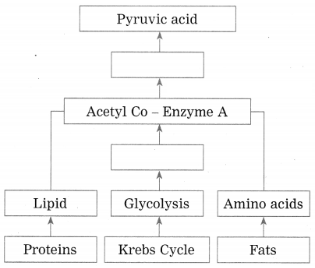
Correct the dagram below.
Download our app for free and get started
$(1)$ First of all the dietary carbohydrates are digested in the digestive system with the help of various enzymes and converted into glucose. Similarly, proteins are converted into amino acids and fats are broken down into fatty aid and glycerol (alcohol).
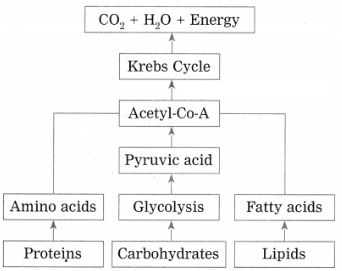
$(2)$ Oxidation of carbohydrates takes place during cellular respiration. Glucose is oxidized by three steps during aerobic respiration, viz. glycolysis, tricarboxylic acid cycle or Krebs cycle and electron transfer chain.
$(3)$ From one molecule of glucose two molecules of each pyruvic acid, ATP, $NADH_2$ and water are formed during glycolysis. Pyruvic acid which is formed in this process is converted into Acetyl-Coenzyme-A along with release of two molecules each of $NADH_2$ and $CO_2.$
$(4)$ In the next step, i.e. in TCA cycle, molecules of Acetyl-Co-A enter the mitochondria and a cyclic chain of reactions take place. Acetyl part of Acetyl- Co-A is completely oxidized through this cyclical process. The molecules $CO_2, H_2O, NADH_2, FADH_2$ are released in this process.
$(5)$ In third step, i.e. in ETC reaction, $NADH_2$ and $FADH_2$ formed during first two steps are used for obtaining ATP molecules. $3$ molecules of ATP are obtained from each $NADH_2$ molecule and $2$ molecules of ATP from each $FADH_2.$
$(6)$ Thus, one molecule of glucose upon complete oxidation in presence of oxygen yields $38$ molecules of ATP. This is how from carbohydrates, energy is obtained.
$(7)$ If carbohydrates are insufficient in diet, then proteins or lipids are used for energy production. Fatty acids derived from fats and amino acids derived from proteins are converted into Acetyl- Co-A. Acetyl-Co-A once again can yield energy through TCA cycle.
Corrected diagram:
$(2)$ Oxidation of carbohydrates takes place during cellular respiration. Glucose is oxidized by three steps during aerobic respiration, viz. glycolysis, tricarboxylic acid cycle or Krebs cycle and electron transfer chain.
$(3)$ From one molecule of glucose two molecules of each pyruvic acid, ATP, $NADH_2$ and water are formed during glycolysis. Pyruvic acid which is formed in this process is converted into Acetyl-Coenzyme-A along with release of two molecules each of $NADH_2$ and $CO_2.$
$(4)$ In the next step, i.e. in TCA cycle, molecules of Acetyl-Co-A enter the mitochondria and a cyclic chain of reactions take place. Acetyl part of Acetyl- Co-A is completely oxidized through this cyclical process. The molecules $CO_2, H_2O, NADH_2, FADH_2$ are released in this process.
$(5)$ In third step, i.e. in ETC reaction, $NADH_2$ and $FADH_2$ formed during first two steps are used for obtaining ATP molecules. $3$ molecules of ATP are obtained from each $NADH_2$ molecule and $2$ molecules of ATP from each $FADH_2.$
$(6)$ Thus, one molecule of glucose upon complete oxidation in presence of oxygen yields $38$ molecules of ATP. This is how from carbohydrates, energy is obtained.
$(7)$ If carbohydrates are insufficient in diet, then proteins or lipids are used for energy production. Fatty acids derived from fats and amino acids derived from proteins are converted into Acetyl- Co-A. Acetyl-Co-A once again can yield energy through TCA cycle.
Corrected diagram:

Download our appand get started for free
Experience the future of education. Simply download our apps or reach out to us for more information. Let's shape the future of learning together!No signup needed.*
Similar Questions
- 1View SolutionWith the help of suitable diagrams, explain the mitosis in detail.
- 2View SolutionATP: Energy Currency
- 3View Solution2 The substances formed by specific chemical bond between fatty acids and alcohol are called lipids. Digestion of lipids consumed by us is nothing but their conversion into fatty acids and alcohol. Fatty acids are absorbed and distributed everywhere within the body. From those fatty acids, different cells produce various substances necessary to themselves. Ex. the molecules called phospholipids which are essential for producing plasma membrane are formed from fatty acids. Besides, fatty acids are used for producing hormones like progesterone, estrogen, testosterone, aldosterone, etc. and the covering around the axons of nerve cells. We get 9 Kcal of energy per gram of lipids. Excess of lipids are stored in adipose connective tissue in the body.
Questions and Answers:
(1) Define lipids.
(2) What happens to fats that are eaten in excess?
(3) Which hormones regulating reproductive functions are produced from fatty acids?
(4) How is plasma membrane of the cells formed?
(5) What happens to lipids when their digestion is completed? How much energy do they provide? - 4View SolutionObserve the diagrams and answer the following questions.
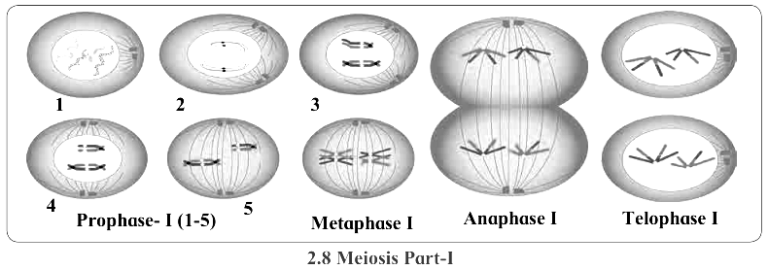
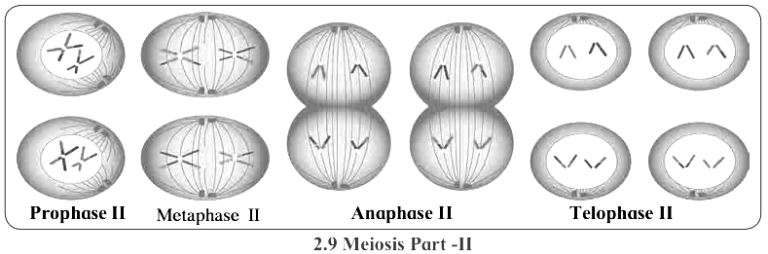
(a) Which peculiarity do you observe in the figure of Metaphase-I of meiosis ?
(b) What is the important difference between Telophase-I and Telophase-II of meiosis?
(c) Which figure shows phenomena of crossing over? - 5View SolutionHow do all the life processes contribute to the growth and development of the body?
- 6View SolutionWhat are symptoms of diseases like night blindness, rickets, beriberi, neuritis, pellagra, anaemia, scurvy?
- 7View SolutionWith the help of suitable diagrams, explain the five stages of prophase-I of meiosis.
- 8View SolutionExplain the glycolysis in detail.
- 9View SolutionLabel the diagram below? Which phase of cell division is seen in the above diagram?
- 10View SolutionDraw a neat diagram of the structure of chromosome and label the parts:
(a) Centromere (b) p-arm