MCQ
Dispersive power depends upon
  • A
    The shape of prism
  • Material of prism
  • C
    Angle of prism
  • D
    Height of the prism

Answer

Correct option: B.
Material of prism
b
( b)$\omega$ depend only on nature of material.

Need a full question paper?

Generate a complete, print-ready paper with questions like this in minutes — across 16+ boards, with answer keys.

Start Generating Free

Similar questions

A $2\, W$ carbon resistor is color coded with green, black, red and brown respectively. The maximum current which can be passed through this resistor is .............. $mA$
An electron moving with the speed $5 \times {10^6}$ per sec is shooted parallel to the electric field of intensity $1 \times {10^3}\,N/C$. Field is responsible for the retardation of motion of electron. Now evaluate the distance travelled by the electron before coming to rest for an instant (mass of $e = 9 \times {10^{ - 31}}\,Kg.$ charge $ = 1.6 \times {10^{ - 19}}\,C)$
Consider the following statements $A$ and $B$ and identify the correct choice of the given answers

$A:$ The width of the depletion layer in a $P-N$ junction diode increases in forwards bias

$B:$In an intrinsic semiconductor the fermi energy level is exactly in the middle of the forbidden gap
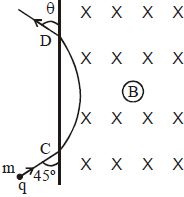
A particle of mass $m = 1.67 \times 10^{-27}\, kg$ and charge $q = 1.6 \times 10^{-19} \, C$ enters a region of uniform magnetic field of strength $1$ $tesla$ along the direction shown in the figure. The speed of the particle is $10^7\, m/s.$ The magnetic field is directed along the inward normal to the plane of the paper. The particle enters the field at $C$ and leaves at $D.$ Then the angle $\theta$ must be :-.........$^o$
When the power delivered by a $100\,volt$ battery is $40\,watts$ the equivalent resistance of the circuit is ........... $ohms$
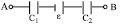
A circuit shown in the figure consists of a battery of $emf$ $10$ $V$ and two capacitance $C_1$ and $C_2 $ of capacitances $1.0$ $ \mu F$ and $2.0$ $\mu F$ respectively. The potential difference $V_A - V_B$ is $5\,V$
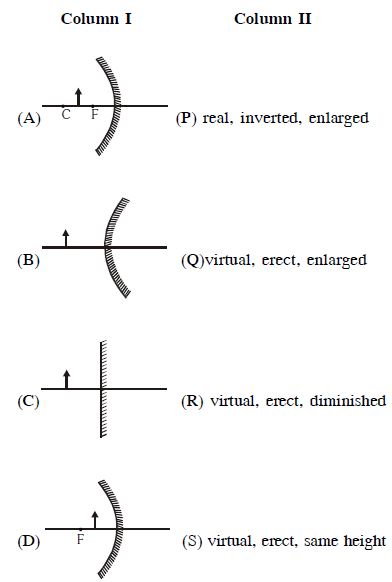
Column $-I$ contains a list of mirrors and position of object. Match this with Column $-II$ describing the nature of image
The temperature at which a black body of unit area loses its energy at the rate of $1$ joule/second is
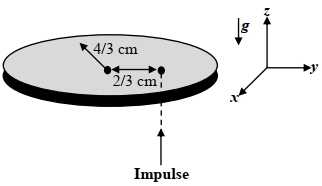
A thin circular coin of mass $5 \mathrm{gm}$ and radius $4 / 3 \mathrm{~cm}$ is initially in a horizontal $x y$-plane. The coin is tossed vertically up ( $+z$ direction) by applying an impulse of $\sqrt{\frac{\pi}{2}} \times 10^{-2} \mathrm{~N}-\mathrm{s}$ at a distance $2 / 3 \mathrm{~cm}$ from its center. The coin spins about its diameter and moves along the $+z$ direction. By the time the coin reaches back to its initial position, it completes $n$ rotations. The value of $n$ is. . . . . [Given: The acceleration due to gravity $\mathrm{g}=10 \mathrm{~ms}^{-2}$ ]
A luminous object is placed at a distance of $30 \,cm$ from the convex lens of focal length $20 \,cm$. On the other side of the lens, at what distance from the lens a convex mirror of radius of curvature $10\, cm$ be placed in order to have an upright image of the object coincident with it.....$cm$