The temperature at which a black body of unit area loses its energy at the rate of $1$ joule/second is
Medium


Download our appand get started for free
Experience the future of education. Simply download our apps or reach out to us for more information. Let's shape the future of learning together!No signup needed.*
Similar Questions
- 1The rate of radiation of a black body at $0°C$ is $E\,J/sec$ . The rate of radiation of this black body at ${273^o}C$ will beView Solution
- 2The 'Kangri' is an earthen pot used to stay warm in Kashmir during the winter months. Assume that the 'Kangri' is spherical and of surface area $7 \times 10^{-2} \,m ^{2}$. It contains $300 g$ of a mixture of coal, wood and leaves with calorific value of $30 \,kJ / g$ (and provides heat with $10 \%$ efficiency). The surface temperature of the 'Kangri' is $60^{\circ} C$ and the room temperature is $0^{\circ} C$. Then, a reasonable estimate for the duration $t$ (in h) that the 'Kangri' heat will last is (take the 'Kangri' to be a black body)View Solution
- 3View SolutionThe wavelength of radiation emitted by a body depends upon
- 4View SolutionEqual masses of two liquids are filled in two similar calorimeters. The rate of cooling will
- 5View SolutionA thermos flask is polished well
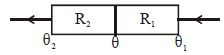
- 6Consider two insulating sheets with thermal resistances $R_1$ and $R_2$ as shown. The temperatures $\theta $ isView Solution
- 7Wires $A$ and $B$ have identical lengths and have circular cross-sections. The radius of $A$ is twice the radius of $B$ $i.e.$ ${r_A} = 2{r_B}$. For a given temperature difference between the two ends, both wires conduct heat at the same rate. The relation between the thermal conductivities is given byView Solution
- 8A body takes $5$ minutes for cooling from ${50^o}C$ to ${40^o}C.$ Its temperature comes down to ${33.33^o}C$ in next $5$ minutes. Temperature of surroundings is ....... $^oC$View Solution
- 9A black body radiates energy at the rate of $E$ $W/m^2$ at a high temperature $TK$ . When the temperature is reduced to $\frac{T}{2}K$, the radiant energy will beView Solution
- 10Three very large plates of same area are kept parallel and close to each other. They are considered as ideal black surfaces and have very high thermal conductivity. The first and third plates are maintained at temperatures $2\ T$ and $3\ T$ respectively. The temperature of the middle ($i.e.$ second) plate under steady state condition isView Solution