Question
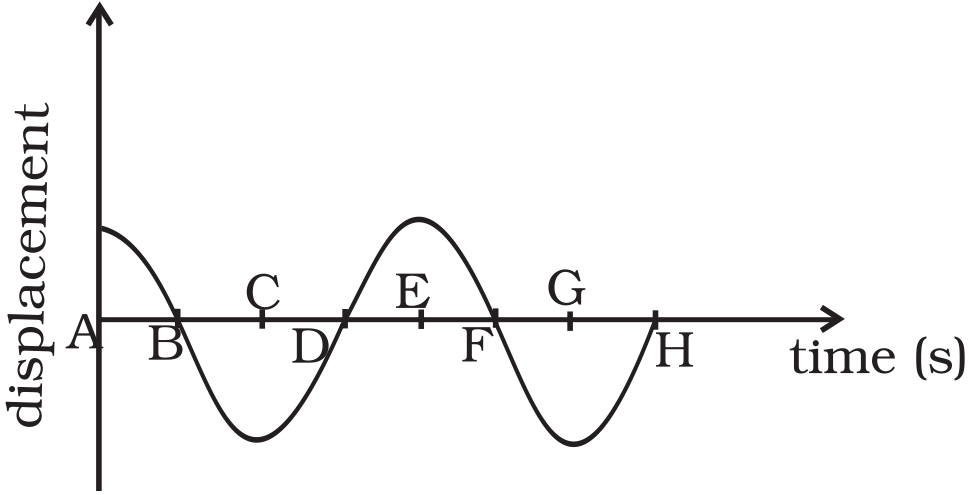
Displacement versus time curve for a particle executing S.H.M. is shown in Fig. Identify the points marked at which,
  1. Velocity of the oscillator is zero,
  2. Speed of the oscillator is maximum.

Answer


Key concept: In displacement-time graph of SHM, zero displacement values correspond to mean position; where velocity of the oscillator is maximum. Whereas the crest and troughs represent amplitude positions, where displacement is maximum and velocity of the oscillator is zero.
  1. The points A, C, E, G lie at extreme positions (maximum displacement, y = A). Hence the velocity of the oscillator is zero.
  2. The points B, D, F, H lie at mean position (zero displacement, y = 0). We know the speed is maximum at mean position.

Need a full question paper?

Generate a complete, print-ready paper with questions like this in minutes — across 16+ boards, with answer keys.

Start Generating Free

Similar questions

A refrigerator is to maintain eatables kept inside at 9°C. If room temperature is 36°C, calculate the coefficient of performance.
Two blocks of mares 10kg and 20kg are placed on the X-axis. The first mass is moved on the axis by a distance of 2cm. By what distance should the second mass be moved to keep the position of the centre of mass unchanged?
In one-dimensional motion the velocity of a particle depends on time in the following manner :
$
v=(5 t+7) m / s
$
If the particle is at the origin at $t=0$, then what will be the position of the particle at $t=2 sec$ ?
An electron and a positron moving at small speeds collide and annihilate each other. Find the energy of the resulting gamma photon.
Find the speed of the electron in the ground state of a hydrogen atom. The description of ground state is given in the previous problem.
A tank is filled with water up to a height of H meter and there is a hole in it at a height from the bottom. Find the volume of water coming out of that hole and how far from the tank will it fall on the ground?
Plot the corresponding reference circle for each of the following simple harmonic motions. Indicate the initial (t = 0) position of the particle, the radius of the circle, and the angular speed of the rotating particle. For simplicity, the sense of rotation may be fixed to be anticlockwise in every case: (x is in cm and t is in s).

$\text{x}=-2\sin\Big(3\text{t}+\frac{\pi}{3}\Big)$

  1. Explain the term impulse. Show that impulse of a variable force is equal to the area enclosed by the force-time curve.
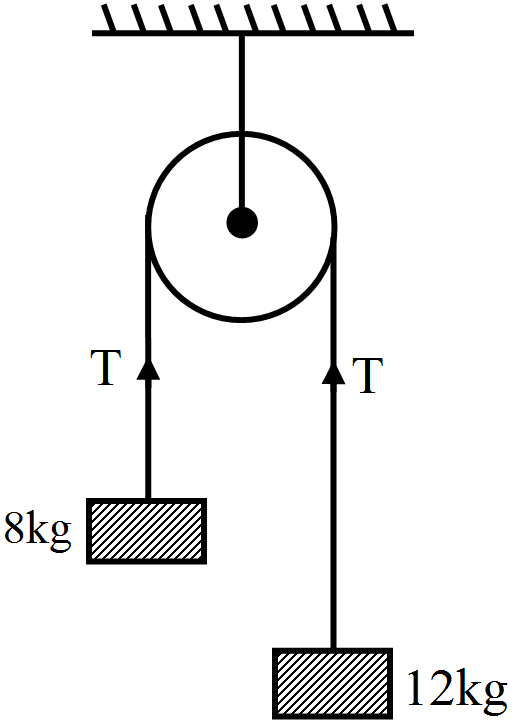
  2. Two masses 8kg and 12kg are connected at the two ends of a light inextensible string that passes over a frictionless pulley. Find the acceleration of the masses and tension in the string, when the masses are released.

A particle of mass 10g is placed in a potential field given by U = 50x2 + 100 erg/gm. Calculate the frequency of oscillation.
The coefficient of apparent expansion of a liquid when determined using two different vessels A and B are $\gamma_1$ and $\gamma_2$ respectively. If the coefficient of linear expansion of vessel A is α, find the coefficient of linear expansion of vessel B.