Distribution of energy in the spectrum of a black body can be correctly represented by
Easy
Download our app for free and get started
(c)Because Planck’s law explains the distribution of energy correctly at low temperature as well as at high temperature.

Download our appand get started for free
Experience the future of education. Simply download our apps or reach out to us for more information. Let's shape the future of learning together!No signup needed.*
Similar Questions
- 1A black body is at $727^o C$. It emits energy at a rate which is proportional toView Solution
- 2View SolutionNewton’s law of cooling, holds good only if the temperature difference between the body and the surroundings is
- 3View SolutionHalf part of ice block is covered with black cloth and rest half is covered with white cloth and then it is kept in sunlight. After some time clothes are removed to see the melted ice. Which of the following statements is correct
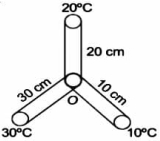
- 4The total energy of a black body radiation source is collected for five minutes and used to heat water. The temperature of the water increases from $10.0^{\circ} C$ to $11.0^{\circ} C$. The absolute temperature of the black body is doubled and its surface area halved and the experiment repeated for the same time. Which of the following statements would be most nearly correct?View Solution
- 5The sun emits a light with maximum wavelength $510\, mm$ while another star $X$ emits a light with maximum wavelength of $350\, nm$. What is the ratio of surface temperature of sun and the star $X$View Solution
- 6$Assertion :$ A body that is good radiator is also a good absorber of radiation at a given wavelength.View Solution
$Reason :$ According to Kirchhoff’s law the absorptivity of a body is equal to its emissivity at a given wavelength. - 7A black body at $227^o C$ radiates heat at the rate of $7\; cals/cm^2 s$. At a temperature of $727^o C$, the rate of heat radiated in the same units will beView Solution
- 8View SolutionThe velocity of heat radiation in vacuum is
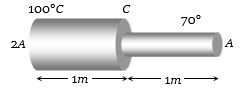
- 9$A$ metal rod of length $2$$m$ has cross sectional areas $2A$ and $A$ as shown in figure. The ends are maintained at temperatures $100°C$ and $70°C$ . The temperature at middle point $C$ is...... $^oC$View Solution
- 10Three rods of same material, same area of crosssection but different lengths $10 \,cm , 20 \,cm$ and $30 \,cm$ are connected at a point as shown. What is temperature of junction $O$ is ......... $^{\circ} C$View Solution