Question
Do permeability and relative permeability have the same dimensions?

Answer

Magnetic permeability $(\mu)$ is the ratio of magnatic flux density (B) to the megnatising field strength (H).$\mu=\frac{\text{B}}{\text{H}}$
In CGS (centimeter-gram-second) dimension of B and H is same. Hence, magnetic permeability is dimensionless. But in SI unit, dimension of B and H is not same. Thus, permeability is not dimensionless. Relative ​permeability is defined as the ratio of magnetic permeability of any medium to the permeability of the vaccum. Hence, it is dimensionless. Thus, permeability and relative permeability have the same dimensions in CS system.

Need a full question paper?

Generate a complete, print-ready paper with questions like this in minutes — across 16+ boards, with answer keys.
Start Generating Free

Similar questions

A projectile, launched with a speed v at an angle $\theta$ to the horizontal, hits a plane inclined at an angle a to the horizontal $(\alpha<\theta)$ and passing through the point of launching. Obtain an expression for the range r of the projectile on this inclined plane. When does the projectile hit this plane?
10kg mass is attached to one end of a copper wire $3m$ long and $1mm$ in diameter. Calculate the lateral compression produced in it (Poisson's ratio is $0.25$ and Young's modulus of the material of the wire is $12.5 \times 10^{10}N/ m^2$).
Consider the following very rough model of a beryllium atom. The nucleus has four protons and four neutrons confined to a small volume of radius $10^{-15} m$. The two 1 s electrons make a spherical charge cloud at an average distance of $1.3 \times 10^{-11} m$ from the nucleus, whereas the two 2 s electrons make another spherical cloud at an average distance of $5.2 \times 10^{-11} m$ from the nucleus. Find the electric field at:
  1. A point just inside the 1s cloud.
  2. A point just inside the 2s cloud.
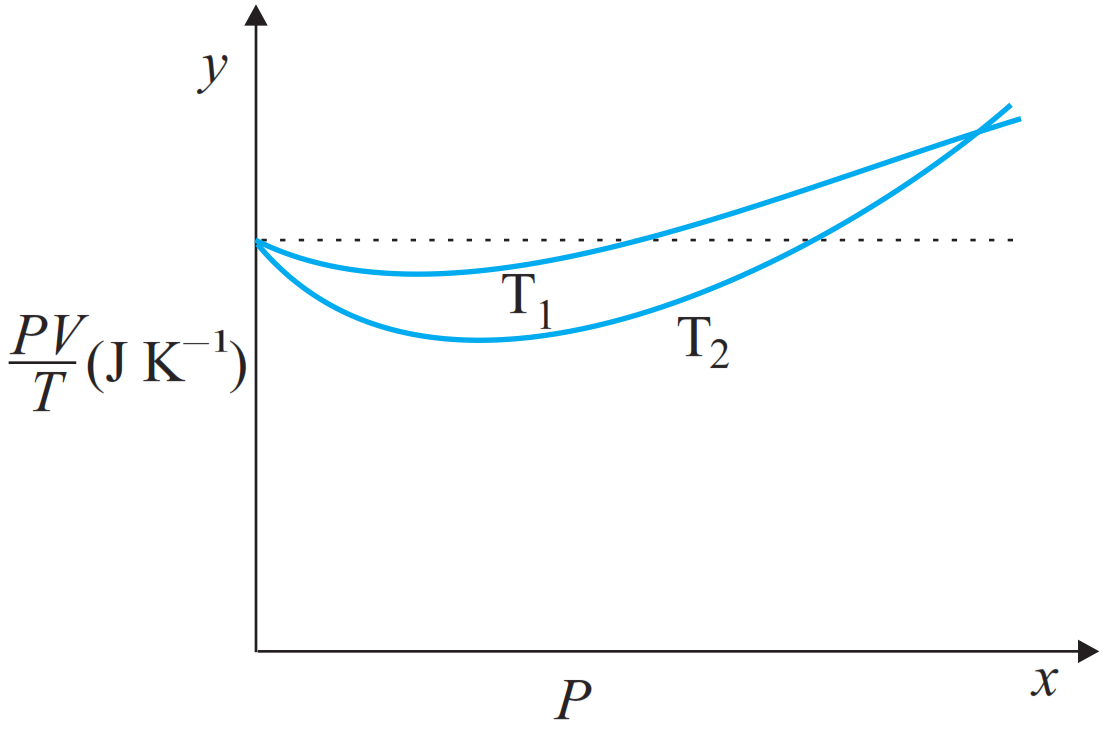
Shows plot of $\frac{\text{PV}}{\text{T}}$ versus P for $1.00 \times 10^{-3}kg$ of oxygen gas at two different temperatures: If we obtained similar plots for $1.00 \times 10^{-3}kg$ of hydrogen, would we get the same value of $\frac{\text{PV}}{\text{T}}$ at the point where the curves meet on the y-axis? If not, what mass of hydrogen yields the same value of $\frac{\text{PV}}{\text{T}}$ (for low pressure high temperature region of the plot)? (Molecular mass of $H_2 = 2.02u, of O_2 = 32.0u, R = 8.31J mo1^{-1}K^{-1}$).
Consider a non-conducting plate of radius r and mass m that has a charge q distributed uniformly over it. The plate is rotated about its axis with an angular speed $\omega.$ Show that the magnetic moment $\mu$ and the angular momentum of the plate are related as $\mu=\frac{\text{q}}{2\text{m}}\text{l}.$
A non-viscous liquid of constant density $1000 \mathrm{~kg} \mathrm{~m}^{-3}$ flows in a streamline motion along a tube of variable crosssection. The tube is a kept inclined in the vertical plane as shown in figure. The area of cross-section of the tube at two points $P$ and $Q$ at heights of 2 m and 5 m are respectively, $4 \times 10^{-3} \mathrm{~m}^2$ and $8 \times 10^{-3} \mathrm{~m}^2$. The velocity of the liquid at point $P$ is $1 \mathrm{~m} \mathrm{~s}^{-1}$. Find the work done per unit volume by the pressure and the gravity forces as the fluid flows from point $P$ to $Q$.
0.040g of He is kept in a closed container initially at 100.0°C. The container is now heated. Neglecting the expansion of the container, calculate the temperature at which the internal energy is increased by 12J.
A particle of charge $2.0 \times 10^{-8} \mathrm{C}$ and mass $2.0 \times 10^{-10} \mathrm{~g}$ is projected with a speed of $2.0 \times 10^3 \mathrm{~m} / \mathrm{s}^{-1}$ in a region with a uniform magnetic field of 0.10 T . The velocity is perpendicular to the field. Find the radius of the circle formed by the particle and also the time period.
What is kinetic energy? Prove that kinetic energy of any object is $\frac{1}{2} m v^2$. Verify this using integration method also.
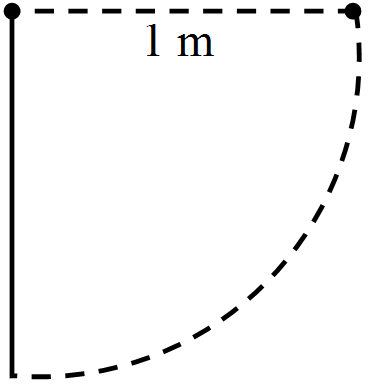
A metre stick weighing 240g is pivoted at its upper end in such a way that it can freely rotate in a vertical plane through this end (figure). A particle of mass 100g is attached to the upper end of the stick through a light string of length 1m. Initially, the rod is kept vertical and the string horizontal when the system is released from rest. The particle collides with the lower end of the stick and sticks there. Find the maximum angle through which the stick will rise.