Question
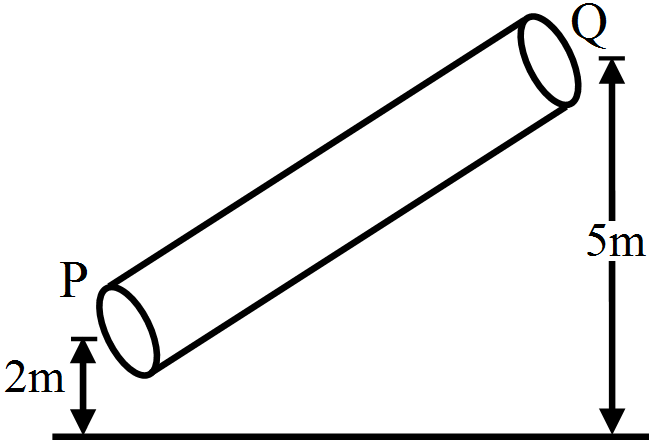
A non-viscous liquid of constant density $1000 \mathrm{~kg} \mathrm{~m}^{-3}$ flows in a streamline motion along a tube of variable crosssection. The tube is a kept inclined in the vertical plane as shown in figure. The area of cross-section of the tube at two points $P$ and $Q$ at heights of 2 m and 5 m are respectively, $4 \times 10^{-3} \mathrm{~m}^2$ and $8 \times 10^{-3} \mathrm{~m}^2$. The velocity of the liquid at point $P$ is $1 \mathrm{~m} \mathrm{~s}^{-1}$. Find the work done per unit volume by the pressure and the gravity forces as the fluid flows from point $P$ to $Q$.
Answer

Given, $\rho=100\text{kg/m}^3,\text{ v}_1=1\text{m/s,}$ $\text{a}_1=4\times10^{-3}\text{m}^2,$$\text{a}_2=8\times10^{-3}\text{m}^2,\text{ h}_1=2\text{m},$ $\text{ h}_2=5\text{m}$
Apply Bernoull's theorem,$\text{p}_1+\frac{1}{2}\rho\text{v}_1^2\rho\text{h}_1=\text{p}_2+\frac12\rho\text{v}^2_2+\text{g}\rho\text{h}_2$
$(\text{p}_1-\text{p}_2)=\frac12\rho(\text{v}^2_2-\text{v}^2_1)+\rho\text{g}(\text{h}_2-\text{h}_1)$
Where, $(p_1 - p_2)$ = Work done by pressure per unit volume, i.e. $\Big(\frac{\text{W}}{\text{Volume}}\Big)_\text{p}=\frac12\rho(\text{v}^2_2-\text{v}^2_1)+\rho\text{g}(\text{h}_2-\text{h}_1)\dots\text{(i})$

From equation of continuity,$\text{a}_1\text{v}_1=\text{a}_2\text{v}_2$
$\text{v}_2=\frac{\text{a}_1\text{v}_1}{\text{a}_2}$
$=\frac{4\times10^{-3}\times1}{8\times10^{-3}}=0.5\text{m/s}$
$\Big(\frac{\text{W}}{\text{Volume}}\Big)_\text{p}=\frac12\times1000[0.25-1]+1000\times10(5-2)$
$=-375+30,000$
$=29,625\text{J/m}^3$
Work done per unit volume by the gravitational force,$=\rho\text{g}(\text{h}_1-\text{h}_2)$
$=100\times10(2-5)$
$=-3\times10^4\text{J/m}^3$

Need a full question paper?

Generate a complete, print-ready paper with questions like this in minutes — across 16+ boards, with answer keys.

Start Generating Free

Similar questions

A uniform spring whose unstretched length is l has a force constant k. The spring is cut into two pieces of unstretched lengths. $l_1$, and $l_2$ where $l_1 = nl_2$, and n is an integer. What are the corresponding force constants $k_1$ and $k_1$ in terms of n and k?
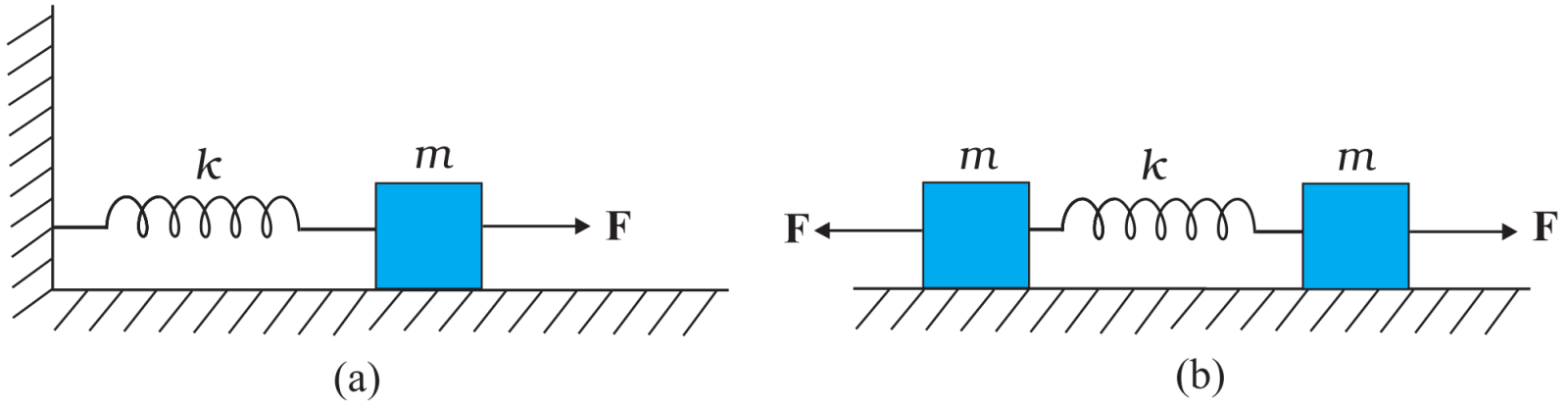
Figure (a) shows a spring of force constant k clamped rigidly at one end and a mass m attached to its free end. A force F applied at the free end stretches the spring. Figure (b) shows the same spring with both ends free and attached to a mass m at either end. Each end of the spring in Fig. (b) is stretched by the same force F.
If the mass in Fig. (a) and the two masses in Fig. (b) are released, what is the period of oscillation in each case?
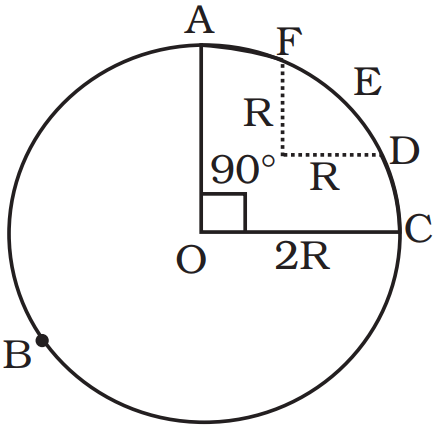
A racing car travels on a track (without banking) ABCDEFA ABC is a circular arc of radius 2 R. CD and FA are straight paths of length R and DEF is a circular arc of radius $R = 100 m$. The co-effecient of friction on the road is $\mu = 0.1.$ The maximum speed of the car is $50m s^{–1}$. Find the minimum time for completing one round.
A gas in equilibrium has uniform density and pressure throughout its volume. This is strictly true only if there are no external influences. A gas column under gravity, for example, does not have uniform density (and pressure). As you might expect, its density decreases with height. The precise dependence is given by the so-called law of atmospheres: $\text{n}_2=\text{n}_1\text{exp}\Big[\frac{-\text{mg}}{\text{k}_\text{B}\text{T}}(\text{h}_2-\text{h}_1)\Big]$ where $n_2, n_1$ refer to number density at heights $h_2$ and $h_1$respectively. Use this relation to derive the equation for sedimentation equilibrium of a suspension in a liquid column: $\text{n}_2=\text{n}_1\text{exp}\Big[\frac{-\text{mgN}_\text{A}(\rho-\rho')(\text{h}_2-\text{h}_1)}{(\rho\text{RT})}\Big]$ where $\rho$ is the density of the suspended particle, and $\rho'$ that of surrounding medium. [NA is Avogadro’s number, and R the universal gas constant] [Hint: Use Archimedes principle to find the apparent weight of the suspended particle]
Suppose a hole was drilled completely through the earth along a diameter. Show that the force on a mass m at a distance r from the centre of the earth is $ \text{F}= \frac{-\text{mgr}}{\text{R}}$ assuming that the density of the earth is uniform.
An aluminium plate fixed in a horizontal position has a hole of diameter 2.000 cm . A steel sphere of diameter 2.005 cm rests on this hole. All the lengths refer to a temperature of $10^{\circ} \mathrm{C}$. The temperature of the entire system is slowly increased. At what temperature willl the ball fall down? Coefficient of linear expansion of aluminium is $23 \times$ $10^{-6}{ }^{\circ} \mathrm{C}^{-1}$ and that of steel is $11 \times 10^{-6}{ }^{\circ} \mathrm{C}^{-1}$.
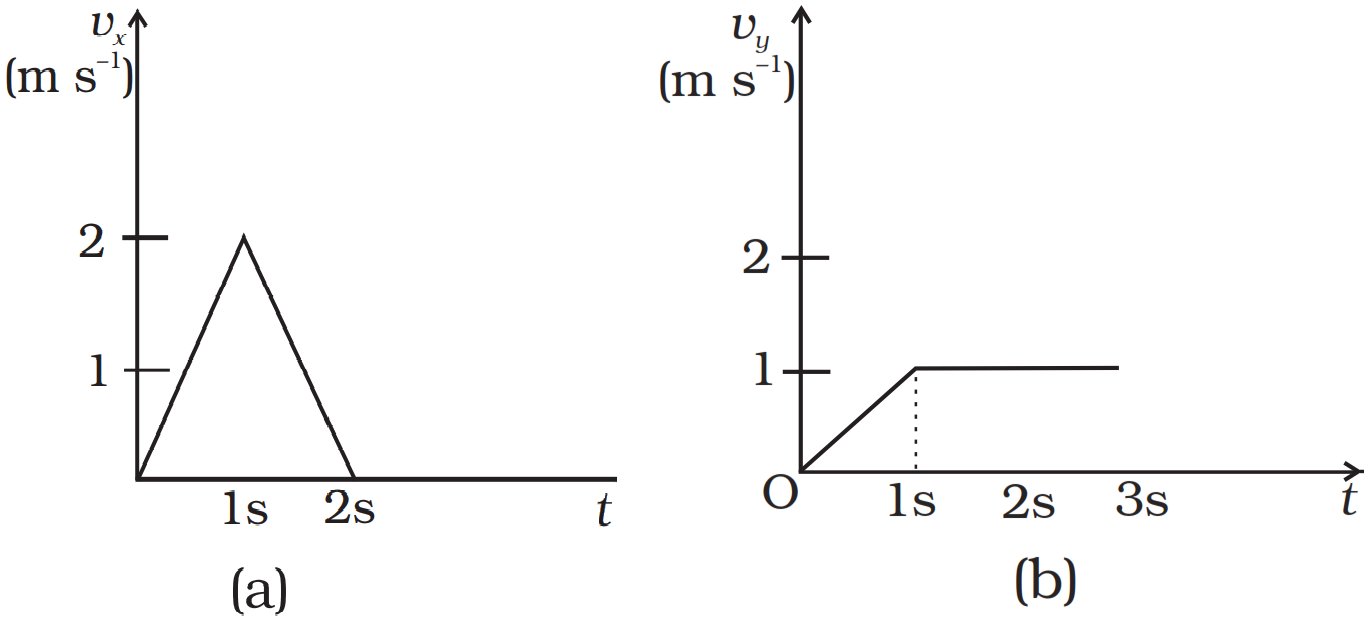
$(v_{x,} t)$, and $(v_{y,} t )$ diagrams for a body of unit mass. Find the force as a function of time.
Derive an expression for the gravitational field due to a uniform rod of length L and mass M at a point on its perpendicular bisector at a distance d from the centre.
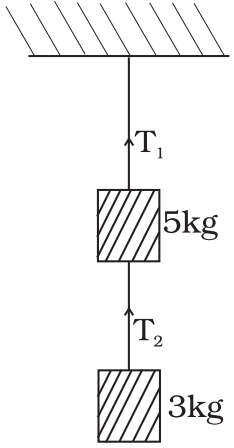
Two masses of $5kg$ and $3kg$ are suspended with help of massless inextensible strings as shown in Calculate $T_1$ and $T_2$ when whole system is going upwards with acceleration = $2m s^2$(use $g = 9.8m s^{–2}$).
An inductor-coil of inductance 20mH having resistance $10\Omega$ is joined to an ideal battery of emf 5.0V. Find the rate of chenge of the induced emf at:
  1. t = 0
  2. t = 10ms
  3. t = 1.0s.