1. Define excretion.
  2. Name the basic filtration unit present in the kidney.
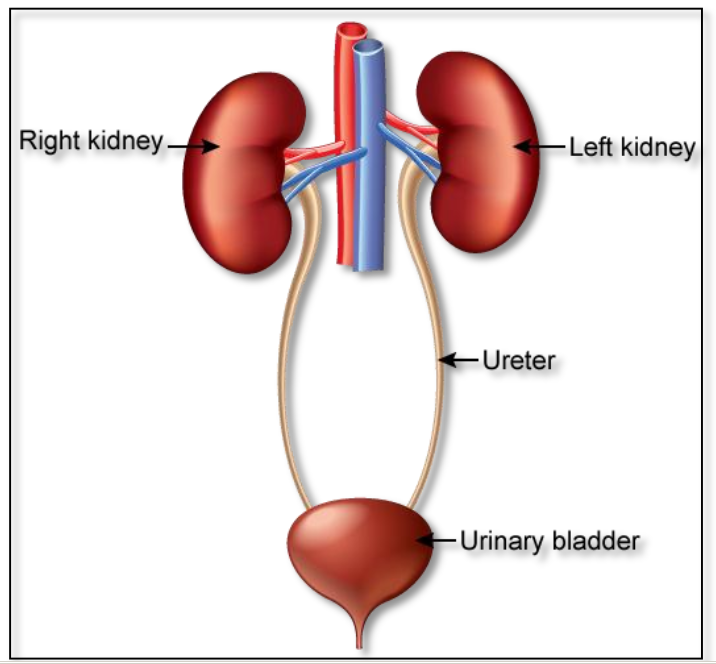
  3. Draw excretory system in human beings and label the following organs of excretory system which perform following functions:
  1. Form urine.
  2. Is a long tube which collects urine from kidney.
  3. Store urine until it is passed out.
CBSE DELHI - OUTSIDE DELHI - FOREIGN SET 1 2018
Download our app for free and get startedPlay store
  1. Excretion is the process of removal of harmful and unwanted substances, especially nitrogenous wastes, from the body.
  2. Nephron is the basic filtration unit of the kidneys.
  3.  
  1. Kidneys: Form urine.
  2. Ureter: Long tube which collects urine from the kidney.
  3. Urinary bladder: Stores urine until it is passed out.
art

Download our app
and get started for free

Experience the future of education. Simply download our apps or reach out to us for more information. Let's shape the future of learning together!No signup needed.*

Similar Questions

  • 1
    What substances are contained in pancreatic juice? What are their functions?
    View Solution
  • 2
    There are five animals P, Q, R, S and T. The animal P always lives in water and has gills for breathing. The animal Q can stay in water as well as on land and can breathe both, through moist skin and lungs. The animal R lives in soil and breathes only through its skin. The animal S lives on land and breathes through spiracles and tracheae. And animal T lives in water and breathes through its cell membrane.
    1. Which of the animals could be Amoeba?
    2. Which of the animals could be frog?
    3. Which animal could be fish?
    4. Which animal could be grasshopper?
    5. Which animal could be earthworm?
    View Solution
  • 3
    What are the methods used by plants to get rid of their waste products?
    View Solution
  • 4
    Distinguish between photosynthesis and respiration.
    View Solution
  • 5
    There is a pair of bean-shaped organs P in the human body towards the back, just above the waist. A waste product Q formed by the decomposition of unused proteins in the liver is brought into organ P through blood by an artery R. The numerous tiny filters S present in organ P clean the dirty blood by removing the waste product Q. The clean blood goes into circulation through a vein T. The waste substance Q, other waste salts, and excess water form a yellowish liquid U which goes from organ P into a bag-like structure V through two tubes W. This liquid is then thrown out of the body through a tube X.
    1. What is (i) organ P and (ii) waste substance Q?
    2. Name (i) artery R, and (ii) vein T.
    3. What are tiny filters S known as?
    4. Name (i) liquid U, (ii) structure V, (iii) tubes W and (iv) tube X.
    View Solution
  • 6
    Distinguish between aquatic and terrestrial respiration.
    View Solution
  • 7
    1. List the three events that accur during the process of photosynthesis. Explain the role of stomata in this process.
    2. Describe an experiment to show that ''sunlight is essential for photosynthesis.''
    View Solution
  • 8
    Each and every respiration organ is structurally specialised in its function. Justify with examples.
    View Solution
  • 9
    Explain the various functions of blood.
    View Solution
  • 10
    The organs A of a person have been damaged completely due to which too much of a poisonous waste material B has started accumulating in his blood, making it dirty. In order to save this person's life, the blood from an artery in the person's arm is made to flow into long tubes made of substance E which are kept in coiled form in a tank containing solution F. This solution contains three materials G, H and I in similar proportions to those in normal blood. As the person's blood passes through long tubes of substance E, most of the wastes present in it go into solution. The clean blood is then put back into a vein in the arm of the person for circulation.
    1. What are organs A?
    2. Name the waste substance B.
    3. What are (i) E and (ii) F? Name G, H and I.
    4. What is the process described above known as?
    View Solution