Draw and complete the following diagrams to show what happens to the beams of light as they enter the glass block and then leave it: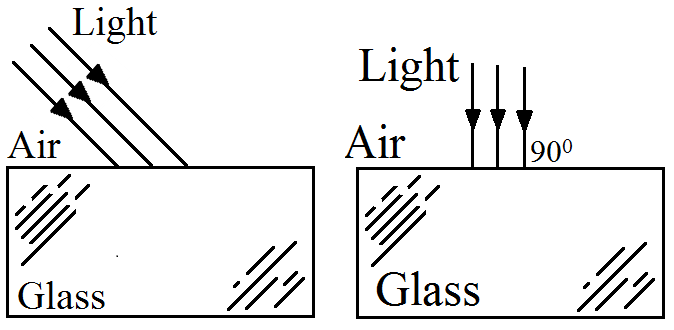
Download our app for free and get started
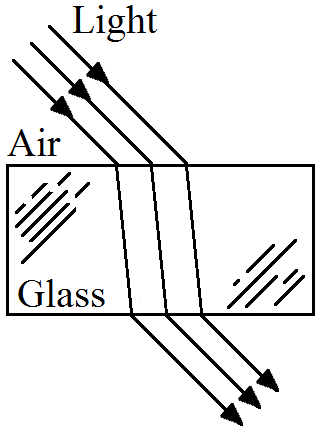
When a beam of light rays enters the glass block, it gets refracted. It bends towards the normal. Also, when these light rays leave the block, they bend away from the normal.
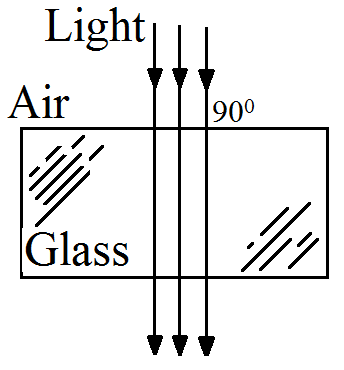
When light rays fall normally on the surface of the glass block, there is no bending of rays; the rays travel straight.

Download our appand get started for free
Experience the future of education. Simply download our apps or reach out to us for more information. Let's shape the future of learning together!No signup needed.*
Similar Questions
- 1View SolutionDraw ray diagrams showing the image formation by a concave mirror when an object is placed:
At centre of curvature of the mirror. - 2The speed of light in water is $2.25 \times 10^8 m / s$. If the speed of light in vacuum be $3 \times 10^8 m / s$, calculate the refractive index of water.View Solution
- 3View SolutionDescribe with the help of a ray-diagram, the size, nature and position of the image formed by a convex lens when an object is placed beyond 2f in front of the lens.
- 4View SolutionThe image formed by a concave mirror is observed to be virtual, erect and larger than the object. Where should the position of the object be relative to the mirror? Draw ray diagram to justify your answer.
- 5View SolutionWhy can you not use a concave mirror as a rear-view mirror in vehicles?
- 6View SolutionA concave mirror and a convex lens are held separately in water. What changes, if any, do you expect in the focal length of either?
- 7View SolutionState the two laws of reflection of light.
- 8In an experiment with a rectangular glass slab, a student observed that a ray of light incident at an angle of $55^{\circ}$ with the normal on one face of the slab, after refraction strikes the opposite face of the slab before emerging out into air making an angle of $40^{\circ}$ with the normal. Draw a labelled diagram to show the path of this ray.' What value would you assign to the angle of refraction and angle of emergence?View Solution
- 9View SolutionAn extended object in the form of an arrow pointing upward has been placed in front of plane mirror. Draw a labelled ray-diagram to show the formation of its image.
- 10View SolutionIf a ray of light is incident on a plane mirror such that it makes an angle of 30with the mirror, then will be the angle of reflection?