If a ray of light is incident on a plane mirror such that it makes an angle of 30with the mirror, then will be the angle of reflection?
Download our app for free and get started
According to the law of reflection, the angle of incidence and angle of reflection are equal. Both these angles are measured with respect to a line normal to the reflection surface. Ray of light strikes the mirror at an angle of 30°. ⇒ It will make an angle of 60° (90° - 30°) with the normal. As shown in the figure below. 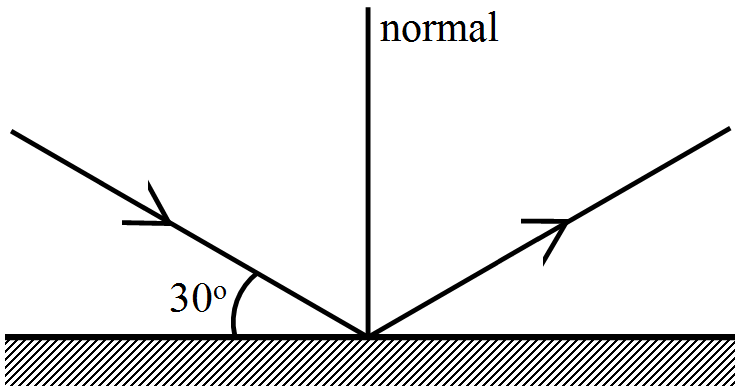 $\therefore$ Angle of incidence = 60°.
Now, By laws of reflection; Angle of Incidence = Angle of reflection; ⇒ Angle of reflection = 60°. Hence Angle of reflection is 60°.
$\therefore$ Angle of incidence = 60°.Now, By laws of reflection; Angle of Incidence = Angle of reflection; ⇒ Angle of reflection = 60°. Hence Angle of reflection is 60°.

Download our appand get started for free
Experience the future of education. Simply download our apps or reach out to us for more information. Let's shape the future of learning together!No signup needed.*
Similar Questions
- 1View SolutionDraw ray diagrams showing the image formation by a convex mirror when an object is placed:
At finite distance from the mirror. - 2View Solution“A ray of light incident on a rectangular glass slab immersed in any medium emerges parallel to itself.” Draw labeled ray diagram to justify this statement.
- 3View SolutionWith the help of a labelled ray diagram, describe how a converging mirror can be used to give an enlarged upright image of an object.
- 4View SolutionIf the magnification of an image formed by a mirror is positive, what does it mean?
- 5View SolutionYour eye contains a convex lens. Why is it unwise to look at the sun?
- 6View SolutionAn object is placed just outside the principal focus of concave mirror. Draw a ray diagram to show how the image is formed, and describe its size, position and nature.
- 7View SolutionA convex lens of power 5D and a concave lens of power 7.5D are placed in contact with each other. What is the:
- Power of this combination of lenses?
- Focal length of this combination of lenses?
- 8View SolutionWhere must the object be placed for the image formed by a converging lens to be:
- Real, inverted and smaller than the object?
- Real, inverted and same size as the object?
- Real, inverted and larger than the object?
- Virtual, upright and larger than the object?
- 9View SolutionThe refractive indices of glass and water with respect to air are 3/2 and 4/3 respectively. If speed of light in glass is 2×10⁸ m/s, find the speed of light in water.
- 10View SolutionList four specific characteristics of the images of the objects formed by convex mirrors.