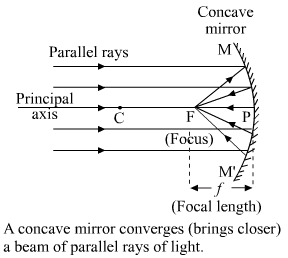
Draw diagram to represent the action of a concave mirror on a beam of parallel light rays. Mark on this diagram principal axis, focus F, centre of curvature C, pole P and focal length ƒ, of the concave mirror.
Download our app for free and get started

Download our appand get started for free
Experience the future of education. Simply download our apps or reach out to us for more information. Let's shape the future of learning together!No signup needed.*
Similar Questions
- 1View SolutionHow will you distinguish between a plane mirror, a concave mirror and a convex mirror without touching them?
- 2View SolutionWith the help of a labelled ray diagram, describe how a converging mirror can be used to give an enlarged upright image of an object.
- 3View SolutionIdentify the device used as a spherical mirror or lens in following cases, when the image formed is virtual and erect in each case.Object is placed between infinity and device, image formed is diminished and between focus and optical centre on the same side as that of the object.
- 4View SolutionAn object of height 2.5 cm is placed at a distance of 15 cm from the optical centre ‘O' of a convex lens of focal length 10 cm. Draw a ray diagram to find the position and size of the image formed. Mark optical centre ‘O', principal focus F and height of the image on the diagram.
- 5View SolutionA 4 cm tall object is placed on the principal axis of a convex lens. The distance of the object from the optical centre of the lens is 12cm and its sharp image is formed at a distance of 24cm from it on a screen on the other side of the lens. If the object is now moved a little away from the lens, in which way (towards the lens or away from the lens) will he have to move the screen to get a sharp image of the object on it again? How will the magnification of the image be affected?
- 6View SolutionFind the focal length of a lens of power – 2.0 D. What type of lens is this?
- 7In an experiment with a rectangular glass slab, a student observed that a ray of light incident at an angle of $55^{\circ}$ with the normal on one face of the slab, after refraction strikes the opposite face of the slab before emerging out into air making an angle of $40^{\circ}$ with the normal. Draw a labelled diagram to show the path of this ray.' What value would you assign to the angle of refraction and angle of emergence?View Solution
- 8View SolutionName the two types of spherical mirrors. What type of mirror is represented by the:
- Back side of a shining steel spoon?
- Front side of a shining steel spoon?
- 9View SolutionDraw ray diagrams showing the image formation by a convex lens when an object is placed:
At infinity. - 10View SolutionA boy with a mouth 5cm wide stands 2m away from a plane mirror. Where is his image and how wide is the image of his mouth?