Question
Draw neat labelled diagram representing the Earth as a magnet.

Answer

Get the step-by-step solution for this question inside the Vidyadip app.

Get the answer in the app

Need a full question paper?

Generate a complete, print-ready paper with questions like this in minutes — across 16+ boards, with answer keys.
Start Generating Free

Similar questions

Draw a neat labelled diagram for angle of dip.
That are rectangular components of vectors? Explain their uses.
At a given place on the Earth, a bar magnet of magnetic moment $\vec{m}$ is kept horizontal in the EastWest direction. $P$ and $Q$ are the two neutral points due to magnetic field of this magnet and $\vec{B}_{ H }$ is the horizontal component of the Earth's magnetic field.
$i$. Calculate the angles between position vectors of $P$ and $Q$ with the direction of $\vec{m}$.
$ii$. Points $P$ and $Q$ are $1 m$ from the centre of the bar magnet and $B_H=3.5 \times 10^{-5} T$. Calculate magnetic dipole moment of the bar magnet.
Neutral point is that point where the resultant magnetic field is zero.
A batsman deflects a ball by an angle of $45^\circ$ without changing its initial speed which is equal to $54 \ km/h.$ What is the impulse imparted to the ball? $($Mass of the ball is $0.15 \ kg).$
Define angular dispersion for a prism. Obtain its expression for a thin prism. Relate it with the refractive indices of the material of the prism for corresponding colours.
What is absolute zero?
$\overrightarrow{ P }=\hat{ i }+ 2 \hat{ k }$ and $\overrightarrow{ Q }=2 \hat{ i }+\hat{ j }-2 \hat{ k }$ are two vectors, find the unit vector parallel to $\overrightarrow{ P } \times \overrightarrow{ Q }$ Also find the vector perpendicular to $P$ and $Q$ of magnitude 6 units.
Prove that: Vector addition is commutative.
Lin an experiment to determine the volume of an object, mass and density are recorded as $m = (5 ± 0.15) \ kg$ and $p = (5 ± 0.2) \ kg m^3$ respectively. Calculate percentage error in the measurement of volume.
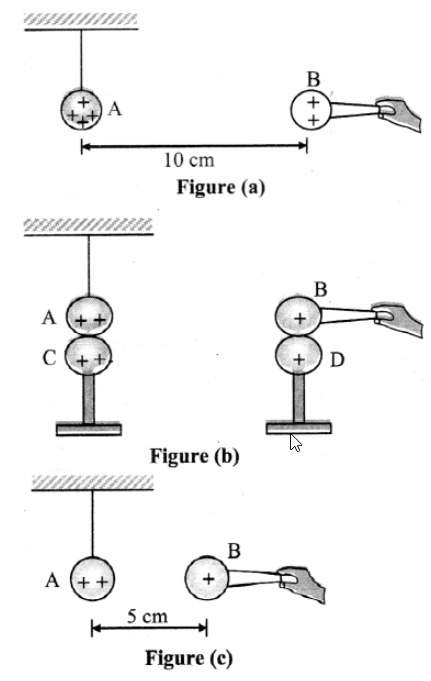
A charged metallic sphere A is suspended by a nylon thread. Another charged metallic sphere B held by an insulating handle is brought close to A such that the distance between their centres is 10 cm, as shown in figure (a). The resulting repulsion of A is noted (for example, by shining a beam of light and measuring the deflection of its shadow on a screen.) Spheres A and B are touched by uncharged spheres C and D respectively, as shown in figure (b). C and D are then removed and B is brought closer to A to a distance of 5.0 cm between their centres, as shown in figure (c). What is the expected repulsion of A on the basis of Coulomb’s law? Spheres A and C and spheres B and D have identical sizes. Ignore the sizes of A and B comparison to the separation between their centres.
Image