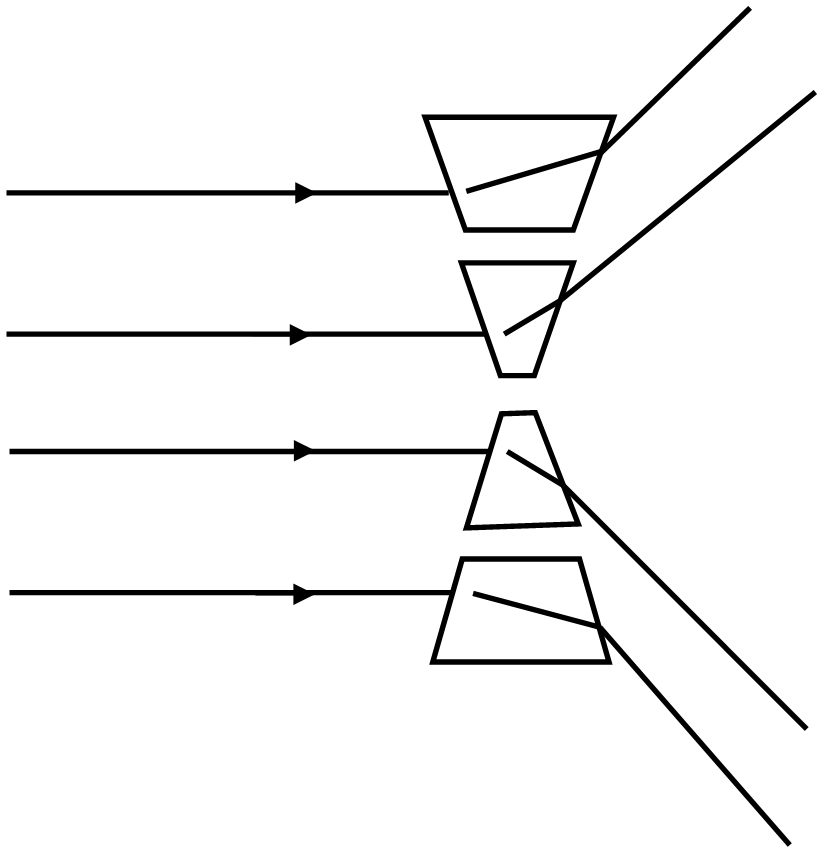
With the help of a ray diagram explain why a concave lens diverges the rays of a parallel beam of light.
Download our app for free and get started
Concave lens, like any other lens works on the principle of refraction. We can divide a lens into tiny pieces which resemble a triangular prism. When a ray of light falls on it, due to the shape of the lens piece, the light refracts either inwards our outwards. Concave lens is such that it is thicker outside and thinner inside (opposite to that of a convex lens), so the light rays are refracted outwards and thus they diverge.

Download our appand get started for free
Experience the future of education. Simply download our apps or reach out to us for more information. Let's shape the future of learning together!No signup needed.*
Similar Questions
- 1View SolutionDoes the incident and emergent ray coincide in the process of refraction through glass slab? Give reason.
- 2View SolutionDraw ray diagrams showing the image formation by a convex lens when an object is placed:
At the focus of the lens. - 3View SolutionDraw ray diagrams showing the image formation by a concave lens when an object is placed:
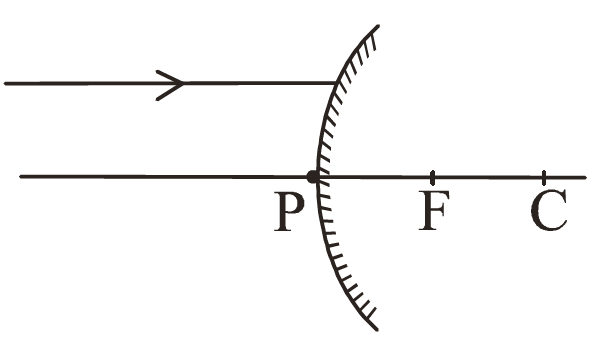
Beyond twice the focal length of the lens. - 4View SolutionA ray of light is incident on a convex mirror as shown. Redraw the diagram and complete the path of this ray after reflection from the mirror. Mark angle of incidence and angle of reflection on it.
- 5View SolutionAn object 1cm tall is placed 30cm in front of a convex mirror of focal length 20cm. Find the size and position of the image formed by the convex mirror.
- 6View SolutionA lens has power 4D. Find the focal length that lens.
- 7View SolutionWhat type of lens is shown in the diagram on the right? What will happen to the parallel rays of light? Show by completing the ray diagram.
- 8View SolutionA convex mirror used as a rear-view mirror in a car has a radius of curvature of 3m. If a bus is located at a distance of 5m from this mirror, find the position of image. What is the nature of the image?
- 9View SolutionDescribe with the help of a diagram, the nature, size and position of the image formed when an object is placed beyond the centre of curvature of a concave mirror.
- 10View SolutionThe diagram given alongside shows a ray of light entering a rectangular block of glass:
- Copy the diagram and draw the normal at the point of entry.
- Draw the approximate path of the ray of light through the glass block and out of the other side.