Draw ray-diagrams to show the formation of images when the object is placed in front of a concave mirror (converging mirror):
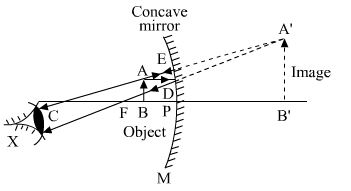
- Between its pole and focus.
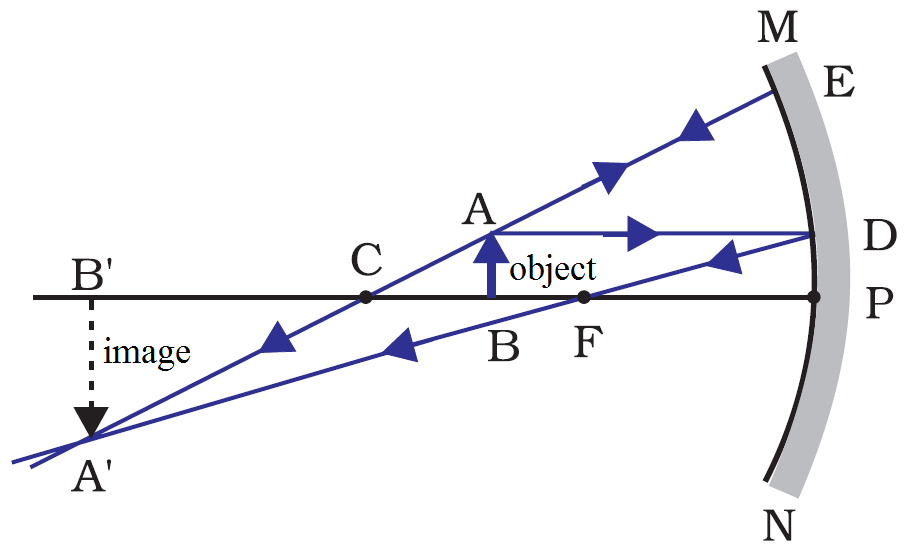
- Between its centre of curvature and focus Describe the nature, size and position of the image formed in each case.
Download our app for free and get started
- When the object is palced between the pole and focus of a concave mirror a mangnified image is formed.
- When the object is palced between the focus and the centre of the curvature of a concave mirror a mangnified image is formed.

Download our appand get started for free
Experience the future of education. Simply download our apps or reach out to us for more information. Let's shape the future of learning together!No signup needed.*
Similar Questions
- 1The refractive index of glass with respect to air is $\frac{3}{2}$ and refractive index of water with respect to air is $\frac{4}{3}$ . What will be the refractive index of water with respect to glass?View Solution
- 2View SolutionAn object is placed at a distance of 10 cm from a convex mirror of focal length 15 cm. Find the position and nature of the image.
- 3State the laws of refraction of light. If the speed of light in vacuum is $3 \times 10^{8} \text{ ms}^{-1},$ find the speed of light in a medium of absolute refractive index 1.5.View Solution
- 4View SolutionThe radius of curvature of a convex mirror used as a rear view mirror in a moving car is 2.0m. A truck is coming from behind it at a distance of 3.5m. Calculate (a) position, and (b) size, of the image relative to the size of the truck. What will be the nature of the image?
- 5View SolutionWhich type of lens is:
- A converging lens, and which is.
- A diverging lens? Explain your answer with diagrams.
- 6View SolutionName the type of mirror used in the following situations.
- Headlights of a car.
- Side/rear-view mirror of a vehicle.
- Solar furnace.
- 7View SolutionThe image of an object formed by a lens is of magnification - 1. If the distance between the object and its image is 60 cm, what is the focal length of the lens? If the object is moved 20 cm towards the lens, where would the image be formed? State reason and also draw a ray diagram in support of your answer.
- 8View SolutionAn object is placed at a distance of 4cm from a concave lens of focal length 12cm. Find the position and nature of the image.
- 9View SolutionA convex lens of focal length 25cm and a concave lens of focal length 10cm are placed in close contact with one another.
- What is the power of this combination?
- What is the focal length of this combination?
- Is this combination converging or diverging?
- 10View SolutionAn object 5 cm in length is held 25 cm away from a converging lens of focal length 10 cm. Draw the ray diagram and find the position, size and the nature of the image formed.