State the laws of refraction of light. If the speed of light in vacuum is $3 \times 10^{8} \text{ ms}^{-1},$ find the speed of light in a medium of absolute refractive index 1.5.
CBSE DELHI - SET 2 2014
Download our app for free and get started
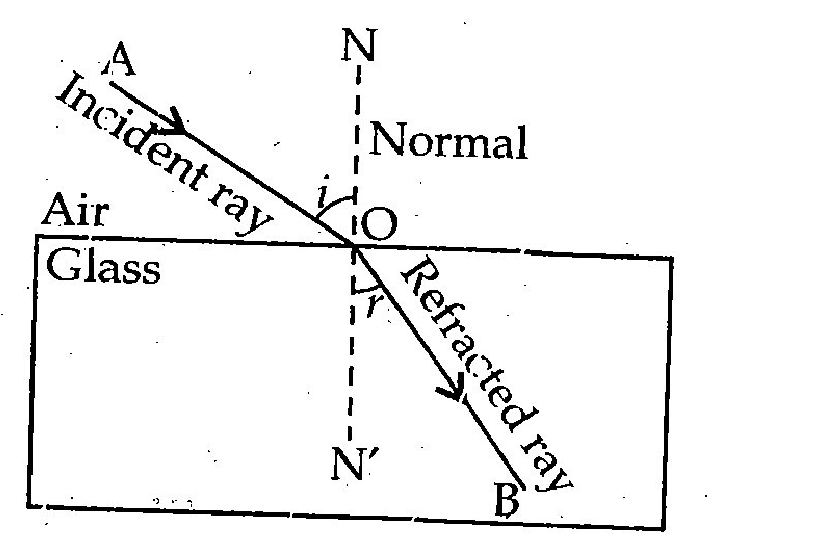
Laws of refraction of light:
- The incident, the refracted ray and normal at the point of incidence, all lie in the same plane.
- The second law of refraction is called snell’s law of refraction. According to snell’s law, “The ratio of sine of angle of incidence to the sine of angle of refraction is a constant for a given pair of mediums”.
$\frac{\text{Speed of light in vaccum}}{\text{Speed of light in a medium}} = \text{Refractive index of the medium}$
$\Rightarrow \frac{3 \times 10^{8} \text{m/s}}{x} = 1.5$
$\Rightarrow x = \frac{3 \times 10^{8} }{1.5} = 2 \times 10^{8} \text{ m/s}$
$\therefore \text{Speed of light in the medium} = 2 \times10^{8} \text{ m/s}$

Download our appand get started for free
Experience the future of education. Simply download our apps or reach out to us for more information. Let's shape the future of learning together!No signup needed.*
Similar Questions
- 1View SolutionWhich type of lens is:
- A converging lens, and which is.
- A diverging lens? Explain your answer with diagrams.
- 2View SolutionWith the help of a ray diagram, state the meaning of refraction of light. State Snell’s law of refraction of light and also express it mathematically.
- 3View SolutionThe diverging lens in part (a) is replaced by a converging lens also of focal length 100mm. The object remains in the same position and an image is formed by the converging lens. Compare two properties of this image with those of the image formed by the diverging lens in part (a).
- 4View Solution(i) Explain why the refractive index of any material with respect to air is always greater 1 .
(ii) In the figure below a light ray travels from air into the semi-circular plastic block. Give a reason why the ray does not deviate at the semi-circular boundary of the plastic block.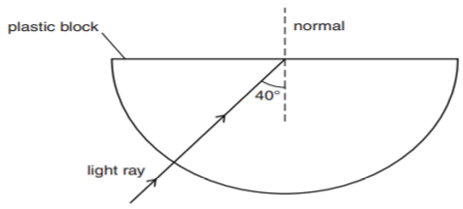
(iii) Complete the ray diagram of the above scenario when the light ray comes out of the plastic block from the top flat end. - 5View SolutionDraw the ray diagram in your answer book and show the formation of image of object AB with suitable rays. Mention the position and nature of image.
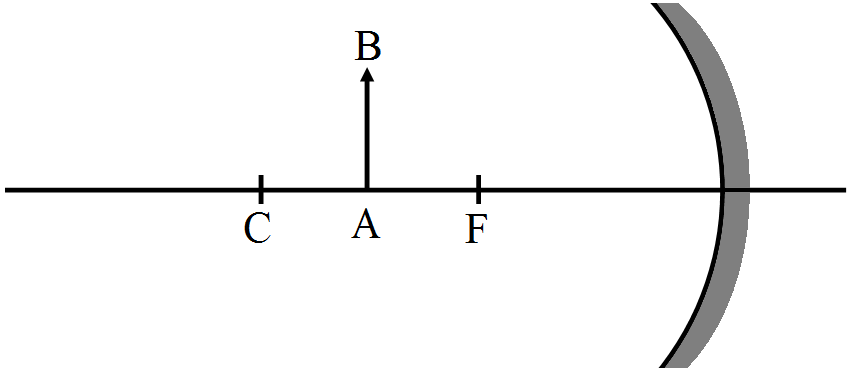
- 6View SolutionA man stands 10m in front of a large plane mirror. How far must the walk before he is 5m away from his image?
- 7View SolutionIf an object of 10cm height is placed at a distance of 36cm from a concave mirror of focal length 12cm, find the position, nature and height of the image.
- 8View SolutionA convex lens of focal length 20cm can produce a magnified virtual as well as real image. Is this a correct statement? If yes, where shall the object be placed in each case for obtaining these images?
- 9View SolutionDescribe with the help of a ray diagram the nature, size and position of the image formed when an object is placed in front of a convex lens between focus and optical centre. State three characteristics of the image formed.
- 10View SolutionDistinguish between a real and a virtual image of an object. What type of image is formed?
- By a plane mirror.
- On a cinema screen?