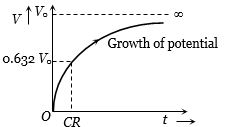
During charging a capacitor variation of potential $V$ of the capacitor with time $t$ is shown as
Easy
Download our app for free and get started
(a) For charging of capacitor $q = {q_0}\left( {1 - {e^{ - \,\frac{t}{{CR}}}}} \right)$ and potential difference $V = {V_0}\left( {1 - {e^{ - \,\frac{t}{{CR}}}}} \right)$

Download our appand get started for free
Experience the future of education. Simply download our apps or reach out to us for more information. Let's shape the future of learning together!No signup needed.*
Similar Questions
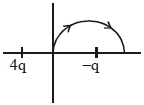
- 1A two point charges $4 q$ and $-q$ are fixed on the $x-$axis at $x=-\frac{d}{2}$ and $x=\frac{d}{2},$ respectively. If a third point charge $'q'$ is taken from the origin to $x = d$ along the semicircle as shown in the figure, the energy of the charge willView Solution
- 2An electric field of $1000\,V/m$ is applied to an electric dipole at angle of $45^o$. The value of electric dipole moment is $10^{-29}\, C.m.$ What is the potential energy of the electric dipole?View Solution
- 3A uniform electric field pointing in positive $x$-direction exists in a region. Let $A$ be the origin, $B$ be the point on the $x$-axis at $x = + 1$ $cm$ and $C$ be the point on the $y$-axis at $y = + 1\,cm$. Then the potentials at the points $A$, $B$ and $C$ satisfyView Solution
- 4Consider a spherical shell of radius $R$ with a total charge $+ Q$ uniformly spread on its surface (centre of the shell lies at the origin $x=0$ ). Two point charges $+q$ and $-q$ are brought, one after the other from far away and placed at $x=-a / 2$ and $x=+a / 2( < R)$, respectively. Magnitude of the work done in this process isView Solution
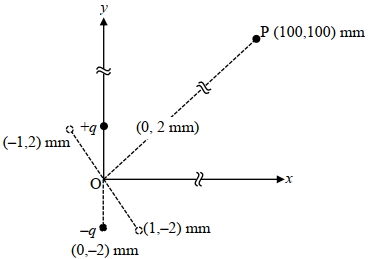
- 5An electric dipole is formed by two charges $+q$ and $-q$ located in xy-plane at $(0,2) \mathrm{mm}$ and $(0,-2) \mathrm{mm}$, respectively, as shown in the figure. The electric potential at point $\mathrm{P}(100,100) \mathrm{mm}$ due to the dipole is $V_0$. The charges $+q$ and $-q$ are then moved to the points $(-1,2) \mathrm{mm}$ and $(1,-2) \mathrm{mm}$, respectively. What is the value of electric potential at $P$ due to the new dipole?View Solution
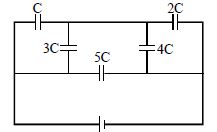
- 6In the given circuit, ratio of charge stored in the capacitors $C, 2C, 3C, 4C, 5C$ isView Solution
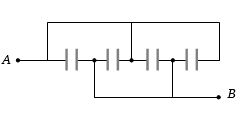
- 7Four condensers are joined as shown in the adjoining figure. The capacity of each is $8\,\mu F$. The equivalent capacity between the points $A$ and $B$ will be......$\mu F$View Solution
- 8Two parallel large thin metal sheets have equal surface charge densities $\left(\sigma=26.4 \times 10^{-12} C / m ^{2}\right)$ of same signs. The electric field between these sheet isView Solution
- 9The radius of a soap bubble whose potential is $16\,V$ is doubled. The new potential of the bubble will be.....$V$View Solution
- 10Energy per unit volume for a capacitor having area $A$ and separation $d$ kept at potential difference $V$ is given byView Solution