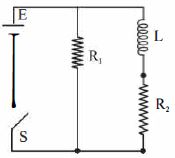
Current flows in the circuit, which is constant during charging or discharging duration
B
No current flows in the circuit
C
Current flows in the circuit and is varying with time
D
During charging current is constant but while discharging current is variable
Easy
Download our app for free and get started
C
Current flows in the circuit and is varying with time
c
Download our app
and get started for free
Experience the future of education. Simply download our apps or reach out to us for more information. Let's shape the future of learning together!No signup needed.*
Two capacitors of capacities $2 {C}$ and ${C}$ are joined in parallel and charged up to potential ${V}$. The battery is removed and the capacitor of capacity $C$ is filled completely with a medium of dielectric constant ${K}$. The potential difference across the capacitors will now be
Three equal charges are placed at the corners of an equilateral triangle. Which of the graphs below correctly depicts the equally-spaced equipotential surfaces in the plane of the triangle? (All graphs have the same scale.)
$27$ similar drops of mercury are maintained at $10 \,V$ each. All these spherical drops combine into a single big drop. The potential energy of the bigger drop is ....... times that of a smaller drop.
A parallel plate capacitor has circular plates of $0.08\,m$ radius and $1.0 \times {10^{ - 3}}\,m$ separation. If a $P.D.$ of $100\;volt$ is applied, the charge will be
Two capacitors of capacitance $2C$ and $C$ are joined in parallel and charged to potential $V$. The battery is now removed and the capacitor $C$ is filled with a medium of dielectric constant $K$. The potential difference across each capacitor will be
A parallel plate capacitor is charged to a certain potential and the charging battery is then disconnected. Now, if the plates of the capacitor are moved apart then:
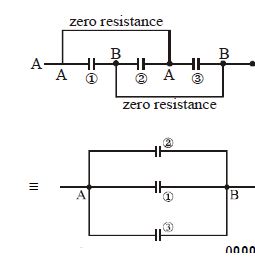
In the given network capacitance, ${C_1} = 10\,\mu \,F,\,{C_2} = 5\,\mu \,F$ and ${C_3} = 4\,\mu \,F$. What is the resultant capacitance between $A$ and $B$.......$\mu \,F$