MCQ
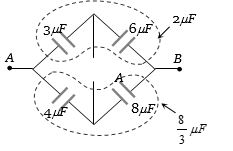
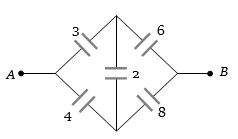
Effective capacitance between $A$ and $B$ in the figure shown is (all capacitance are in $\mu F$)
  • A
    $21\,\mu F$
  • B
    $23\,\mu F$
  • C
    $\frac{3}{{14}}\mu F$
  • $\frac{{14}}{3}\,\mu F$

Answer

Correct option: D.
$\frac{{14}}{3}\,\mu F$
d
(d) Given circuit is balanced Whetstone bridge. So capacitor of $2\ \mu F$ can be dropped from the circuit
${C_{AB}} = 2 + \frac{8}{3} = \frac{{14}}{3}\,\mu F$

Need a full question paper?

Generate a complete, print-ready paper with questions like this in minutes — across 16+ boards, with answer keys.
Start Generating Free

Similar questions

Assertion : The whole charge of a conductor cannot be transferred to another isolated conductor.
Reason : The total transfer of charge from one to another is not possible
The essential distinction between $X-$ rays and $\gamma - $ rays is that
Two particles $X$ and $Y$ having equal charge, after being accelerated through the same potential difference enter a region of uniform magnetic field and describe circular paths of radii $R_1$ and $R_2$ respectively. The ratio of the mass of $X$ to that of $Y$ is:
Gauss is unit of which quantity
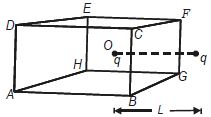
A charged particle $q$ is placed at the centre $O$ of cube of length $L$ $(A\,B\,C\,D\,E\,F\,G\,H)$. Another same charge $q$ is placed at a distance $L$ from $O$.Then the electric flux through $BGFC$ is
In the disintegration series the $_{92}^{238}U\xrightarrow{\alpha }X\xrightarrow{{\beta  - }}_Z^AY$ values of $Z$ and $A$ respectively will be
A voltmeter of resistance $1000\,\Omega $ gives full scale deflection when a current of $100\, mA$ flow through it. The shunt resistance required across it to enable it to be used as an ammeter reading $1\, A$ at full scale deflection is ............... $\Omega $
Which of the following statement$(s)$ is/are correct?

$(A)$ If the electric field due to a point charge varies as $r^{-25}$ instead of $r^{-2}$, then the Gauss law will still be valid.

$(B)$ The Gauss law can be used to calculate the field distribution around an electric dipole.

$(C)$ If the electric field between two point charges is zero somewhere, then the sign of the two charges is the same.

$(D)$ The work done by the external force in moving a unit positive charge from point $A$ at potential $V_A$ to point $B$ at potential $V_B$ is $\left(V_B-V_A\right)$.
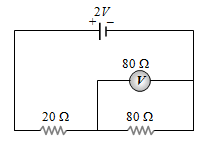
In the adjoining circuit, the e.m.f. of the cell is 2 volt and the internal resistance is negligible. The resistance of the voltmeter is 80 ohm. The reading of the voltmeter will be

A solid is completely immersed in a liquid. The force exerted by the liquid on the solid will. 
  1. Increase if it is pushed deeper inside the liquid.
  2. Change if its orientation is changed.
  3. Decrease if it is taken partially out bf the liquid.
  4. Be in the vertically upward direction.