MCQ
Einstein's work on the photoelectric effect provided support for the equation:
  • A
    $E =-\frac{R h c}{n^2}$
  • B
    $E = hv$
  • C
    $E = mc ^2$
  • D
    $KE =\frac{1}{2} mv { }^2$

Answer

B. $E = hv$
Explanation:
Einstein's photoelectric effect & compton effect establish the particle nature of light. These effects can be explained only, when we assume that the light has particle nature (To explain, Interference & diffraction the light must have wave nature. It means that light has both particle and have nature, so it is called dual nature of light).
$KE_{\max }=E_{\text {photon }}-W_0$
The above equation supports:
$E_{\text {photon }}=hv$
It proves that light is in the form of discrete packets of energy and not wave. Otherwise, the light with a lower frequency than the threshold could give enough energy(slowly accumulate) to the electrons to come out of the metal. Hence this theory supports the particle nature of light, as suggested by Einstein.

Need a full question paper?

Generate a complete, print-ready paper with questions like this in minutes — across 16+ boards, with answer keys.

Start Generating Free

Similar questions

On a hot summer night, the refractive index of air is smallest near the ground and increases with height from the ground. When a light beam is directed horizontally, the Huygens' principle leads us to conclude that as it travels, the light beam
A uniform beam of positively charged particles is moving with a constant velocity parallel to another beam of negatively charged particles moving with the same velocity in opposite direction separated by a distance $d.$ The variation of magnetic field $B$ along a perpendicular line draw between the two beams is best represented by
A free hydrogen atom after absorbing a photon of wavelength $\lambda_{ a }$ gets excited from the state $n =1$ to the state $n =4$. Immediately after that the electron jumps to $n=m$ state by emitting a photon of wavelength $\lambda_{\text {. }}$. Let the change in momentum of atom due to the absorption and the emission are $\Delta p_2$, and $\Delta p_\theta$, respectively. If $\lambda_2 / \lambda_0=\frac{1}{5}$. Which of the option(s) is/are correct ?

[Use $hc =1242 eV nm ; 1 nm =10^{-9} m , h$ and $c$ are Planck's constant and speed of light, respectively]

$(1)$ $\lambda_0=418 nm$

$(2)$ The ratio of kinetic energy of the electron in the state $n = m$ to the state $n =1$ is $\frac{1}{4}$

$(3)$ $m =2$

$(4)$ $\Delta p_{ a } / \Delta p _{ o }=\frac{1}{2}$

A cylindrical vessel of cross-section $A$ contains water to a height $h$ . There is a hole in the bottom of radius $'a'$ . The time in which it will be emptied is
The $x-z$ plane separates two media $A$ and $B$ with refractive indices $\mu_1$ and $\mu_2$ respectively. $A$ ray of light travels from $A$ to $B$. Its directions in the two media are given by the unit vectors,${\vec r_A} = a\,\hat i + b\,\hat j$ & ${\vec r_B} = \alpha \,\hat i + \beta \,\hat j$ respectively where $\hat i$ & $\hat j$ are unit vectors in the $x$ and $y$ directions. Then
Ploughing help to retain water by soil ...........
If the force constant of a wire is $K,$ the work done in increasing the length of the wire by $l$ is
Two capacitors connected in parallel having the capacities ${C_1}$ and ${C_2}$ are given $'q'$ charge, which is distributed among them. The ratio of the charge on ${C_1}$ and ${C_2}$ will be
Assertion : In series $LCR$ circuit resonance can take place.

Reason : Resonance takes place if inductance and capacitive reactances are equal and opposite.
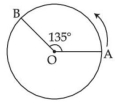
A person moved from $A$ to $B$ on a circular path as shown in figure. If the distance travelled by him is $60 \,m$, then the magnitude of displacement would be$.....\,m$ (Given $\left.\cos 135^{\circ}=-0.7\right)$