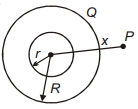
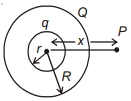
Two concentric hollow conducting spheres of radius $r$ and $R$ are shown. The charge on outer shell is $Q$. What charge should be given to inner sphere so that the potential at any point $P$ outside the outer sphere is zero?
Easy


Download our appand get started for free
Experience the future of education. Simply download our apps or reach out to us for more information. Let's shape the future of learning together!No signup needed.*
Similar Questions
- 1Two identical positive charges are placed on the $y$-axis at $y=-a$ and $y=+a$. The variation of $V$ (electric potential) along $x$-axis is shown by graphView Solution
- 2A parallel plate air capacitor is charged to a potential difference of $V$. After disconnecting the battery, distance between the plates of the capacitor is increased using an insulating handle. As a result, the potential difference between the platesView Solution
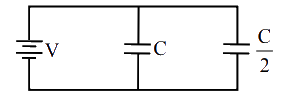
- 3Two condensers, one of capacity $C$ and other of capacity $C/2$ are connected to a $V-$ volt battery, as shown in the figure. The work done in charging fully both the condensers isView Solution
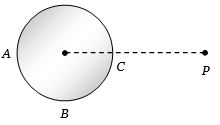
- 4A hollow conducting sphere is placed in an electric field produced by a point charge placed at $P$ as shown in figure. Let ${V_A},{V_B},{V_C}$ be the potentials at points $A,B$ and $C$ respectively. ThenView Solution
- 5When two identical capacitors are in series have $3\,\mu F$ capacitance and when parallel $12\,\mu F$. What is the capacitance of each.......$\mu \,F$View Solution
- 6Three capacitors of capacity ${C_1},\;{C_2}\;{C_3}$ are connected in series. Their total capacity will beView Solution
- 7A molecule with a dipole moment $p$ is placed in an electric field of strength $E$. Initially the dipole is aligned parallel to the field. If the dipole is to be rotated to be anti-parallel to the field, the work required to be done by an external agent isView Solution
- 8The charge deposited on $4\,\mu F$ capacitor in the circuit isView Solution
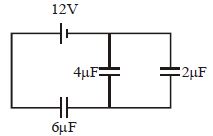
- 9In free space, a particle $A$ of charge $1\,\mu C$ is held fixed at a point $P.$ Another particle $B$ of the same charge and mass $4\,\mu g$ is kept at a distance of $1\,mm$ from $P$. If $B$ is released, then its velocity at a distance of $9\,mm$ from $P$ is [ Take $\frac{1}{{4\pi {\varepsilon _0}}} = 9 \times {10^9}\,N{m^2}{C^{ - 2}}$ ]View Solution
- 10Three capacitors each of capacity $4\,\mu \,F$ are to be connected in such a way that the effective capacitance is $6\,\mu \,F$. This can be done byView Solution