Question
Electrical work done in unit time is equal to electrical potential multiplied by total charge passed. ln order to obtain maximum work from a cell, the charge has to be passed reversibly. The reversible work done by a cell is equal to decrease in its Gibb's energy. Hence, Gibb's energy of reaction is given by $\Delta\text{G}=\text{nFE}_\text{cell}$ Hence, Eis the emfof the cell and $nF$ is the amount of energy. In these questions $(Q$. No. $i-Iv),$ a statement of assertion followed by a statement ofreason is given. Choose the correct answer out of the following choices.
  1. Assertion and reason both are correct statements and reason is correct explanation for assertion.
  2. Assertion and reason both are correct statements but reason is not correct explanation for assertion.
  3. Assertion is correct statement but reason is wrong statement.
  4. Assertion is wrong statement but reason is correct statement.
  1. Assertion : $\Delta\text{G}^\circ=-\text{nFE}^\circ$
Reason : $E^\circ$ ​​​​​​​ should be positive for a spontaneous reaction.
  1. Assertion : An electrochemical cell can be set up only if the red ox reaction is spontaneous.
Reason : A reaction is spontaneous if free energy change is negative.
  1. Assertion : For an electrochemical cell, $\Delta\text{G}<0$ and $\text{E}_\text{cell}>0.$
Reason : The given cell is non $-$ spontaneous.
  1. Assertion : Current stops flowing when $E_\text{cell} = 0$.
Reason : Equilibrium of the cell reaction is attained.
  1. Assertion :$ E_\text{cell}$ should have a positive value for the cell to function.
Reason : $E_\text{cell} = E_\text{cathode} - E_\text{anode}$

Answer

  1. $(b)$ Assertion and reason both are correct statements but reason is not correct explanation for assertion.
  1. $(b)$ Assertion and reason both are correct statements but reason is not correct explanation for assertion.
If redox reaction is spontaneous, $\Delta\text{G}$ is $-ve$ and hence $, E^\circ$ is positive.
$-\Delta\text{G}^\circ=\text{nFE}^\circ\text{cell}$
  1. $(c)$ Assertion is correct statement but reason is wrong statement.
$\Delta\text{G}<0$ and $\text{E}_\text{cell}>0$ ; spontaneous.
  1. $(a)$ Assertion and reason both are correct statements and reason is correct explanation for assertion.
  1. $(b)$ Assertion and reason both are correct statements but reason is not correct explanation for assertion.

Need a full question paper?

Generate a complete, print-ready paper with questions like this in minutes — across 16+ boards, with answer keys.

Start Generating Free

Similar questions

Read the passage given below and answer the following questions:
$(A), (B)$ and $(C)$ are three non $-$ cyclic functional isomers of a carbonyl compound with molecular formula $\ce{C_4H_8O}$. Isomers $(A)$ and $(C)$ give positive Tollen's test whereas isomer $(B)$ does not give Tollen's test but gives positive iodoform test. Isomers $(A)$ and $(B)$ on reduction with $\frac{Zn}{(Hg)}$ conc.  $\text{HCl}$ give the same product $(D).$
The following questions are multiple choice questions. Choose the most appropriate answer:
  1. Compound $A$ is:
  1. $\text{CH}_3-\text{CH}-\text{CHO}\\\ \ \ \ \ \ \ \ \ \ \ \ \ |\\ \ \ \ \ \ \ \ \ \ \ \ \ \text{CH}_3$
  2. $\text{CH}_3\text{CH}_2\text{CH}_2\text{CHO}$
  3. $\ \ \ \ \ \ \ \ \ \ \ \ \text{O}\\\ \ \ \ \ \ \ \ \ \ \ \ \ ||\\\text{CH}_3-\text{C}-\text{CH}_2-\text{CH}_3$
  4. None of these.
  1. Compound $(C)$ is:
  1. Iso $-$ butyraldehyde
  2. Butyraldehyde
  3. Crotonaldehyde
  4. Acrolein
  1. Compound $(B)$ can be obtained by:
  1. $\text{CH}_3-\text{C}\equiv\text{C}-\text{CH}_2-\text{CH}_3\xrightarrow[333\text{K}]{\text{dil.H}_2\text{SO}_4+\text{HgSO}_4}$
  2. $(\text{CH}_3\text{CH}_2\text{COO})_2\text{Ca}\xrightarrow{\text{Dry distill}}$
  3. $\text{CH}_3-\text{C}\equiv\text{C}-\text{CH}_3\xrightarrow[\frac{\text{H}_2\text{O}_2}{\text{NaOH}}]{\frac{\text{B}_2\text{H}_6}{\text{THF}}}$
  4. $\text{CH}_3-\text{CH}=\text{CH}-\text{CH}_3\xrightarrow[\frac{\text{ZN}}{\text{H}_2\text{O}}]{\text{O}_3}$
  1. Out of $(A), (B)$ and $(C)$ isomers, which one is least reactive towards addition of $\text{HCN}$ ?
  1. $A$
  2. $B$
  3. $C$
  4. All are equally reactive.
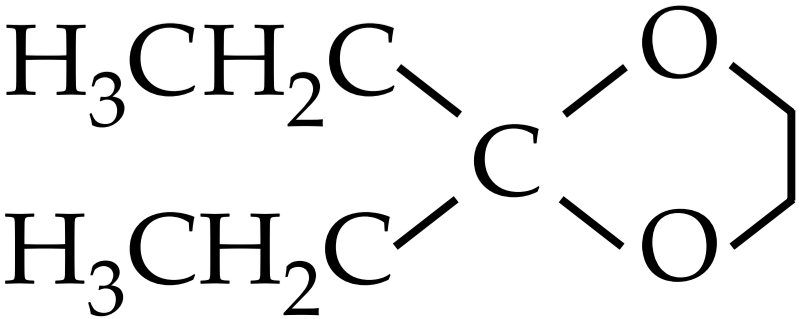
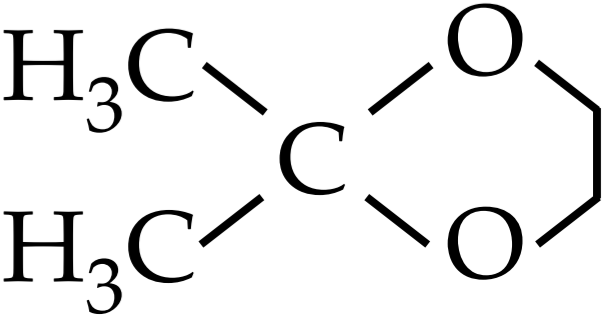
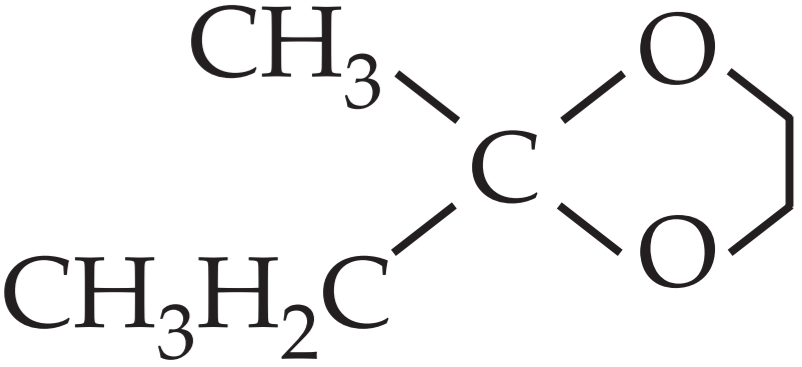
  1. What will be the product when $(B)$ reacts with ethylene glycol in presence of $\text{HCl}$ gas?
  1.  
  1.  
  1.  
  1. None of these.
Read the passage given below and answer the following questions:
The concentration of a solute is very important in studying chemical reactions because it determines how often molecules collide in solution and thus indirectly determine the rate of reactions and the conditions at equilibrium. There are several ways to express the amount of solute present in a solution. The concentration of a solution is a measure of the amount of solute that has been dissolved in a given amount of solvent or solution. Concentration can be expressed in terms of molarity, molality, parts per million, mass percentage, volume percentage, etc.
The following questions are multiple choice questions. Choose the most appropriate answer:
  1. A solution is prepared using aqueous $Kl$ which is turned out to be $20\%$ w/w Density of $Kl$ is $1.202 g/mL$ the molality of the given solution and mole fraction of solute are respectively.
  1. $1.95m, 0.120$
  2. $1.5m, 0.0263$
  3. $2.5m, 0.0569$
  4. $3.0m, 0.0352$
  1. The molarity $($in mol $L^{-1})$ of the given solution will be.
  1. $1.56$
  2. $1.89$
  3. $0.263$
  4. $1.44$
  1. Which of the following is correct relationship between mole fraction and molality?
  1. $\text{x}_2=\frac{\text{mM}_1}{1+\text{mM}_1}$
  2. $\text{x}_2=\frac{\text{mM}_1}{1-\text{mM}_1}$
  3. $\text{x}_2=\frac{1+\text{mM}_1}{\text{mM}_1}$
  4. $\text{x}_2=\frac{1-\text{mM}_1}{\text{mM}_1}$
  1. Which of the following is temperature dependent?
  1. Molarity
  2. Molality
  3. Mole fraction
  4. Mass percentage
  1. Which of the following is true for an aqueous solution of the solute in terms of concentration?
  1. $1M = 1m$
  2. $1M > 1m$
  3. $1M < 1m$
  4. Cannot be predicted
Read the passage given below and answer the following questions: Ligands are atoms or ions which can donate electrons to the central atoms. Ligands can be monodentate, bidentate or polydentate as well. Few ligands can coordinate with the central atom through more than one site, these are called ambidentate ligands. When a di- or polydentate ligand uses its two or more donor atoms to bind a single metal ion, it is said to be a chelating ligand. In these questions $(Q. No. i-iv),$ a statement of assertion followed by a statement ofreason is given. Choose the correct answer out of the following choices.
  1. Assertion and reason both are correct statements and reason is correct explanation for assertion.
  2. Assertion and reason both are correct statements but reason is not correct explanation for assertion.
  3. Assertion is correct statement but reason is wrong statement.
  4. Assertion is wrong statement but reason is correct statement.
The following questions are multiple choice questions. Choose the most appropriate answer:
  1. Assertion: Glycinate ion is an example of monodentate ligand.
Reason: Glycinate contains $N $ and $O$ as donor atoms.
  1. Assertion: $EDTA$ forms complex with divalent metals of 3d-series in the ratio of $1 : 1.$
Reason: $EDTA$ has $4 - COOH$ groups.
  1. Assertion: Oxalate ion is a bidentate ligan.
Reason: Oxalate ion has two donor atoms.
  1. Assertion: A chelating ligand must possess two or more lone pairs at such a distance that it may form suitable strain free $5 $ and $6$ membered rings with the metal ion.
Reason: $H_2N - NH_2$ is a chelating ligand.
  1. Assertion: In Zeise's salt coordination number of $Pt$ is five.
Reason: Ethene is a monodentate ligand.
Read the passage given below and answer the following questions:
To explain bonding in coordination compounds various theories were proposed. One of the important theory was valence bond theory. According to that, the central metal ion in the complex makes available a number of empty orbitals for the formation of coordination bonds with suitable ligands. The appropriate atomic orbitals of the metal hybridise to give a set of equivalent orbitals of definite geometry.
The $d-$orbitals involved in the hybridisation may be either inner $d-$orbitals i.e.$, (n - 1)d$ or outer $d-$orbitals i.e.$, nd.$
For example, $Co^{3+}$ forms both inner orbital and outer orbital complexes, with ammonia it forms $[\ce{Co(NH3)6]^{3+}}$ and with fluorine it forms $[\ce{CoF6]^{3-}}$ complex ion.
The following questions are multiple choice questions. Choose the most appropriate answer :
  1. Which of the following is not true for $[\ce{CoF6}]^{3-}$?
  1. It is paramagnetic.
  2. It has coordination number of $6.$
  3. It is outer orbital complex.
  4. It involves $d^2sp^3$ hybridisation.
  1. $[\ce{Cr(H2O)6]Cl3}\ ($at. no. of $Cr = 24)$ has a magnetic moment of $3.83\ B.M.$ The correct distribution of $3d-$electrons in the central metal of the complex is :
  1. $3\text{d}^1_\text{xy},3\text{d}^1_{\text{x}^2-\text{y}^2},3\text{d}^1_\text{yz}$
  2. $3\text{d}^1_\text{xy},3\text{d}^1_{\text{yz}},3\text{d}^1_\text{zx}$
  3. $3\text{d}^1_\text{xy},3\text{d}^1_{\text{zy}},3\text{d}^1_{\text{z}^2}$
  4. $3\text{d}^1_{\text{x}^2-\text{y}^2},3\text{d}^1_{\text{z}^2},3\text{d}^1_\text{xz}$
  1. Which of the following is true for $[\ce{Co(NH3)6}]^{3+}$?
  1. It is an octahedral, di magnetic and outer orbital complex.
  2. It is an octahedral, paramagnetic and outer orbital complex.
  3. It is an octahedral, paramagnetic and inner orbital complex.
  4. It is an octahedral, di magnetic and inner orbital complex.
  1. The paramagnetism of $[\ce{CoF6}]^{3-}$ is due to.
  1. $3$ electrons.
  2. $4$ electrons.
  3. $2$ electrons.
  4. $1$ electron.
  1. Which of the following is an inner orbital or low spin complex?
  1. $[\ce{Ni(H2O)6}]^{3+}$
  2. $[\ce{FeF6}]^{3-}$
  3. $[\ce{Co(CN)6}]^{3-}$
  4. $[\ce{NiCl4}]^{2-}$
Read the passage given below and answer the following questions: Transition elements are elements that have partially filled $d-$orbitals. The configuration of these elements corresponds to$ (n - 1)d^{1-10} \ ns^{1-2}.$ It is important to note that the elements mercury, cadmium and zinc are not considered transition elements because of their electronic configurations, which corresponds to $(n - 1)d^{10} \ ns^2.$ Some general properties of transition elements are: These elements can fonn coloured compounds and ions due to $d-d$ transition; These elements exhibit many oxidation states; A large variety of ligands can bind themselves to these elements, due to this, a wide variety of stable complexes formed by these ions. The boiling and melting point of these elements are high. These elements have a large ratio of charge to the radius. In these questions $(Q.$ No. $i-iv),$ a statement of assertion followed by a statement ofreason is given. Choose the correct answer out of the following choices.
  1. Assertion: Tungsten has very high melting point.
Reason: Tungsten is a covalent compound.
  1. Assertion: $Zn, Cd$ and $Hg$ are normally not considered transition metals.
Reason: $d-$Orbitals in $Zn, Cd$ and $Hg$ elements are completely filled, hence these metals do not show the general characteristics properties of the transition elements.
  1. Assertion: Copper metal gets readily corroded in acidic aqueous solution such as $\ce{HCl}$ and dil. $\ce{H_2SO_4}.$
Reason: Free energy change for this process is positive.
  1. Assertion: Tailing of mercury occurs on passing ozone through it.
Reason: Due to oxidation of mercury.
  1. Assertion: Transition metals are poor reducing agents.
Reason: Transition metals fonn numerous alloys with other metals.
Read the passage given below and answer the following questions:
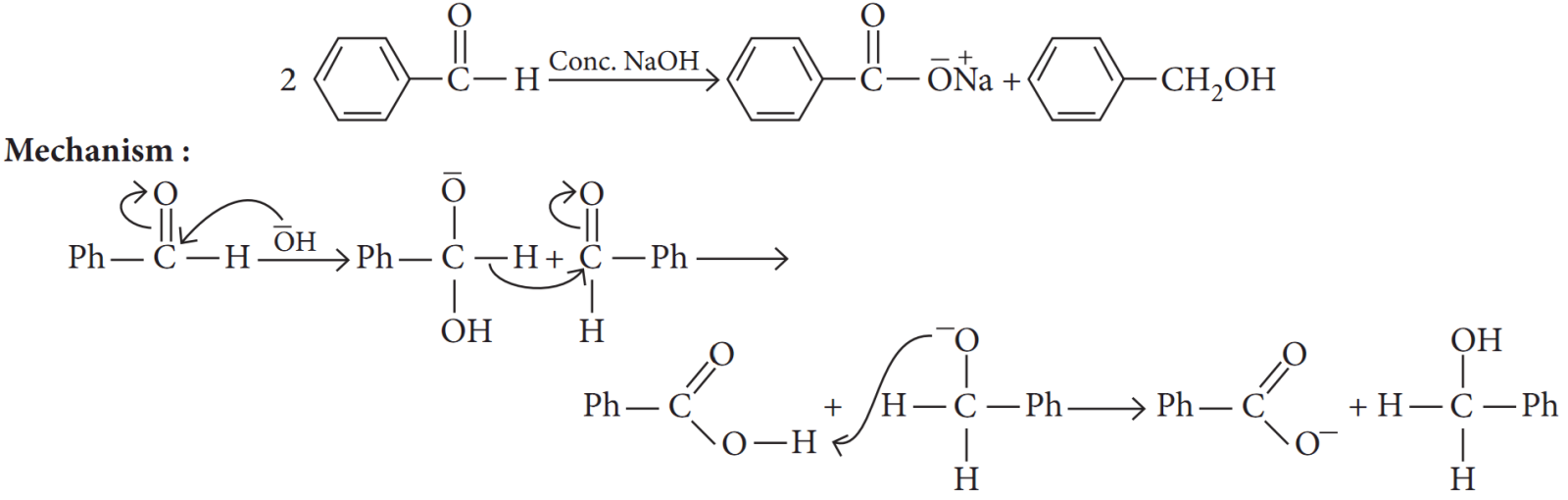
When an aldehyde with no et $-$ hydrogen reacts with concentrated aqueous $\ce{NaOH},$ half the aldehyde is converted to carboxylic acid salt and other half is converted to an alcohol. In other words, half of the reactant is oxidized and other half is reduced. This reaction is known as Cannizzaro reaction.

The following questions are multiple choice questions. Choose the most appropriate answer:
  1. A mixture of benzaldehyde and formaldehyde on heating with aqueous $\ce{NaOH}$ solution gives:
  1. Benzyl alcohol and sodium formate.
  2. Sodium benzoate and methyl alcohol.
  3. Sodium benzoate and sodium formate.
  4. Benzyl alcohol and methyl alcohol.
  1. Which of the following compounds will undergo Cannizzaro reaction?
  1. $\ce{CH_3CHO}$
  2. $\ce{CH_3COCH_3}$
  3. $\ce{C_6H_5CHO}$
  4. $\ce{C_6H_5CH_2CHO}$
  1. Trichloroacetaldehyde is subjected to Cannizzaro's reaction by using $\ce{NaOH}$. The mixture of the products contains sodium trichloroacetate ion and another compound. The other compounds is:
  1. $2, 2, 2-$ trichloroethanol.
  2. Trichloromethanol.
  3. $2, 2, 2-$ trichloropropanol.
  4. Chloroform.
  1. In Cannizzaro reaction given below:
$2\text{PhCHO}\xrightarrow{\stackrel{-}{\hbox{ OH}}}\text{PhCH}_2+\text{OH}+\text{PhCO}_2^-$ the slowest step is:
  1. The attack $^-OH$ at the carboxyl group.
  2. The transfer of hydride to the carbonyl group.
  3. The abstraction of proton from the carboxylic group.
  4. The deprotonation of $\ce{PhCH_2OH}.$
  1. Which of the following reaction will not result in the formation of carbon $-$ carbon bonds?
  1. Cannizzaro reaction.
  2. Wurtz reaction.
  3. Reimer $-$Tiemann reaction.
  4. Friedel $-$ Crafts' acylation.
Read the passage given below and answer the following questions:
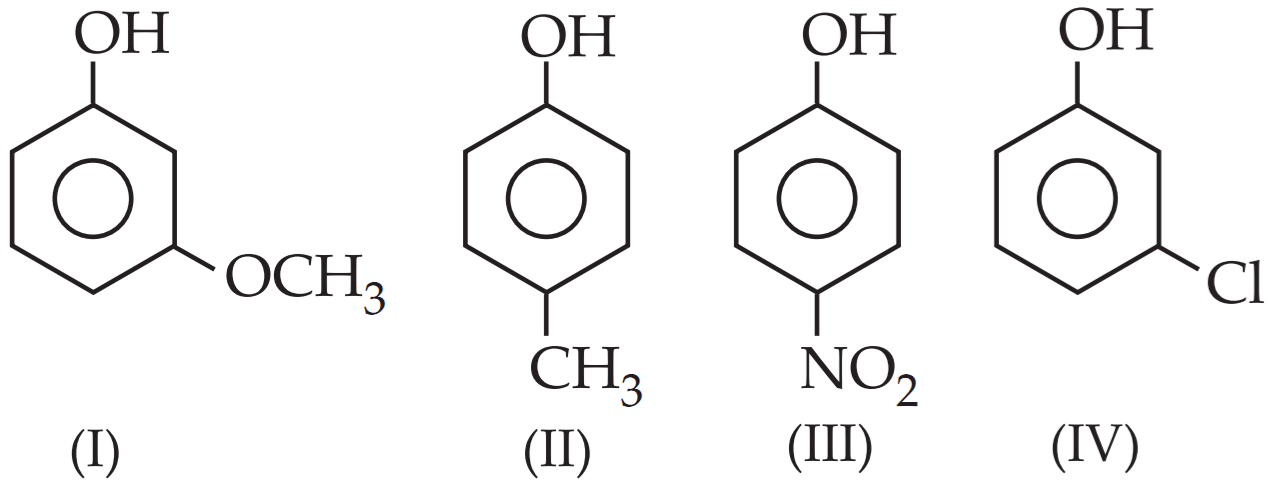
Both alcohols and phenols are acidic in nature, but phenols are more acidic than alcohols. Acidic strength of alcohols mainly depends upon the inductive effect. Acidic strength of phenols depends upon a combination of both inductive effect and resonance effects of the substituent and its position on the benzene ring. Electron withdrawing groups increases the acidic strength of phenols whereas electron donating groups decreases the acidic strength of phenols. Phenol is a weaker acid than carboxylic acid.
The following questions are multiple choice questions. Choose the most appropriate answer:
  1. Phenols are highly acidic as compare to alcohols due to:
  1. The higher molecular mass of phenols.
  2. The stronger hydrogen bonds in phenols.
  3. Alkoxide ion is a strong conjugate base.
  4. Phenoxide ion is resonance stabilised.
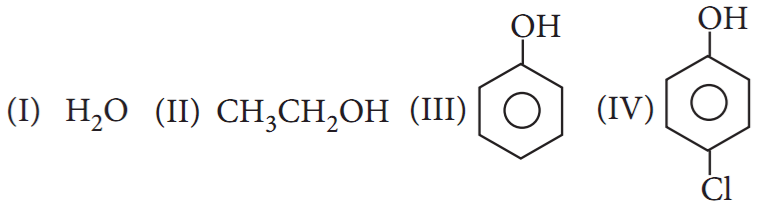
  1. The correct order of acidic strength among the following is:
  1. $(III) > (IV) > (II) > (I)$
  2. $(IV) > (III) > (I) > (II)$
  3. $(IV) > (III) > (II) > (I)$
  4. $(I) > (II) > (IV) > (III)$
  1. The correct decreasing order of $pK_a$ value is:
  1. $II > IV > I > III$
  2. $IV > II > III > I$
  3. $II I> II > IV > I$
  4. $IV > I > II > III$
  1. The compound that does not liberate $CO_2,$ on treatment with aqueous sodium bicarbonate solution is:
  1. Benzoic acid.
  2. Benzenesulphonic acid.
  3. Salicylic acid.
  4. Carbolic acid.
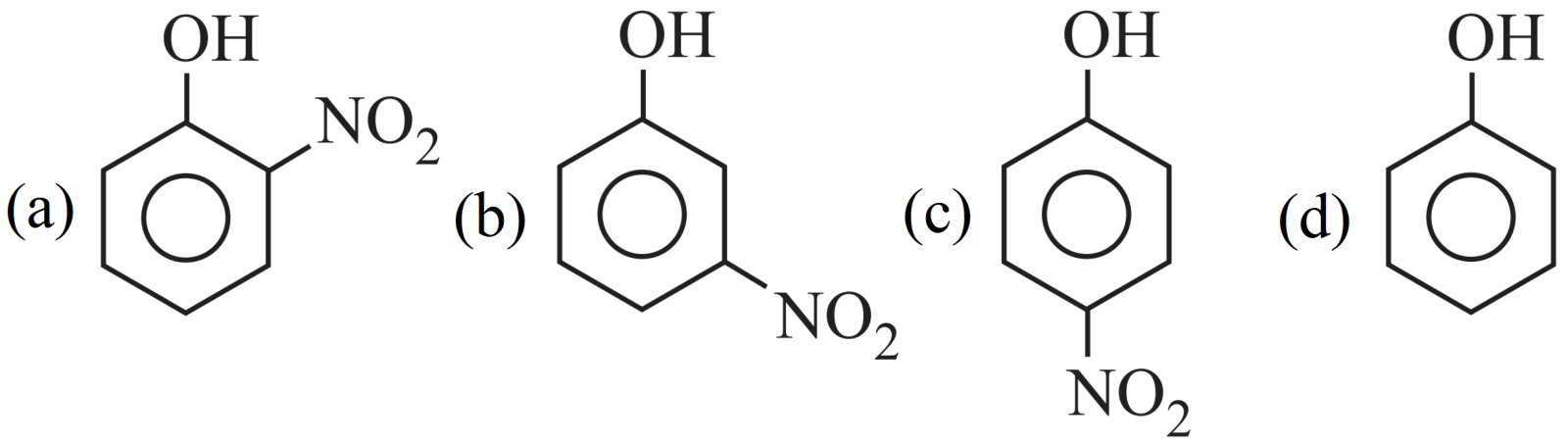
  1. Most acidic amongst the following is:
Read the passage given below and answer the following questions: The phenomenon of the flow of solvent through a semipermeable membrane from pure solvent to the solution is called osmosis. Sometimes a pressure is applied to stop the process of osmosis, this is known as osmotic pressure. It is denoted by $\pi.$ Osmotic pressure is expressed as : $\pi=\text{CRT}$ Since, osmotic pressure depends upon the molar concentration of solution, therefore it is a colligative property. A statement of assertion followed by a statement of reason is given. Choose the correct answer out of the following choices.
  1. Assertion and reason both are correct statements and reason is correct explanation for assertion.
  2. Assertion and reason both are correct statements but reason is not correct explanation for assertion.
  3. Assertion is correct statement but reason is wrong statement.
  4. Assertion is wrong statement but reason is correct statement.
  1. Assertion: If red blood cells were removed from the body and placed in pure water, pressure inside the cells increases.
Reason: The concentration of salt content in the cells increases.
  1. Assertion: The osmotic pressure of a solution obtained by mixing 100mL of 3.4% solution of urea and 100mL of 1.6% solution of cane sugar at 293K is 7.46 bar.
Reason: The total osmotic pressure will be equal to the sum of partial osmotic pressures.
  1. Assertion: When a solution is separated from the pure solvent by a semipermeable membrane, the solvent molecules pass through it from pure solvent side to the solution side.
Reason: Diffusion of solvent occurs from a region of high concentration to a region of low concentration solution.
  1. Assertion: Two solutions having same osmotic pressure at a given temperature are called isotonic solutions.
Reason: Osmotic pressure is not a colligative property.
  1. Assertion: The preservation of meat by salting and fruits by adding sugar protects against bacterial action.
Reason: A bacterium on salted meat or candid fruit loses water due to osmosis shrivels and ultimately dies.
What change in the concentration of H₂ will triple the rate of reaction?
(c). Suppose a reaction between A and B, was experimentally found to be first order with respect to both A and B. So the rate equation is:
Rate = k[A][B]
Which of these two mechanisms is consistent with this experimental finding? Why?
Mechanism 1
A → C + D (slow)
B+C → E (fast)
Mechanism 2
A+B →C + D (slow)
C → E (fast)
Read the passage given below and answer the following questions: Fehling's reagent: Fehling's reagent is a mixture of two solutions. Fehllng's solution $A$ is aqueous copper sulphate solution. Fehling's solution Bis alkaline sodium potassium tartarate $($Rochelle salt$). \ \ \ \ \ \ \ \ \ \ \ \ \ \ \ \ \ \ \ \ \text{CH(OH)COONa}\\\text{CuSo}_{4\text{(aq)}}+|\\\ \ \ \ \ \ \ \ \ \ \ \ \ \ \ \ \ \ \ \ \text{CH(OH)COOK}$ It is a mild oxidising agent. It is weaker than Tollens' reagent. It oxidises only aliphatic aldehydes to carboxylate ions and itself gets reduced to reddish brown precipitate of cuprous oxide. Aromatic aldehydes do not respond to Fehling's test. This reaction is used for the test of aliphatic aldehydes known as Fehling's reagent test. In these questions $(Q$. No. $l-iv),$ a statement of assertion followed by a statement ofreason is given. Choose the correct answer out of the following choices.
  1. Assertion and reason both are correct statements and reason is correct explanation for assertion.
  2. Assertion and reason both are correct statements but reason is not correct explanation for assertion.
  3. Assertion is correct statement but reason is wrong statement.
  4. Assertion is wrong statement but reason is correct statement.
  1. Assertion : Fehling's solution can be used to distinguish between acetaldehyde and acetone.
Reason : Fehling's reagent is a mixture of two solutions.
  1. Assertion : Aromatic aldehydes can be distinguished from aliphatic aldehydes by Fehling's solution.
Reason : Aromatic aldehydes reduce Fehling's solution, but aliphatic aldehydes do not.
  1. Assertion : Fehling's solution oxidises acetaldehyde to acetic acid but not benzaldehyde to benzoic acid.
Reason : The $C-H$ bond of $-\text{CHO}$ group in benzaldehyde is stronger than in acetaldehyde.
  1. Assertion : $\ce{CH_3CHO}$ and $\ce{C_6H_5CH_2CHO}$ cannot be distinguished chemically by Fehling's solution.
Reason : $\ce{CH_3CHO}$ and $\ce{C_6H_5CH_2CHO}$ cannot be distinguished chemically by Fehling's solution.
  1. Assertion : Formaldehyde, when heated with Fehling's reagent produces a reddish brown ppt, of $\ce{Cu}$.
Reason : Fehling's reagent oxidises fonnaldehyde to formate ion.