Question
Read the passage given below and answer the following questions:
When an aldehyde with no et $-$ hydrogen reacts with concentrated aqueous $\ce{NaOH},$ half the aldehyde is converted to carboxylic acid salt and other half is converted to an alcohol. In other words, half of the reactant is oxidized and other half is reduced. This reaction is known as Cannizzaro reaction.
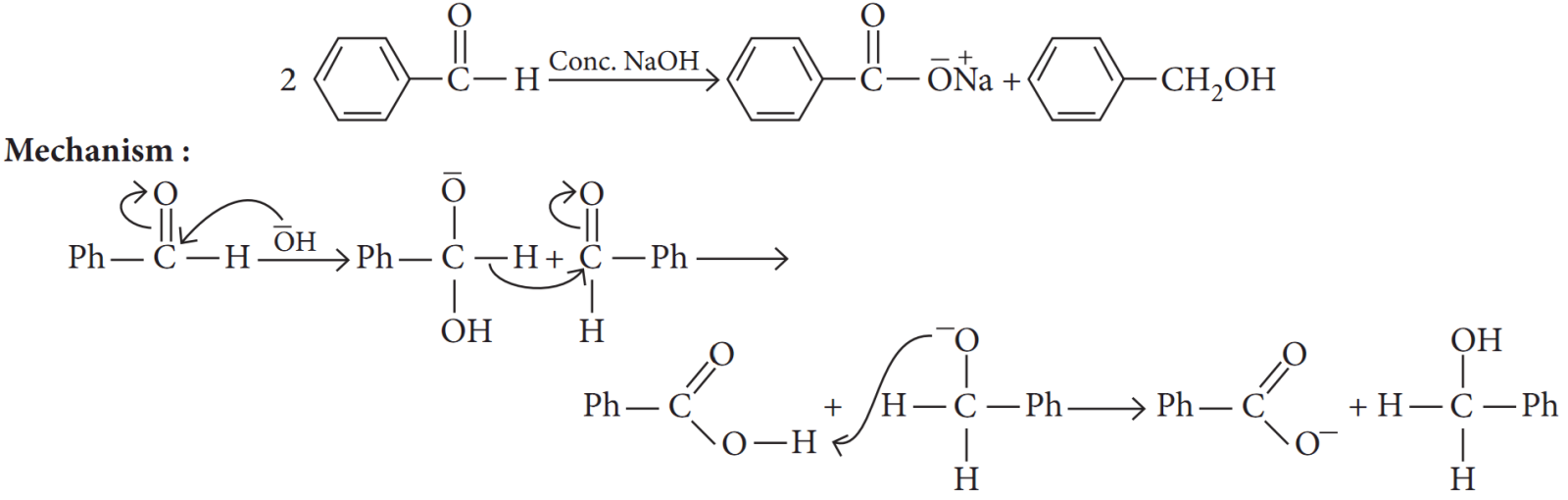
The following questions are multiple choice questions. Choose the most appropriate answer:
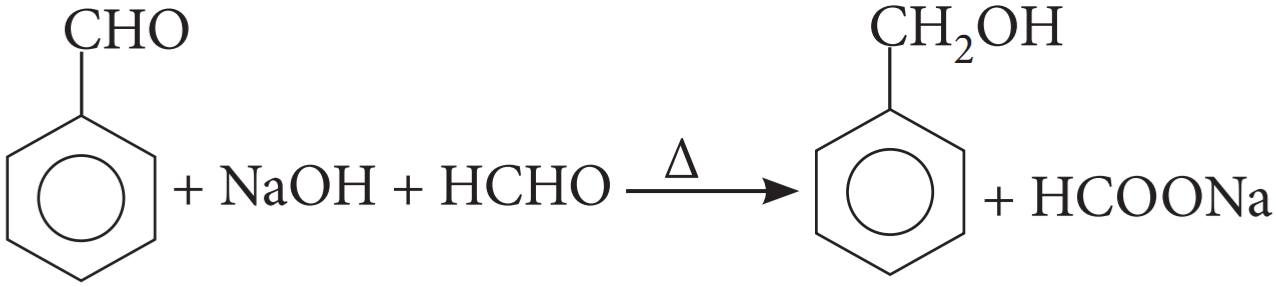
  1. A mixture of benzaldehyde and formaldehyde on heating with aqueous $\ce{NaOH}$ solution gives:
  1. Benzyl alcohol and sodium formate.
  2. Sodium benzoate and methyl alcohol.
  3. Sodium benzoate and sodium formate.
  4. Benzyl alcohol and methyl alcohol.
  1. Which of the following compounds will undergo Cannizzaro reaction?
  1. $\ce{CH_3CHO}$
  2. $\ce{CH_3COCH_3}$
  3. $\ce{C_6H_5CHO}$
  4. $\ce{C_6H_5CH_2CHO}$
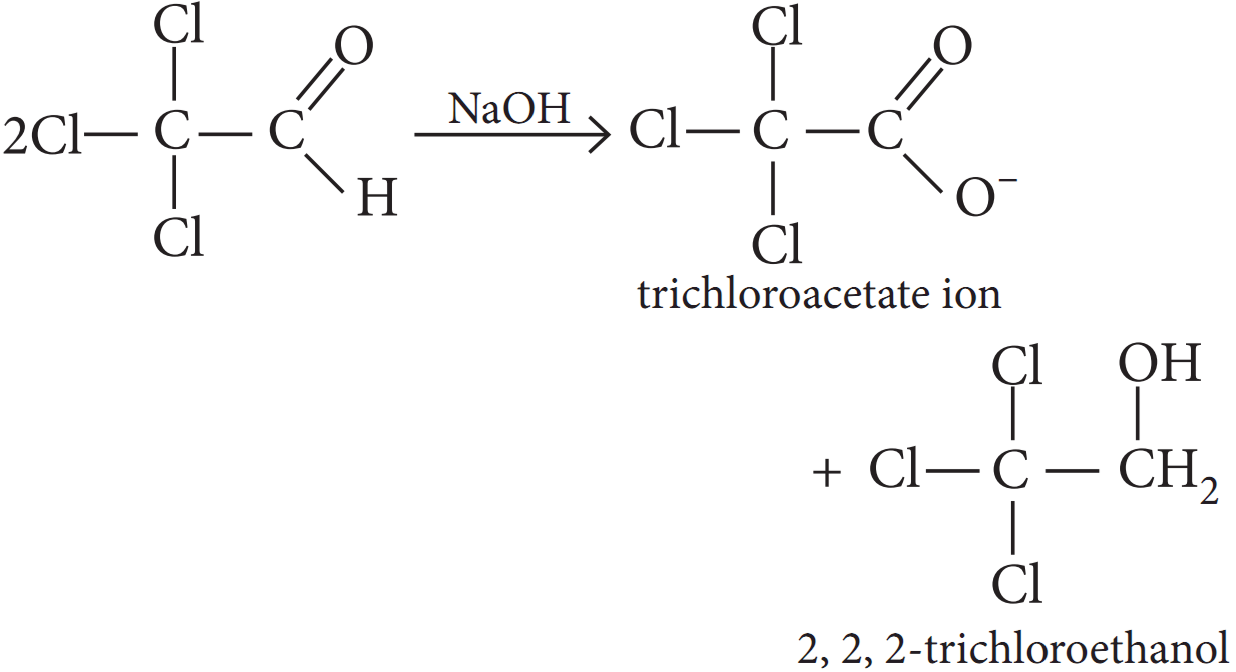
  1. Trichloroacetaldehyde is subjected to Cannizzaro's reaction by using $\ce{NaOH}$. The mixture of the products contains sodium trichloroacetate ion and another compound. The other compounds is:
  1. $2, 2, 2-$ trichloroethanol.
  2. Trichloromethanol.
  3. $2, 2, 2-$ trichloropropanol.
  4. Chloroform.
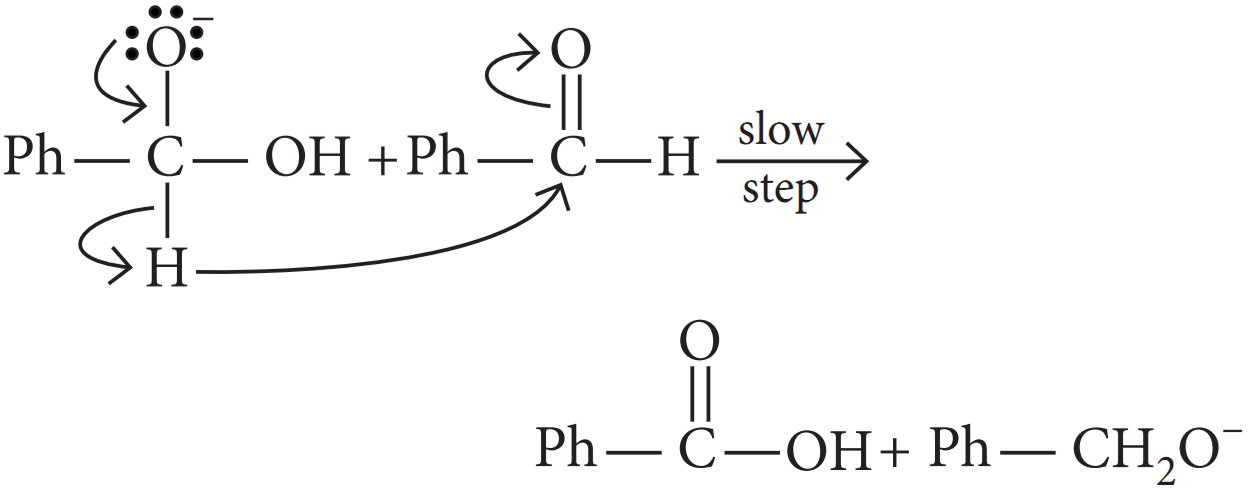
  1. In Cannizzaro reaction given below:
$2\text{PhCHO}\xrightarrow{\stackrel{-}{\hbox{ OH}}}\text{PhCH}_2+\text{OH}+\text{PhCO}_2^-$ the slowest step is:
  1. The attack $^-OH$ at the carboxyl group.
  2. The transfer of hydride to the carbonyl group.
  3. The abstraction of proton from the carboxylic group.
  4. The deprotonation of $\ce{PhCH_2OH}.$
  1. Which of the following reaction will not result in the formation of carbon $-$ carbon bonds?
  1. Cannizzaro reaction.
  2. Wurtz reaction.
  3. Reimer $-$Tiemann reaction.
  4. Friedel $-$ Crafts' acylation.
Answer

  1. $(a)$ Benzyl alcohol and sodium formate.
It is an example of cross Cannizzaro reaction where aromatic aldehyde gets reduced to alcohol and aliphatic aldehyde gets oxidised to its sodium salt $($both aldehydes must not contain any propto $-$ hydrogen$)$.
  1. $(c)\ \ce{C_6H_5CHO}$
  2. $(a)\  2, 2, 2-$ trichloroethanol.
The Cannizzaro product of given reaction yields $2, 2, 2-$ trichloroethanol.
  1. $(b)$ The transfer of hydride to the carbonyl group.
Hydride transfer is the slowest step.
  1. $(a)$ Cannizzaro reaction.
​​​​​​​​​​​​​​​​​​​​​​​​​​$C-C$ bond is not formed in Cannizzaro reaction while other reactions result in the formation of $C-C$ bond.

Need a full question paper?

Generate a complete, print-ready paper with questions like this in minutes — across 16+ boards, with answer keys.

Start Generating Free

Similar questions

Read the passage given below and answer the following questions:
At $298 K,$ the vapour pressure of pure benzene $, C_6, H_6$ is $0.256$ bar and the vapour pressure of pure toluene $\ce{C_6 H_5 CH_3}$ is $0.0925$ bar. Two mixtures were prepared as follows:
  1. $7.8g$ of $\ce{C_6 H_6 + 9.2g}$ of toluene
  2. $3.9g$ of $\ce{C_6 H_6 + 13.8g}$ of toluene
The following questions are multiple choice questions. Choose the most appropriate answer:
  1. The total vapour pressure $($bar$)$ of solution I is.
  1. $0.128$
  2. $0.174$
  3. $0.198$
  4. $0.258$
  1. Which of the given solutions have higher vapour pressure?
  1. $I$
  2. $II$
  3. Both have equal vapour pressure
  4. Cannot be predicted
  1. Mole fraction of benzene in vapour phase in solution I is.
  1. $0.128$
  2. $0.174$
  3. $0.734$
  4. $0.266$
  1. Which of the following statements is/are correct?
  1. Mole fraction of toluene in vapour phase is more in solution $ I$.
  2. Mole fraction of toluene in vapour phase is less in solution $I.$
  3. Mole fraction of benzene in vapour phase is less in solution $I.$
  1. Only $II$
  2. Only $I$
  3. $I$ and $III$
  4. $II$ and $III$
  1. Solution I is an example of a/an.
  1. Ideal solution.
  2. Non $-$ ideal solution with positive deviation.
  3. Non $-$ ideal solution with negative deviation.
  4. Can't be predicted.
Read the passage given below and answer the following questions:
Amines are alkyl or aryl derivatives of ammonia formed by replacement of one or more hydrogen atoms. Alkyl derivatives are called aliphatic amines and aryl derivatives are known as aromatic amines. The presence of aromatic amines can be identified by performing dye test. Aniline is the simplest example of aromatic amine. It undergoeselectrophilic substitution reactions in which $-\ce{NH_2}$ group strongly activates the aromatic ring through delocalisation of lone pair of electrons of $N-$atom. Aniline undergoes electrophilic substitution reactions. Ortho and para positions to the $-\ce{NH_2}$ group become centres of high electrons density. Thus, $-\ce{NH_2}$ group is ortho and para$-$directing and powerful activating group.
The following questions are multiple choice questions. Choose the most appropriate answer:
  1. Cyclohexylamine and aniline can be distinguished by:
  1. Hinsberg test.
  2. carbylamine test.
  3. Lassaigne test.
  4. azo dye test.
  1. Which of the following compounds gives dye test?
  1. Aniline.
  2. Methyl amine.
  3. Diphenyl amine.
  4. Ethyl amine.
  1. Aniline when acetylated, the major product on nitration followed by alkaline hydrolysis gives:
  1.  Acetanilide.
  2. $o-$nitroacetanitide.
  3. $p-$nitroaniline.
  4. $m-$nitroanitine.
  1. Oxidation of aniline with manganese dioxide and sulphuric acid produces:
  1. Phenylhydroxylamine.
  2. Nitrobenzene.
  3. $p-$benzoquinone.
  4. Phenol.
  1. Aniline when treated with cone. $\ce{HNO_3}$ and $\ce{H_2SO_4}$​​​​​​​​​​​​​​ gives:
  1.  $p-$phenylenediamine.
  2. $m-$nitroaniline.
  3. $p-$benzoquinone.
  4. Nitrobenzene.
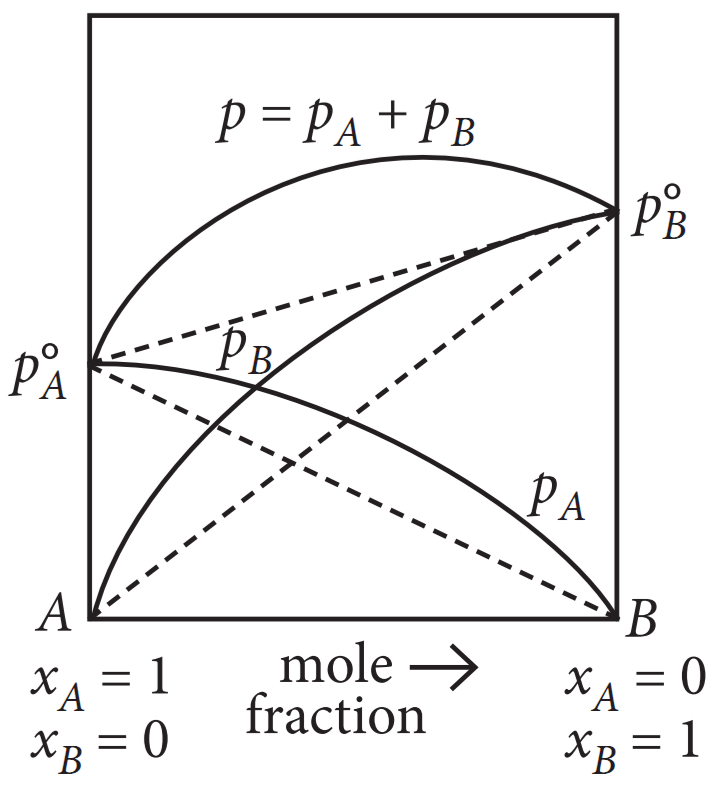
Read the passage given below and answer the following questions: An ideal solution may be defined as the solution which obeys Raoult's law exactly over the entire range of concentration. The solutions for which vapour pressure is either higher or lower than that predicted by Raoult's law are called non-ideal solutions.Non-ideal solutions can show either positive or negative deviations from Raoult's law depending on whether the A-B interactions in solution are stronger or weaker than A - A and B - B interactions. The following questions are multiple choice questions. Choose the most appropriate answer:
  1. Which of the following solutions is/are ideal solution(s)?
  1. Bromoethane and iodoethane.
  2. Acetone and chloroform
  3. Benzene and acetone
  4. n-heptane and n-hexane
  1. Only I
  2. I and II
  3. II and III
  4. I and Iv
  1. For which of the following solutions $\Delta\text{H}_{\text{mix}}$ and $\Delta\text{V}_{\text{mix}}$ is negative?
  1. Acetone and aniline
  2. Ethyl alcohol and cyclohexane
  3. Acetone and CS2
  4. Benzene and toluene
  1. Which of the following is not true for positive deviations?
  1. The A-B interactions in solution are weaker than the A - A and B - B interactions.
  2. $\text{P}_\text{A}<\text{P}\mathring{\text{A}}\ \text{x}_\text{A}$ and $\text{P}_\text{B}<\text{P}\mathring{\text{B}}\ \text{x}_\text{B}$
  3. Carbon tetrachloride and chloroform mixture is an example of positive deviations.
  4. All of these.
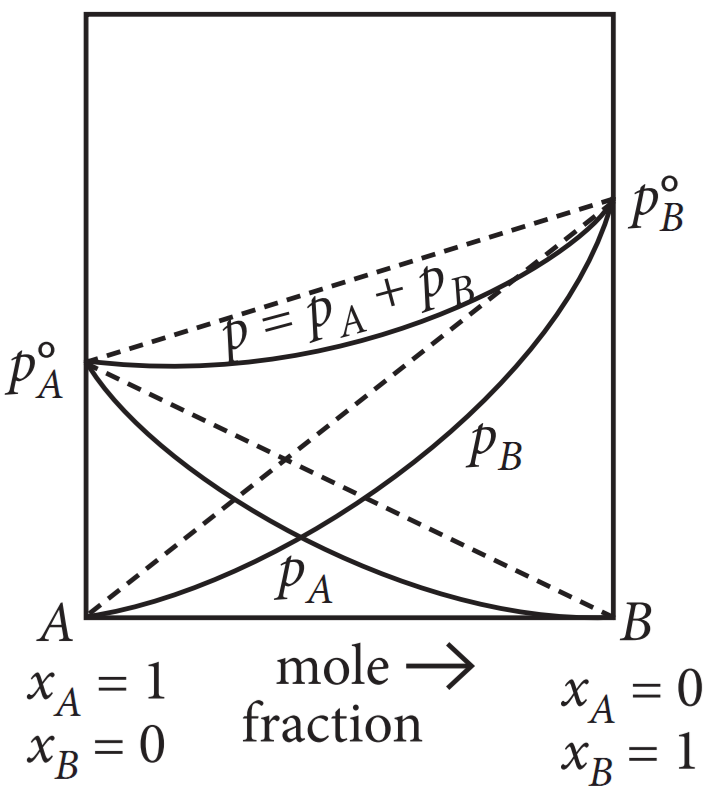
  1. For water and nitric acid mixture, which of the given graph is correct?
 
  1.  
 
  1.  
  1. Both of these
  2. None of these
  1. Water-HCI mixture.
  1. Shows positive deviations.
  2. Forms minimum boiling azeotrope.
  3. Shows negative deviations.
  4. Forms maximum boiling azeotrope.
  1. I and II
  2. I and III
  3. I and IV
  4. III and IV

Read the passage given below and answer the following questions:
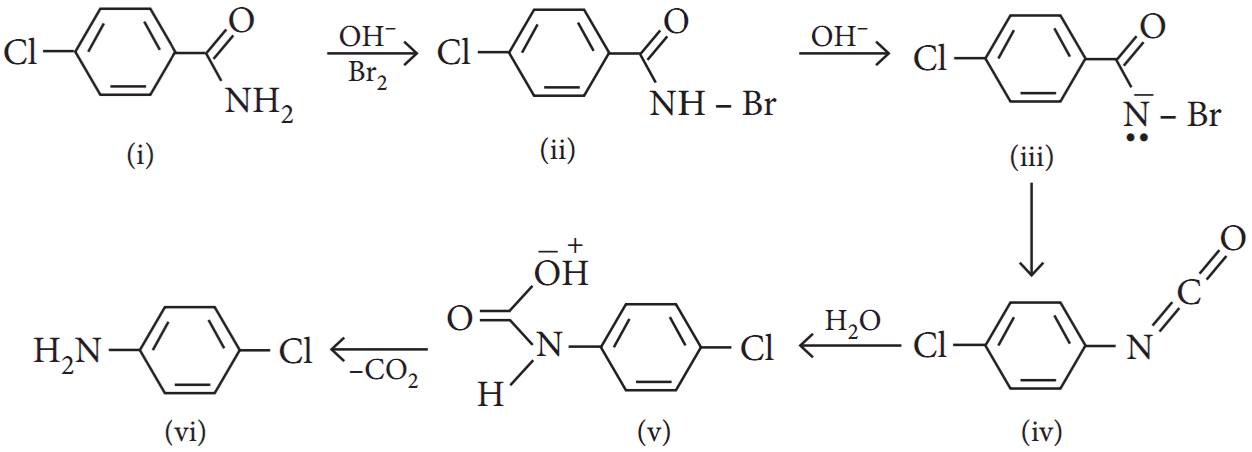
$\ce{RCONH_2}$ is converted into $\ce{RNH_2}$ by means of Hoffmann bromamide degradation. During the reaction amide is treated with $\ce{Br_2}$ and alkali to get amine. This reaction is used to descend the series in which carbon atom is removed as carbonate ion $(\text{CO}^{2-}_3)$ Hoffmann bromide degradation reaction can be written as:

The following questions are multiple choice questions. Choose the most appropriate answer:
  1. Hoffmann bromamide degradation is used for the preparation of
  1. Primary amines.
  2. Secondary amines.
  3. Tertiary amines.
  4. Secondary aromatic amines.
  1. Which is the rate determining step in Hoffmann bromamide degradation?
  1. Formation of $(i)$
  2. Formation of $(ii)$
  3. Formation of $(iii)$
  4. Formation of $(iv).$
  1. Which of the following are used for the conversion of $(i)$ to $(ii)?$
  1. $\ce{KBr}$
  2. $\ce{KBr + CH_3ONa}$
  3. $\ce{KBr + KOH}$
  4. $\ce{Br_2 + KOH}$
  1. Identify Bin the following reaction.
$\text{R}-\text{C}\equiv\text{N}\xrightarrow[\text{(Partially hydrolysis) }]{\text{Cone. HCI}}\text{A}\xrightarrow{\frac{\text{Br}_2}{\text{KOH}}}\text{B}$
  1. $\ce{RCONH_2}$
  2. $\ce{RNH_2}$
  3. $\ce{RNHBr}$
  4. $\ce{R = N = C = O}$
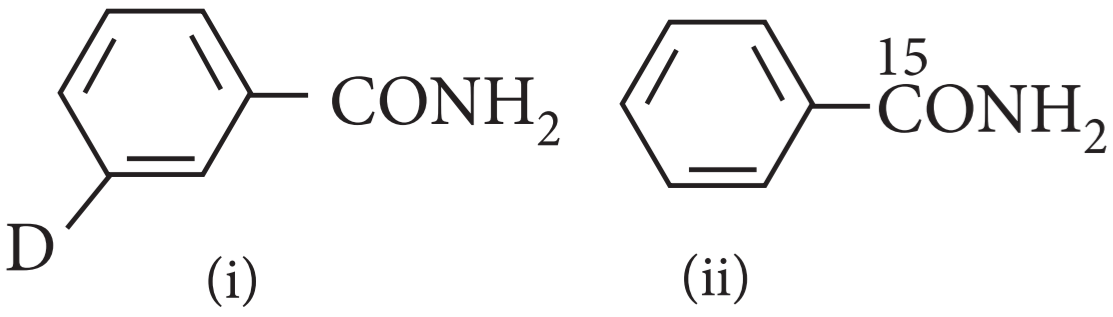
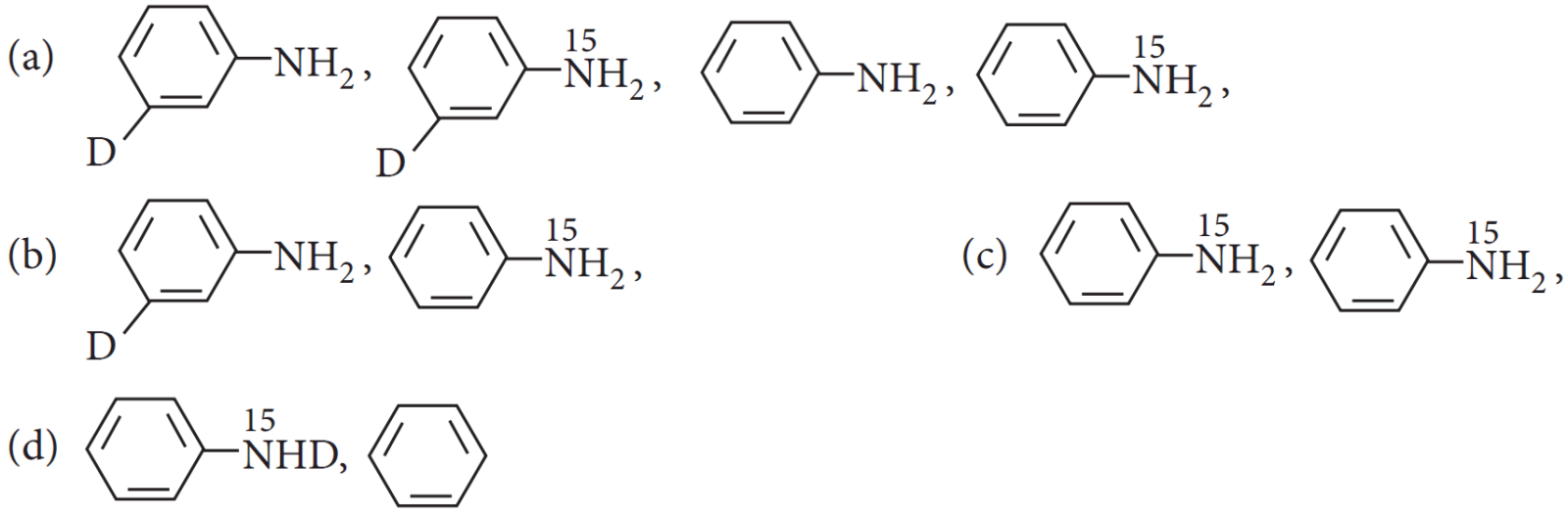
  1. What are the constituent amines formed when the mixture of $(i)$ and $(ii)$ undergoes Hoffmann bromamide degradation?
 
Read the passage given below and answer the following questions: The order of reactivity towards $S_N1$ reaction depends upon the stability of carbocation in the first step. Greater the stability of the carbocation, greater will be its ease of formation from alkyl halide and hence faster will be the rate of the reaction. As we know $, 3^\circ$ carbocation is most stable, therefore, the tert $-$ alkyl that halides will undergo $S_N1$ reaction very fast. For example, it has been observed that the reaction $\ce{(CH_3)_3CBr}$ with $\ce{OH}^-$ ion to give $2-$ methyl $-2-$ propanol is about I million times as fast as the corresponding reaction of the methyl bromide to give methanol. The primary alkyl halides always react predominantly by $S_N2$ mechanism. On the other hand, the tertiary alkyl halides react predominantly by $S_N1$ mechanism. Secondary alkyl halides may react by either mechanism or by both the mechanisms without much preference depending upon the nature of the nucleophile and solvent. In these questions $(Q$. No. $i-tv),$ a statement of assertion followed by a statement of reason is given. Choose tile correct answer out of tile following choices.
  1. Assertion and reason both are correct statements and reason is correct explanation for assertion.
  2. Assertion and reason both are correct statements but reason is not correct explanation for assertion.
  3. Assertion is correct statement but reason is wrong statement.
  4. Assertion is wrong statement but reason is correct statement.
  1. Assertion : Low concentration of nudeophile favours $S_N1$ mechanism.
Reason : $2^\circ$ alkyl halides are less reactive than $1^\circ$ towards $S_N1$ reactions.​​​​​​​
  1. Assertion : Polar solvent slows down $S_N2$ reactions.
Reason : $\ce{CH_3-Br}$ is less reactive than $\ce{CH_3Cl}$.​​​​​​​
  1. Assertion : Benzyl bromide when kept in acetone $-$ water it produces benzyl alcohol.
Reason : The reaction follows $S_N2$ mechanism.
  1. Assertion : Rate of hydrolysis of methyl chloride to methanol is higher in $\text{DMF}$ than in water.
Reason : Hydrolysis of methyl chloride follows second order kinetics.
  1. Assertion : $S_N1$ reaction is carried out in the presence of a polar protic solvent.
Reason : A polar protic solvent increases the stability of carbocation due to solvation.

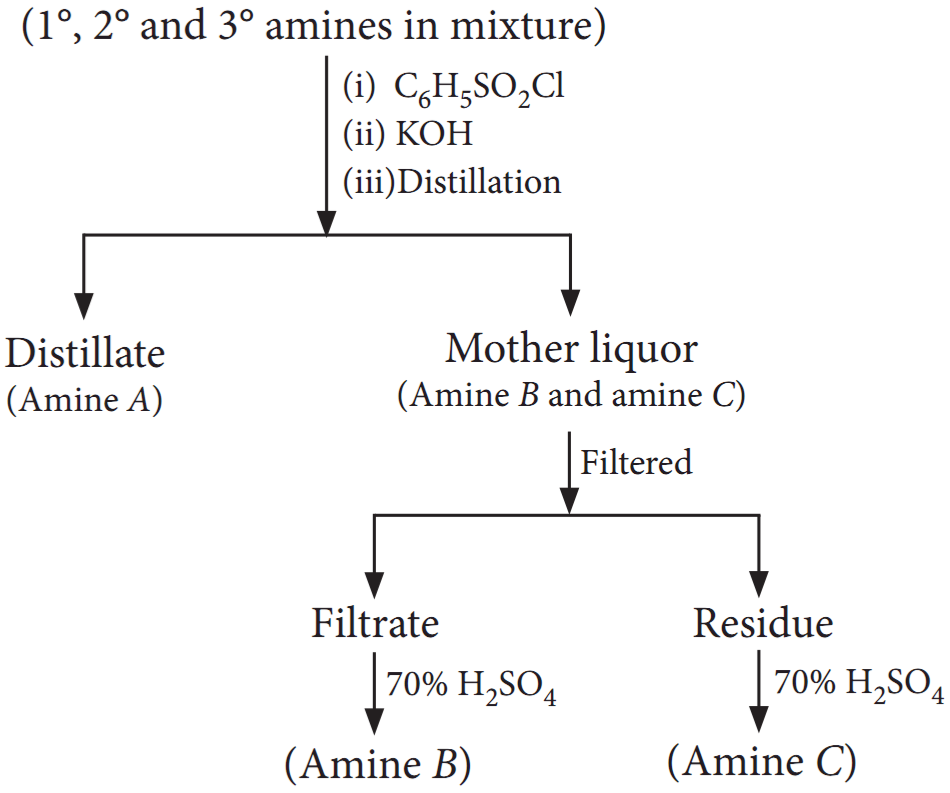
When the mixture contains the three amine salts (1º, 2º and 3º) along with quaternary salt, it is distilled with KOH solution. The three amines distill, leaving the quaternary salt unchanged in the solution. Then the mixture of amines is separated by fractional distillation, Hinsberg's method and Hoffmann's method.

The following questions are multiple choice questions. Choose the most appropriate answer:
  1. Hinsberg reagent is:
  1. Aliphatic sulphonyl chloride.
  2. Phthalamide.
  3. Aromatic sulphonyl chloride.
  4. Anhydrous ZnCl2 + cone. HCI.
  1. Primary amine with Hinsberg's reagent forms:
  1. N-alkyl benzene sulphonamide soluble in KOH solution.
  2. N-alkyl benzene sulphonamide insoluble in KOH solution.
  3. N, N-alkyl benzene sulphonamide soluble in KOH solution.
  4. N, N-alkyl benzene sulphonamide insoluble in KOH solution.
  1. Secondary amine with Hinsberg's reagent forms:
  1. N-alkyl benzene sulphonamide soluble in KOH solution.
  2. N-alkyl benzene sulphonamide insoluble in KOH solution.
  3. N,N-dialkyl benzene sulphonamide soluble in KOH solution.
  4. N,N-dialkyl benzene sulphonamide insoluble in KOH solution.
  1. To separate amines in a mixture Hoffmann's method is used. The Hoffman n's reagent is:
  1. Benzenesulphonyl chloride.
  2. Diethyl oxalate.
  3. Benzeneisocyanide.
  4. P-toulenesulphonic acid.
  1. 3º amines with Hinsberg's reagent give:
  1. No reaction.
  2. Product which is same as that of 1° amine.
  3. Product which is same as that of 2° amine.
  4. Products which is a quaternary salt.
Read the passage given below and answer the following questions: Ligands are atoms or ions which can donate electrons to the central atoms. Ligands can be monodentate, bidentate or polydentate as well. Few ligands can coordinate with the central atom through more than one site, these are called ambidentate ligands. When a di- or polydentate ligand uses its two or more donor atoms to bind a single metal ion, it is said to be a chelating ligand. In these questions $(Q. No. i-iv),$ a statement of assertion followed by a statement ofreason is given. Choose the correct answer out of the following choices.
  1. Assertion and reason both are correct statements and reason is correct explanation for assertion.
  2. Assertion and reason both are correct statements but reason is not correct explanation for assertion.
  3. Assertion is correct statement but reason is wrong statement.
  4. Assertion is wrong statement but reason is correct statement.
The following questions are multiple choice questions. Choose the most appropriate answer:
  1. Assertion: Glycinate ion is an example of monodentate ligand.
Reason: Glycinate contains $N $ and $O$ as donor atoms.
  1. Assertion: $EDTA$ forms complex with divalent metals of 3d-series in the ratio of $1 : 1.$
Reason: $EDTA$ has $4 - COOH$ groups.
  1. Assertion: Oxalate ion is a bidentate ligan.
Reason: Oxalate ion has two donor atoms.
  1. Assertion: A chelating ligand must possess two or more lone pairs at such a distance that it may form suitable strain free $5 $ and $6$ membered rings with the metal ion.
Reason: $H_2N - NH_2$ is a chelating ligand.
  1. Assertion: In Zeise's salt coordination number of $Pt$ is five.
Reason: Ethene is a monodentate ligand.
Read the passage given below and answer the following questions:
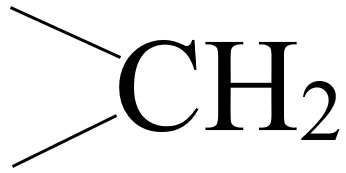
Aldehydes and ketones are reduced to primary and secondary alcohols respectively by $\ce{NaBH}_4$ or $\ce{LiAlH_4}$ as well as catalytic hydrogenation. The carbonyl group of aldehydes and ketones is reduced to  group on treatment with $\ce{Zn-Hg}$ and cone. $\text{HCl} \ ($Clemmensen reduction$)$ or with hydrazine followed by $\ce{NaOH}$ or $\text{KOH}$ in highly boiling solvent such as ethylene glycol $($Wolff $-$ Kishner reduction).Aldehydes differ from ketones in their oxidation reactions. Aldehydes are easily oxidised to carboxylic acids on treatment with $\ce{HNO_3, KMnO_4, K_2Cr_2O_7}$ etc. Even mild oxidising agents mainlyTollens' reagent and Fehling's solution also oxidise aldehydes. Ketones are generally oxidised under vigorous conditions i.e., strong oxidising agents and at elevated temperatures, to give mixture of carboxylic acids having lesser number of $C-$ atoms than the parent ketone.
The following questions are multiple choice questions. Choose the most appropriate answer:
  1. Which of the following cannot be made by reduction of ketone or aldehyde with $\ce{NaBH}_4$ in methanol?
  1. $1-$ Butanol
  2. $2-$ Butanol
  3. $2-$ Methyl $-1-$ propanol
  4. $2-$ Methyl $-2-$ propanol
  1. The carbonyl compound producing an optically active product by reaction with $\ce{LiAlH}_4$ is:
  1. Propanone
  2. Butanone
  3. 3-pentanone
  4. Benzophenone
  1. A substance $\ce{C_4H_{10}O} (X)$ yields on oxidation a compound $\ce{C_4H_8O}$ which gives an oxime and a positive iodoform test.
  2. The substance $X$ on treatment with cone. $\ce{H_2SO}_4$ gives $\ce{C_4H_8}$. The structure of the compound $(X)$ is:
  1. $\ce{CH_3CH_2CH_2CH_2OH}$
  2. $\ce{CH_3CH(OH)CH_2CH_3}$
  3. $\ce{(CH_3)_3COH}$
  4. $\ce{CH_3CH_{2 }- O - CH_2CH_3}$
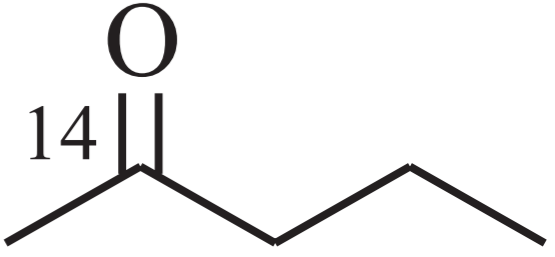
  1. In the oxidation of  by acidified $\ce{K_2Cr_2O_7},$ the products are:
  1. $\ \ \ \ \ \ \ \ \ \ \ \ \ \ \ \ \text{O}\\\ \ \ \ \ \ \ \ \ \ \ \ \ \ \ \ ||\\\text{CH}_3-\ ^\text{14}\text{C}-\text{OH}$ and $\text{CH}_3\text{CH}_2\text{COOH}$
  2. $\ \ \ \ \ \ \ \ \ \ \ \ \ \ \ \ \ \ \ \ \ \ \ \ \ \ \ \ \ \ \ \ \ \ \ \ \text{O}\\ \ \ \ \ \ \ \ \ \ \ \ \ \ \ \ \ \ \ \ \ \ \ \ \ \ \ \ \ \ \ \ \ \ \ \ \ \ ||\\\text{CH}_3(\text{CH}_2)_2\text{COOH}-\text{C}-\text{OH}$ and $ \ \ \ \ \ \ \ 14\\\text{CH}_3\text{CH}_2\text{COOH}$
  3. $\ \ \ \ \ \ \ \ \ \ \ \ \ \ \ \ \ \ \ \ \ \ \ \ \ \ \ \ \ \ \ \ \ \ \ \ \ \ \ \ \ \ 14\\\text{CH}_3\text{CH}_2\text{CH}_2\text{COOH}+\text{HCOOH}$
  4. None of these.
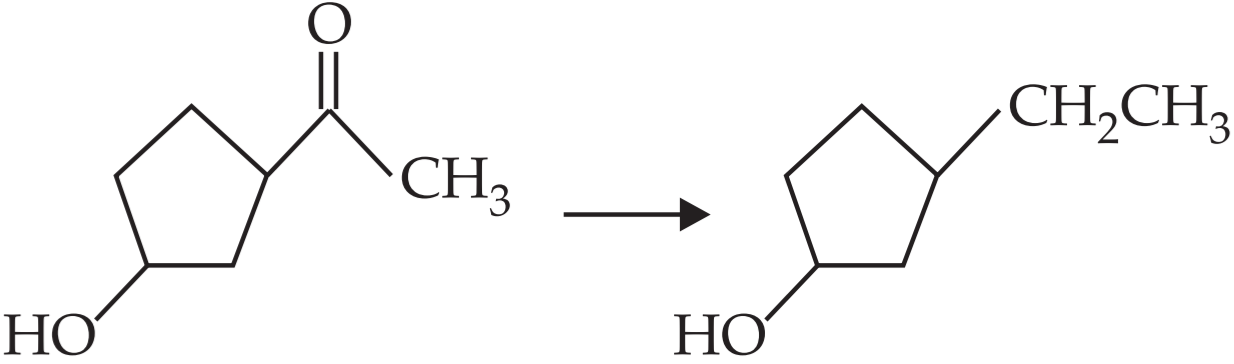
  1. The appropriate reagent for the following transformation is:
  1. $\text{Na}_2\text{NH}_2,^-\text{OH}$
  2. $\text{NaBH}_4$
  3. $\frac{\text{H}_2}{\text{Ni}}$
  4. $\text{AICl}_3$
Read the passage given below and answer the following questions:
The amines are basic in nature due to the presence of a lone pair of electron on $N-$atom of the $-NH_2$ group, which it can donate to electron deficient compounds. Aliphatic amines are stronger bases than $NH_3$ because of the $+I$ effect of the alkyl groups. Greater the number of alkyl groups attached to $N-$atom, higher is the electron density on it and more will be the basicity. Thus, the order of basic nature of amines is expected to be $3^\circ > 2^\circ > 1^\circ ,$ however the observed order is $2^\circ > 1^\circ > 3^\circ .$ This is explained on the basis of crowding on $N-$atom of the amine by alkyl groups which hinders the approach and bonding by a proton, consequently, the electron pair which is present on $N$ is unavailable for donation and hence $3^\circ$ amines are the weakest bases.
Aromatic amines are weaker bases than ammonia and aliphatic amines. Electron-donating groups such as $-\ce{CH_3, -OCH_3,}$ etc. increase the basicity while electron-withdrawing substitutes such as $\ce{-NO_2, -CN,}$ halogens, etc. decrease the basicity of amines. The effect of these substituents is more at $p$ than at $m-$positions.
The following questions are multiple choice questions. Choose the most appropriate answer:
  1. Which one of the following is the strongest base in aqueous solution?
  1. Methyl amine.
  2. Tri methyl amine.
  3. Aniline.
  4. Dimethyl amine.
  1. Which order ofbasicity is correct?
  1. Aniline $>$ $m-$toluidine $> o-$toluidine
  2. Aniline $> o-$toluidine $> m-$toluidine
  3. $o-$toluidine $>$ aniline $> m-$toluidine
  4. $o-$toluidine $<$ aniline $< m-$toluidine
  1. What is the decreasing order of basicity of primary, secondary and tertiary ethylamines and $NH_3$?
  1. $\ce{NH_3 > C_2H_5NH_2 > (C_2H_5)_2NH > (C_2H_5)_3N}$
  2. $\ce{(C_2H_5)_3N > (C_2H_5)_2NH_{ }> C_2H_5NH_2 > NH_3}$
  3. $\ce{(C_2H_5)_2NH > C_2H_5NH_2> (C_2H_5)_3N > NH_3}$
  4. $\ce{(C_2H_5)_2NH > (C_2H_5)_3N > C_2H_5NH_2 > NH_3​​​​​​​}$
  1. The order of basic strength among the following amines in benzene solution is:
  1. $\ce{CH_3NH_2 > (CH_3)_3N > (CH_3)_2NH}$
  2. $\ce{(CH_3)_3N > (CH_3)_2NH > CH_3NH_2​​​​​​​}$
  3. $\ce {CH_3NH_2 > (CH_3)_2NH > (CH_3)_3N}$
  4. $\ce{(CH_3)_3N > CH_3NH_2 > (CH_3)_2NH}$
  1. Choose the correct statement.
  1. Methylamine is slightly acidic.
  2. Methylamine is less basic than ammonia.
  3. Methylamine is a stronger base than ammonia.
  4. Methylamine forms salts with alkalies.
For the reaction : $2\text{NO}_\text{(g)}+\text{Cl}_{2\text{(g)}}\rightarrow2\text{NOCl}_\text{(g)},$ the following data were collected. All the measurements were taken at $263K.$
Experiment No.
Initial $\ce{[NO] (M)}$
Initial $\ce{[Cl_2] (M)}$
Initial rate of disapp. of $\ce{Cl_2 (M/ min)}$
$1.$ $0.15$ $0.15$ $0.60$
$2.$ $0.15$ $0.30$ $1.20$
$3.$ $0.30$ $0.15$ $2.40$
$4.$ $0.25$ $0.25$ $?$
The following questions are multiple choice questions. Choose the most appropriate answer:
  1. The molecularity of the reaction is:
  1. $1$
  2. $2$
  3. $3$
  4. $4$
  1. The expression for rate law is:
  1. $\text{r}=\text{k}[\text{NO}][\text{Cl}_2]$
  2. $\text{r}=\text{k}[\text{NO}]^2[\text{Cl}_2]$
  3. $\text{r}=\text{k}[\text{NO}][\text{Cl}_2]^2$
  4. $\text{r}=\text{k}[\text{NO}]^2[\text{Cl}_2]^2$
  1. The overall order of the reaction is:
  1. $2$
  2. $0$
  3. $1$
  4. $3$
  1. The value of rate constant is:
  1. $150.32\ M^{-2}\ min^{-1}$
  2. $200.08\ M^{-1}\ min^{-1}$
  3. $177.77\ M^{-2}\ min^{-1}$
  4. $155.75\ M^{-1}\ min^{-1}$
  1. The initial rate of disappearance of $Cl_2$ in experiment $4$ is:
  1. $1.75\ M\ min^{-1}$
  2. $3.23\ M\ min^{-1}$
  3. $2.25\ M\ min^{-1}$
  4. $2.77\ M\ min^{-1}$