- ATo detect and test small electric charges.
- BTo calculate the amount of electric charge flowing through the conductor in the given interval of time.
- CTo find out the presence of antimatter.
- DTo test the presence of magnetic field.
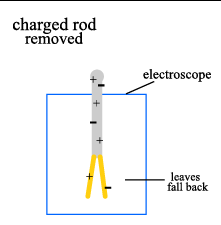
Explanation:
Electroscope is an old electrical instrument, used to detect the presence and magnitude of electric charges on a body.

Generate a complete, print-ready paper with questions like this in minutes — across 16+ boards, with answer keys.
The cold junction of a thermocouple is maintained at 10℃. No thermo e.m.f. is developed when the hot junction is maintained at 530 ℃ . The neutral temperature is
|
(a) 260℃ |
(b) 270℃ |
(c) 265℃ |
(d) 520℃ |
An expression for rate of heat generated, if a current of I ampere flows through a resistance of R W, is
|
(a) |
(b) |
(c) |
(d) IR |
Identify the wrong statement in the following. Coulomb's law correctly describes the electric force that
|
(a) Binds the electrons of an atom to its nucleus |
|
(b) Binds the protons and neutrons in the nucleus of an atom |
|
(c) Binds atoms together to form molecules |
|
(d) Binds atoms and molecules together to form solids |
In a PN-junction
|
(a) P and N both are at same potential |
|
(b) High potential at N side and low potential at P side |
|
(c) High potential at P side and low potential at N side |
|
(d) Low potential at N side and zero potential at P side |
When one of the slits of Young’s experiment is covered with a transparent sheet of thickness 4.8 mm, the central fringe shifts to a position originally occupied by the 30th bright fringe. What should be the thickness of the sheet if the central fringe has to shift to the position occupied by 20th bright fringe
|
(a) 3.8 mm |
(b) 1.6 mm |
(c) 7.6 mm |
(d) 3.2 mm |