Equal masses of two liquids are filled in two similar calorimeters. The rate of cooling will
Easy
Download our app for free and get started
(b)Liquid having more specific heat has slow rate of cooling because for equal masses rate of cooling $\frac{{d\theta }}{{dt}} \propto \frac{1}{c}$.

Download our appand get started for free
Experience the future of education. Simply download our apps or reach out to us for more information. Let's shape the future of learning together!No signup needed.*
Similar Questions
- 1The total radiative power emitted by spherical black body with radius $R$ and temperature $T$ is $P$. If the radius is doubled and the temperature is halved, then the radiative power will beView Solution
- 2View SolutionThe dimensions of thermal resistance are
- 3According to Newton’s law of cooling, the rate of cooling of a body is proportional to ${(\Delta \theta )^n}$, where $\Delta \theta $ is the difference of the temperature of the body and the surroundings, and n is equal toView Solution
- 4A cylindrical metallic rod in thermal contact with two reservoirs of heat at its two ends conducts an amount of heat $Q$ in time $t$. The metallic rod is melted and the material is formed into a rod of half the radius of the original rod. What is the amount of heat conducted by the new rod, when placed in thermal contact with the two reservoirs in time $t$ ?View Solution
- 5View SolutionA hot body will radiate heat most rapidly if its surface is
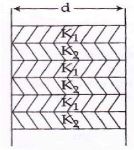
- 6A wall consists of alternating blocks of length $d$ and coefficient of thermal conductivity $K_{1}$ and $K_{2}$ respectively as shown in figure. The cross sectional area of the blocks are the same. The equivalent coefficient of thermal conductivity of the wall between left and right isView Solution
- 7The sun emits a light with maximum wavelength $510\, mm$ while another star $X$ emits a light with maximum wavelength of $350\, nm$. What is the ratio of surface temperature of sun and the star $X$View Solution
- 8View SolutionThe spectral energy distribution of star is maximum at twice temperature as that of sun. The total energy radiated by star is
- 9Four rods of indentical cross-sectional area and made from the same metal form the sides of a square. The temperature of two diagonally opposite points are $\theta$ and $\sqrt2 \theta$ respectively in the teady state. Assuming that only heat conduction takes place, what will be the temperature difference between other two points ?View Solution
- 10Two rods of same length and material transfer a given amount of heat in $12$ seconds, when they are joined end to end. But when they are joined lengthwise, then they will transfer same heat in same conditions in ....... $\sec$View Solution
