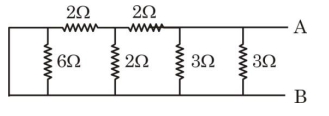
Equivalent resistance of the following network is____ $\Omega$.
JEE MAIN 2024, Diffcult
Download our app for free and get started
$6 \ \Omega$ is short circuit
${R}_{\mathrm{eq}}=3 \times \frac{1}{3}=1\ \Omega$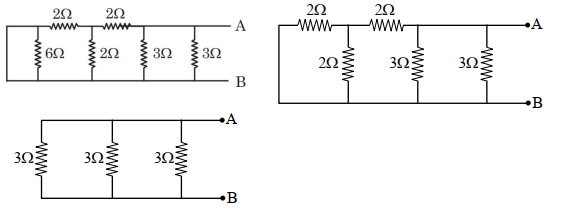

Download our appand get started for free
Experience the future of education. Simply download our apps or reach out to us for more information. Let's shape the future of learning together!No signup needed.*
Similar Questions
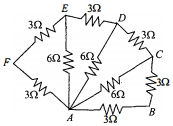
- 1Six resistors of $3 \;\Omega$ each are connected along the sides of a hexagon and three resistors of $6\; \Omega$ each are connected along $A C, A D$ and $A E$ as shown in the figure. The equivalent resistance between $A$ and $B$ is equal toView Solution
- 2$n$ identical cells are joined in series with two cells $A$ and $B$ with reversed polarities. $emf$ of each cell is $E$ and internal resistance is $r$. Potential difference across cell $A$ and $B$ is : $(n > 4)$View Solution
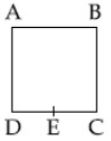
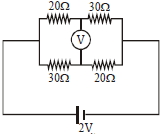
- 3The reading of an ideal voltmer in the circuit shown is.....$V$View Solution
- 4View SolutionConductivity increases in the order of
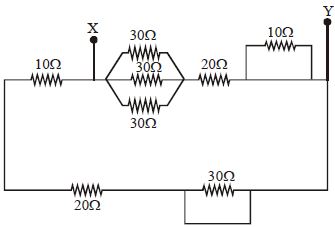
- 5Net resistance between $X$ and $Y$ is ............... $\Omega$View Solution
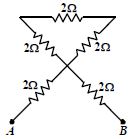
- 6For the circuit shown in the figure , the equivalent resistance between $A$ and $B$ is ............. $\Omega$View Solution
- 7An electric fan and a heater are marked as $100\, watt$, $220\, volt$ and $1000\, watt$, $220\, volt$ respectively. The resistance of the heater isView Solution
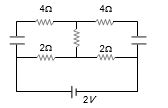
- 8Find the power of the circuit ............ $W$View Solution
- 9Current density in a cylindrical wire of radius $R$ is given as $J =$ $\left\{ {\begin{array}{*{20}{c}}View Solution
{{J_0}\left( {\frac{x}{R} - 1} \right)\,\,for\,\,0 \leqslant x < \frac{R}{2}} \\
{{J_0}\frac{x}{R}\,\,\,\,for\,\,\,\frac{R}{2} \leqslant x \leqslant R}
\end{array}} \right.$The current flowing in the wire is: - 10A wire of resistance $R$ is bent to form a square $ABCD$ as shown in the figure. The effective resistance between $E$ and $C$ is ( $E$ is mid-point of arm $CD$ )View Solution