Question
Establish a formula for converting the magnitude of a physical quantity from one unit system to another through the dimensional method. Convert one horse power to watts using the formula.

Answer

self

Need a full question paper?

Generate a complete, print-ready paper with questions like this in minutes — across 16+ boards, with answer keys.
Start Generating Free

Similar questions

Answer the following questions based on the $P - T$ phase diagram of $CO _2$ :
a. $CO _2$ at 1 atm pressure and temperature $-60^{\circ} C$ is compressed isothermally. Does it go through a liquid phase?
b. What happens when $CO _2$ at 4 atm pressure is cooled from room temperature at constant pressure ?
c. Describe qualitatively the changes in a given mass of solid $CO _2$ at 10 atm pressure and temperature $-65^{\circ} C$ as it is heated up to room temperature at constant pressure.
d. $CO _2$ is heated to a temperature $70^{\circ} C$ and compressed isothermally. What changes in its properties do you expect to observe?
A pump on the ground floor of a building can pump up water to fill a tank of volume $30m^3$ in $15min$. If the tank is $40m$ above the ground, and the efficiency of the pump is $30\%$, how much electric power is consumed by the pump?
Is it possibe for a body to have inertia but no weight?
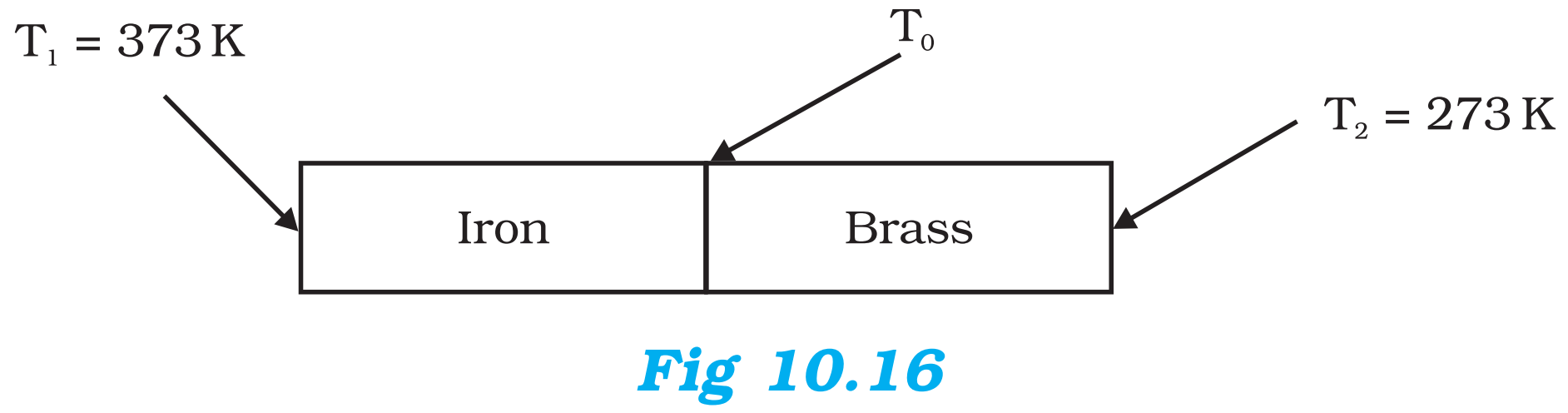
An iron bar $\left(L_1=0.1 m , A_1=\right. \left.0.02 m ^2, K_1=79 W m ^{-1} K ^{-1}\right)$ and a brass bar $\left(L_2=0.1 m , A_2=0.02 m ^2\right.$, $K_2=109 W m ^{-1} K ^{-1}$ ) are soldered end to end as shown in Fig. $10.16.$ The free ends of the iron bar and brass bar are maintained at $373 K$ and $273 K$ respectively. Obtain expressions for and hence compute $(i)$ the temperature of the junction of the two bars, $(ii)$ the equivalent thermal conductivity of the compound bar, and $(iii)$ the heat current through the compound bar.
Image
The transverse displacement of a string (clamped at its both ends) is given by
$\text{y}(\text{x, t})=0.06\sin\Big(\frac{2\pi}{3}\text{x}\Big)\cos(120\pi\text{ t})$
where x and y are in m and t in s. The length of the string is $1.5m$ and its mass is $3.0 \times 10^{–2}kg$.
Answer the following:
Interpret the wave as a superposition of two waves travelling in opposite directions. What is the wavelength, frequency, and speed of each wave?
For the wave on a string described in Exercise 15.11, do all the points on the string oscillate with the same,
  1. Frequency,
  2. Phase,
  3. Amplitude?
A tuning fork vibrating with a frequency of 512Hz is kept close to the open end of a tube filled with water The water level in the tube is gradually lowered. When the water level is 17cm below the open end, maximum intensity of sound is heard. If the room temperature is 20° C, calculate
  1. Speed of sound in air at room temperature
  2. Speed of sound in air at 0° C
  3. If the water in the tube is replaced with mercury, will there be any difference in your observations?
Explain Aristotle's Fallacy and Galileo's refutation.
A body is in translational equilibrium under the action of coplanar forces. If the torque of these forces is zero about a point, is it necessary that it will also be zero about any other point?
Consider a particle moving in simple harmonic motion according to the equation $\text{x}=2.0\cos(50\pi\text{t}+\tan^{-1}0.75)$ where x is in centimetre and t in second. The motion is started at $t = 0$.
  1. When does the particle come to rest for the first time?
  2. When does the acceleration have its maximum magnitude for the first time?
  3. When does the particle come to rest for the second time?