A body is in translational equilibrium under the action of coplanar forces. If the torque of these forces is zero about a point, is it necessary that it will also be zero about any other point?
Download our app for free and get started
Yes, if the torque due to forces in translation equillibriumis zero about a point, it will be zero about other point in the plane.
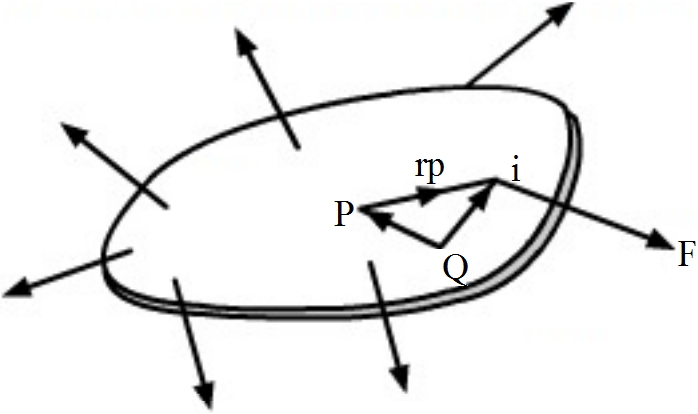
Let us consider a planner lamina of some mass, acted upon by forces $\vec{\text{F}}_1,\ \vec{\text{F}}_2,\ \dots\ \vec{\text{F}}_{\text{i,}}$ etc. Let a force $\vec{\text{F}}_1$ act on a $i^{th}$ particle and torque due to $\vec{\text{F}}_{\text{i}}$ be zeroat a point Q. Since the body is in translation equillibrium, we have: $\sum \vec{\text{F}}_{\text{i}}=0\ \dots(1)$ Again, torque about P is zero. Therefore, we have: $\sum\Big(\vec{\text{r}}_{\text{pi}}\times \vec{\text{F}}_{\text{i}}\Big)=0\ \dots(2)$ Now, torque about point Q will be: $\sum\vec{\text{r}}_{\text{Qi}}\times \vec{\text{F}}_{\text{i}}$
$=\sum\Big( \overrightarrow{\text{r}}_{\text{QP}}+ \overrightarrow{\text{r}}_{\text{pi}}\Big)\times \overrightarrow{\text{F}}_{\text{i}}$ [From fig.] $=\sum\Big( \vec{\text{r}}_{\text{Qp}}\times \vec{\text{F}}_{\text{i}}+ \vec{\text{r}}_{\text{pi}}\times \vec{\text{F}}_{\text{i}}\Big)$
$= \overrightarrow{\text{r}_{\text{Qp}}}\times \overrightarrow{\text{F}}_{\text{i}}+ \overrightarrow{\text{r}_{\text{pi}}}\times \overrightarrow{\text{F}}_{\text{i}}$
$=\sum \overrightarrow{\text{r}_{\text{QP}}}\times\sum \overrightarrow{\text{F}}_{\text{i}}+0$ [From (2)] $ \overrightarrow{\text{r}_{\text{Qp}}}\times0$ [From (1)] $=0$ Thus, $\overrightarrow{\text{F}}$ is zero about any other point Q.
Let us consider a planner lamina of some mass, acted upon by forces $\vec{\text{F}}_1,\ \vec{\text{F}}_2,\ \dots\ \vec{\text{F}}_{\text{i,}}$ etc. Let a force $\vec{\text{F}}_1$ act on a $i^{th}$ particle and torque due to $\vec{\text{F}}_{\text{i}}$ be zeroat a point Q. Since the body is in translation equillibrium, we have: $\sum \vec{\text{F}}_{\text{i}}=0\ \dots(1)$ Again, torque about P is zero. Therefore, we have: $\sum\Big(\vec{\text{r}}_{\text{pi}}\times \vec{\text{F}}_{\text{i}}\Big)=0\ \dots(2)$ Now, torque about point Q will be: $\sum\vec{\text{r}}_{\text{Qi}}\times \vec{\text{F}}_{\text{i}}$
$=\sum\Big( \overrightarrow{\text{r}}_{\text{QP}}+ \overrightarrow{\text{r}}_{\text{pi}}\Big)\times \overrightarrow{\text{F}}_{\text{i}}$ [From fig.] $=\sum\Big( \vec{\text{r}}_{\text{Qp}}\times \vec{\text{F}}_{\text{i}}+ \vec{\text{r}}_{\text{pi}}\times \vec{\text{F}}_{\text{i}}\Big)$
$= \overrightarrow{\text{r}_{\text{Qp}}}\times \overrightarrow{\text{F}}_{\text{i}}+ \overrightarrow{\text{r}_{\text{pi}}}\times \overrightarrow{\text{F}}_{\text{i}}$
$=\sum \overrightarrow{\text{r}_{\text{QP}}}\times\sum \overrightarrow{\text{F}}_{\text{i}}+0$ [From (2)] $ \overrightarrow{\text{r}_{\text{Qp}}}\times0$ [From (1)] $=0$ Thus, $\overrightarrow{\text{F}}$ is zero about any other point Q.

Download our appand get started for free
Experience the future of education. Simply download our apps or reach out to us for more information. Let's shape the future of learning together!No signup needed.*
Similar Questions
- 1From a uniform disk of radius R, a circular hole of radius $\frac{\text{R}}{2}$ is cut out. The centre of the hole is at $\frac{\text{R}}{2}$ from the centre of the original disc. Locate the centre of gravity of the resulting flat body.View Solution
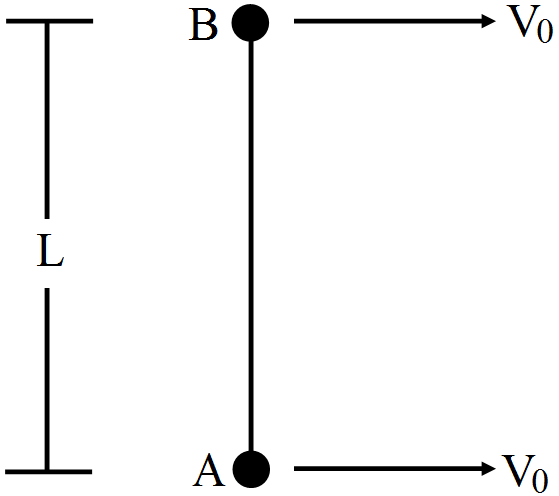
- 2View SolutionTwo small balls A and B, each of mass m, are joined rigidly to the ends of a light rod of lengh L (figure). The system translates on a frictionless horizontal surface with a velocity vo in a direction perpendicular to the rod. A particle P of mass m kept at rest on the surface sticks to the ball A as the ball collides with it. Find:
- The linear speeds of the balls A and B after the collision.
- The velocity of the centre of mass C of the system A + B + P.
- The angular speed of the system about C after the collision.
- 3A comet revolves around the sun in a highly elliptical orbit having a minimum distance of $7 \times 10^{10}m$ and a maximum distance of $1.4 \times 10^{13}m$. If its speed while nearest to the Sun is $60km s^{-1}$, find its linear speed when situated farthest from the Sun.View Solution
- 4A meter stick held vertically, with one end on the ground, is then allowed to fall. What is the value of the radial and tangential acceleration of the top end of the stick when the stick has turned through on angle $\theta?$ What is the speed with which the top end of the stick hits the ground? Assume that the end of the stick in. contact with the ground does not slip.View Solution
- 5Separation of Motion of a system of particles into motion of the centre of mass and motion about the centre of mass: Show $\text{p}=\text{p}'_\text{i}+\text{m}_\text{i}\text{V}$ where $p_i$ is the momentum of the ith particle (of mass $m_i$ ) and $p′_i = m_iv′_i$. Note: $v′_i$ is the velocity of the ith particle relative to the centre of mass. Also, prove using the definition of the centre of mass.View Solution
- 6A uniform square plate S(side c) and a uniform rectangular plate R(sides b, a) have identical areas and masses:View Solution
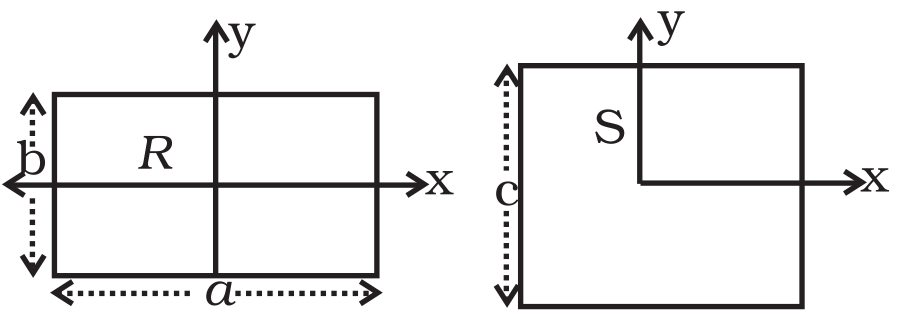
Show that:- $\frac{\text{I}_\text{xR}}{\text{I}_\text{xS}}<1$
- $\frac{\text{I}_\text{ys}}{\text{I}_\text{ys}}>1$
- $\frac{\text{I}_{2\text{R}}}{\text{I}_{2\text{s}}}>1$
- 7Locate the centre of mass of a system of particles of mass $m_1 = 1kg, m_2 = 2kg$ and $m_3 = 3kg$, situated at the corners of an equilateral triangle of side 1.0 metre.View Solution
- 8View SolutionA sphere of a radius 10cm weighs 1kg, calculate the moment of inertia.
- About the diameter.
- About the tangent.
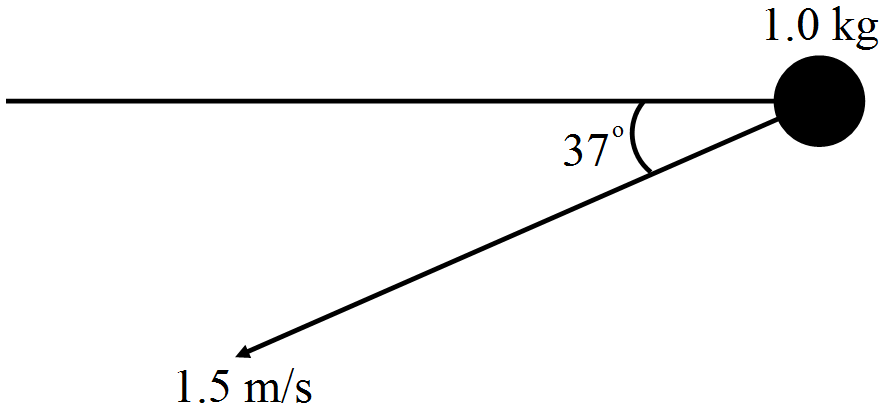
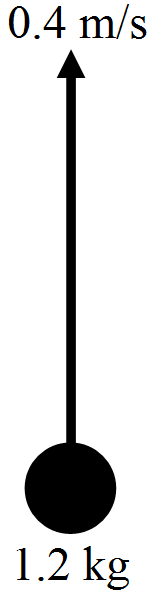
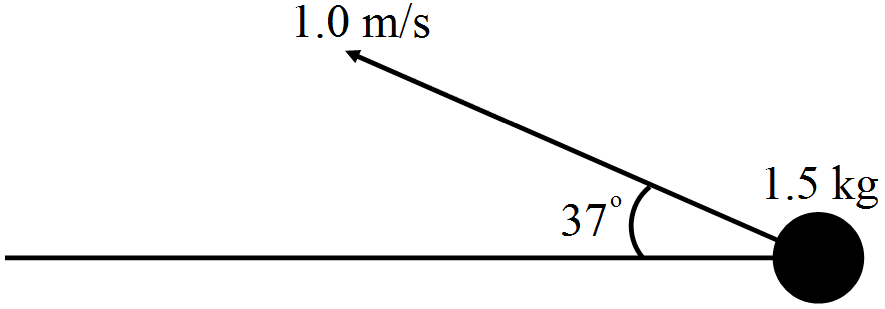
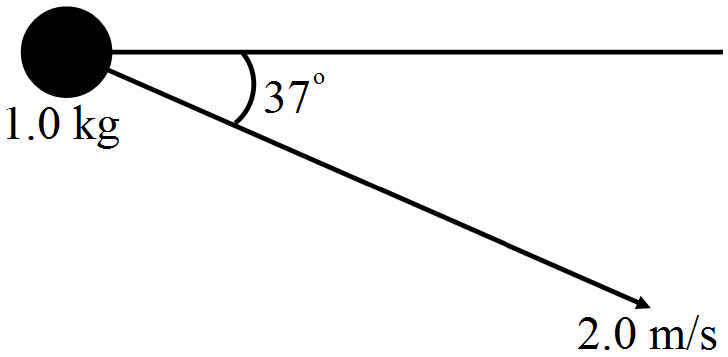
- 9View SolutionCalculate the velocity of the centre of mass of the system of particles shown in figure.

- 10A solid disc and a ring, both of radius $10cm$ are placed on a horizontal table simultaneously, with initial angular speed equal to $10 π$ rad $s^{-1}$. Which of the two will start to roll earlier? The co-efficient of kinetic friction is $\mu_\text{k}=0.2$View Solution