Question
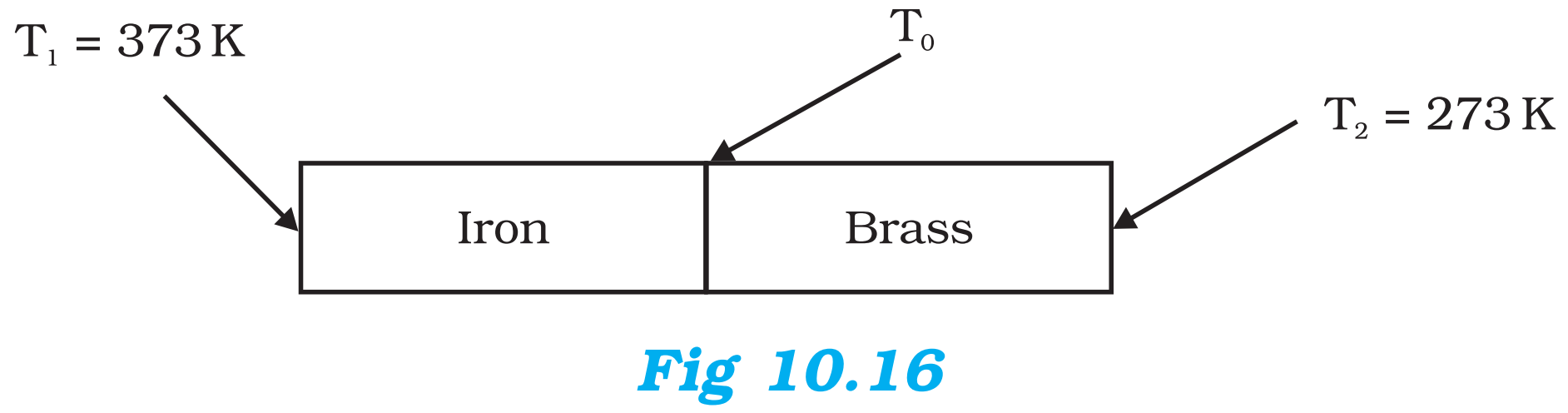
An iron bar $\left(L_1=0.1 m , A_1=\right. \left.0.02 m ^2, K_1=79 W m ^{-1} K ^{-1}\right)$ and a brass bar $\left(L_2=0.1 m , A_2=0.02 m ^2\right.$, $K_2=109 W m ^{-1} K ^{-1}$ ) are soldered end to end as shown in Fig. $10.16.$ The free ends of the iron bar and brass bar are maintained at $373 K$ and $273 K$ respectively. Obtain expressions for and hence compute $(i)$ the temperature of the junction of the two bars, $(ii)$ the equivalent thermal conductivity of the compound bar, and $(iii)$ the heat current through the compound bar.
Image

Answer

Given, $L_1=L_2=L=0.1 m , A_1=A_2=A=0.02 m ^2$
$K_1=79 W m ^{-1} K ^{-1}, K_2=109 W m ^{-1} K ^{-1}$, $T_1=373 K$, and $T_2=273 K$.
Under steady state condition, the heat current $\left(H_1\right)$ through iron bar is equal to the heat current $\left( H _2\right)$ through brass bar.
$\text { So, }H =H_1=H_2$
$ =\frac{K_1 A_1\left(T_1-T_0\right)}{L_1}=\frac{K_2 A_2\left(T_0-T_2\right)}{L_2}$
For $A_1=A_2=A$ and $L_1=L_2=L$, this equation leads to
$K_1\left(T_1-T_0\right)=K_2\left(T_0-T_2\right)$
Thus, the junction temperature $T_0$ of the two bars is
$T_0=\frac{\left(K_1 T_1+K_2 T_2\right)}{\left(K_1+K_2\right)}$
Using this equation, the heat current $H$ through either bar is
$H =\frac{K_1 A\left(T_1-T_0\right)}{L}=\frac{K_2 A\left(T_0-T_2\right)}{L}$
$ =\left(\frac{K_1 K_2}{K_1+K_2}\right) \frac{A\left(T_1-T_0\right)}{L}=\frac{A\left(T_1-T_2\right)}{L\left(\frac{1}{K_1}+\frac{1}{K_2}\right)}$
Using these equations, the heat current $H^{\prime}$ through the compound bar of length $L_1+L_2=2 L$ and the equivalent thermal conductivity $K$, of the compound bar are given by
$H^{\prime} =\frac{K^{\prime} A\left(T_1-T_2\right)}{2 L}=H$
$K^{\prime} =\frac{2 K_1 K_2}{K_1+K_2}$
$(i) T_0=\frac{\left(K_1 T_1+K_2 T_2\right)}{\left(K_1+K_2\right)}$
$=\frac{\left(79 W m ^{-1} K ^{-1}\right)(373 K )+\left(109 W m ^{-1} K ^{-1}\right)(273 K )}{79 W m ^{-1} K ^{-1}+109 W m ^{-1} K ^{-1}}$
$=315 K$
$(ii)\ K^{\prime} =\frac{2 K_1 K_2}{K_1+K_2}$
$ =\frac{2 \times\left(79 W m ^{-1} K ^{-1}\right) \times\left(109 W m ^{-1} K ^{-1}\right)}{79 W m ^{-1} K ^{-1}+109 W m ^{-1} K ^{-1}}$
$ =91.6 W m ^{-1} K ^{-1}$
$(iii)\ H^{\prime}=H=\frac{K^{\prime} A\left(T_1-T_2\right)}{2 L}$
$=\frac{\left(91.6 W m ^{-1} K ^{-1}\right) \times\left(0.02 m ^2\right) \times(373 K -273 K )}{2 \times(0.1 m )}$
$=916.1 W$

Need a full question paper?

Generate a complete, print-ready paper with questions like this in minutes — across 16+ boards, with answer keys.

Start Generating Free

Similar questions

The length of a second’s pendulum on the surface of Earth is 1m. What will be the length of a second’s pendulum on the moon?
The linear momentum of a body is increased by 10%. What is the percentage change in kinetic energy?
A uniform square plate S(side c) and a uniform rectangular plate R(sides b, a) have identical areas and masses:
Show that:
  1. $\frac{\text{I}_\text{xR}}{\text{I}_\text{xS}}<1$
  2. $\frac{\text{I}_\text{ys}}{\text{I}_\text{ys}}>1$
  3. $\frac{\text{I}_{2\text{R}}}{\text{I}_{2\text{s}}}>1$
Prove that the root mean square velocity of a molecule is absolute, is directly proportional to the square root of temperature and the mean kinetic energy is directly proportional to absolute temperature.
A small block of superdense material has a mass of $3 \times 10^{24}kg$. It is situated at a height h (much smaller than the earth's radius) from where it falls on the earth's surface. Find its speed when its height from the earth's surface has reduced to $\frac{\text{h}}{2}.$ The mass of the earth is $6 \times 10^{24}kg$.
Two identical ball bearings in contact with each other and resting on a frictionless table are hit head-on by another ball bearing of the same mass moving initially with a speed V. If the collision is elastic, which of the following is a possible result after collision?
A block of mass M is moving with a velocity $v_1$ on a frictionless surface as shown in fig. It passes over to a cylinder of radius R and moment of inertia I which has fixed axis and is initially at rest. When it first makes contact with the cylinder, it slips on the cylinder, but the friction is large enough so that slipping ceases before it losses contact with the cylinder. Finally it goes to the dotted position with velocity $v_2$ compute $v_2$ in terms of $v_1, M, I$ and $R$.
A grindstone has a moment of inertia of $6kg m^2$. A constant torque is applied and the grindstone is found to have a speed of $150rpm, 10s$. after starting from rest. Calculate the torque.
A car starting from rest, accelerates uniformly with $5m/s^2$ for sometime and then decelerates to come to rest with $3m/s^2$. Find the maximum velocity attained during the motion and the distance covered in a total time of 6 seconds of the journey.
Solve the previous problem if the coefficient of restitution is e. Use $\theta=45^\circ,\ \text{e}=\frac{3}{4}$ and h = 5m