Question
Establish a relationship between angular momentum (L), moment of inertia (I) and angular velocity $(\omega)$.
Answer

self

Need a full question paper?

Generate a complete, print-ready paper with questions like this in minutes — across 16+ boards, with answer keys.

Start Generating Free

Similar questions

Two glass bulbs of equal volume are connected by a narrow tube and are filled with a gas at 0°C at a pressure of 76cm of mercury. One of the bulbs is then placed in melting ice and the other is placed in a water bath maintained at 62°C. What is the new value of the pressure inside the bulbs? The volume of the connecting tube is negligible.
A cricketer can throw a ball to a maximum horizontal distance of 100m. How much high above the ground can the cricketer throw the same ball.
The internal energy of a gas is given by U = 1.5PV. It expands from 100cm3 to 200cm3 against a constant pressure of 1.0 x 10⁵Pa. Calculate the heat absorbed by the gas in the process.
We would like to make a vessel whose volume does not change with temperature (take a hint from the problem above). We can use brass and iron $\big(\beta_\text{ubrass}=6\times10^{-5}/\text{K and }\beta_\text{uiron}=3.55\times10^{-5}\text{K}\big)$ to create a volume of 100cc. How do you think you can achieve this.
Find the velocity of source of sound, when the frequency appears to be:
  1. Double.
  2. Half, the original frequency to a stationary listener.
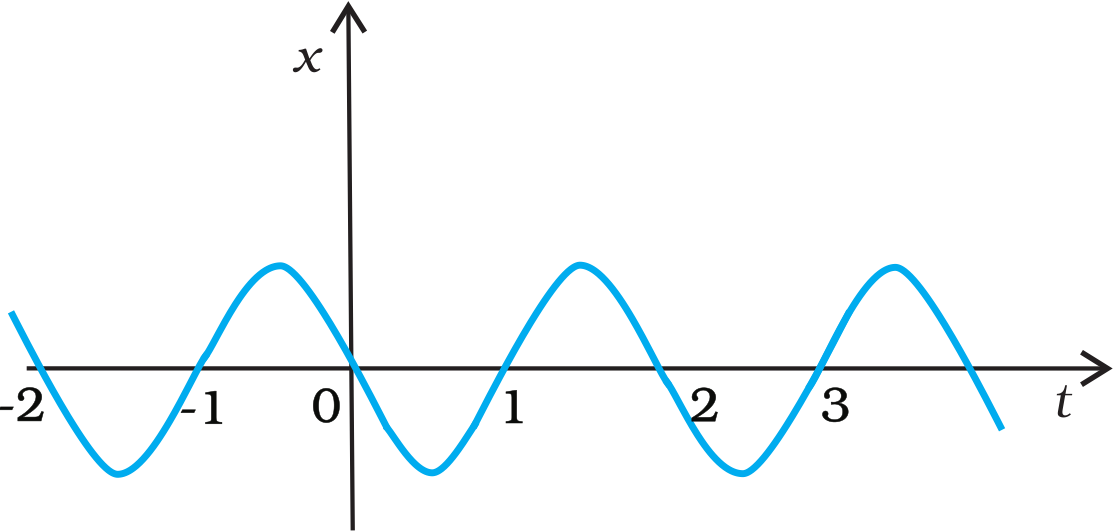
Gives the x-t plot of a particle executing one-dimensional simple harmonic motion. (You will learn about this motion in more detail in Chapter 14). Give the signs of position, velocity and acceleration variables of the particle at t = 0.3 s, 1.2 s, – 1.2 s.

For the motion of a body due to external force, prove that its entire mass can be considered concentrated at the center of mass.
The edge of an aluminium cube is 10 cm long. One face of the cube is firmly fixed to a vertical wall. A mass of 100 kg is then attached to the opposite face of the cube. The shear modulus of aluminium is 25 GPa. What is the vertical deflection of this face?
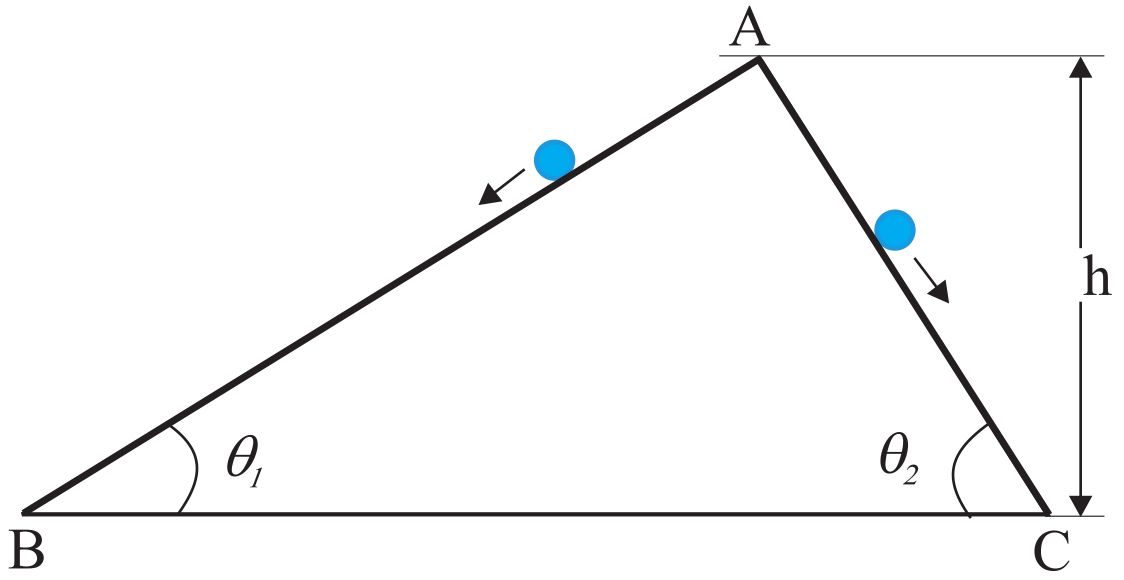
Two inclined frictionless tracks, one gradual and the other steep meet at A from where two stones are allowed to slide down from rest, one on each track. Will the stones reach the bottom at the same time? Will they reach there with the same speed? Explain. Given $\theta_1= 300,\theta_2= 600 ,$ and h = 10m, what are the speeds and times taken by the two stones?

 
A body performs simple harmonic motion according to the following equation :
$
x=6 \sin \left(3 \pi t+\frac{\pi}{3}\right)
$
Find out : (i) amplitude (ii) period (iii) initial art (iv) displacement, velocity and acceleration at time $t = 2$.