Question
Establish the following vector inequalities geometrically or otherwise: $|\text{a}-\text{b}|\ge||\text{a}|-|\text{b}||$When does the equality sign above apply?
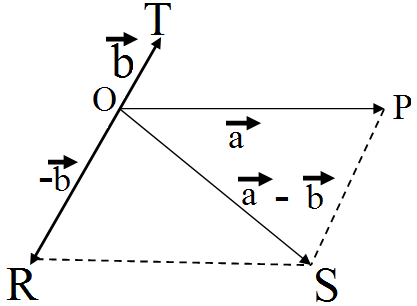 The following relations can be written for the given parallelogram. (OS + PS) > OP .....(i) OS < (OP - PS) .....(ii) $|\vec{\text{a}}-\vec{\text{b}}|>|\vec{\text{a}}|-|\vec{\text{b}}|\ ...(\text{iii})$ The quantity on the LHS is always positive and that on the RHS can be positive or negative. To make both quantities positive, we take modulus on both sides as: $||\vec{\text{a}}-\vec{\text{b}}||>||\vec{\text{a}}|-|\vec{\text{b}}||$ $|\vec{\text{a}}-\vec{\text{b}}|>||\vec{\text{a}}|-|\vec{\text{b}}||\ ...(\text{iv})$ If the two vectors act in a straight line but in opposite directions, then we can write: $|\vec{\text{a}}-\vec{\text{b}}|=||\vec{\text{a}}|-|\vec{\text{b}}||\ ...(\text{v})$ Combining equations (iv) and (v), we get: $|\vec{\text{a}}-\vec{\text{b}}|\ge||\vec{\text{a}}|-|\vec{\text{b}}||$
Generate a complete, print-ready paper with questions like this in minutes — across 16+ boards, with answer keys.
|
|
Lowest Point
|
Highest Point
|
|
(a)
|
$mg - T_1$
|
$mg + T_2$
|
|
(b)
|
$mg + T_1$
|
$mg - T_2$
|
|
(c)
|
$mg + T_1 - (mv_1^2)/R$
|
$mg - T_2 + (mv_1^2)/R$
|
|
(d)
|
$mg - T_1 - (mv_1^2)/R$
|
$mg + T_2 + (mv_1^2)/R$
|