Question
What is viscosity? What are the factors affecting viscous force in a liquid flowing in a tube? Derive the relation for the velocity upto which the liquid can have streamlined flow.

Answer

Viscosity: The opposing force that exists between the layers of a liquid and the inner walls of the tube in which it flows is called viscous drag or viscous force and the property is called viscosity. The viscous force directly depends on the area of the layer and the velocity gradient.$\text{F}=-\eta\text{A}\frac{\text{dv}}{\text{dx}}$
-ve sign shows the opposing nature n refers to coefficient of viscosity. Factors affecting viscosity:
  1. Increase in temperature decreases viscosity.
  2. Increase in pressure increases viscosity in liquids. In water, it decreases while in gases it remains same.
Expression for velocity of streamlined flow: The net force on the sphere becomes zero as the viscous force equals the apparent weight (weight in air-upthrust). Consider a lengthy column of a dense liquid like glycerine. As the ball or spherical ball is dropped in it, the forces experienced are,
  1. Weight $=\text{mg}=\frac{4}{3}\pi\text{r}^3\rho\text{g}$
where $\rho-$ density of ball
  1. Upthrust, $\text{U}=\frac43\pi\text{r}^3\rho_\text{l}\text{g}$
Where $\rho_\text{l}-$ densicy of liquid
  1. Viscous force, $\text{F}_\text{v}=6\pi\eta\text{ rv}$
Where v - terminal velocity
When terminal velocity is attained, acceleration should be zero and the ner force should be zero.$\therefore\text{mg}-\text{U}-\text{F}_\text{v}=0$
$\Rightarrow\frac43\pi\text{r}^3\rho\text{g}-\frac43\pi\text{r}^3\rho_\text{l}\text{g}-6\pi\eta\text{ rv}=0$
$\therefore\text{v}=\frac{\frac43\pi\text{r}^3\text{g}(\rho-\rho_\text{l})}{6\pi\eta\text{r}}=\frac29\frac{\text{r}^2\text{g}(\rho-\rho_\text{l})}{\eta}$

Need a full question paper?

Generate a complete, print-ready paper with questions like this in minutes — across 16+ boards, with answer keys.
Start Generating Free

Similar questions

Three equal masses of $m kg$ each are fixed at the vertices of an equilateral triangle $ABC$.
$(a)$ What is the force acting on a mass $2 m$ placed at the centroid $G$ of the triangle?
$(b)$ What is the force if the mass at the vertex $A$ is doubled?
Take $AG = BG = CG =1 m ($see $Fig. 7.5)$
A venturimeter is connected to two points in the mains where its radii are 20cm and 10cm, respectively, and the levels of water column in the tubes differ by 10cm. How much water flows through the pipe per minute?
The molecules of a given mass of a gas have root mean square speeds of 1 $100ms− at 27C ^\circ$ and $1.00$ atmospheric pressure. What will be the root mean square speeds of the molecules of the gas at $127^\circ C$ and $2.0$ atmospheric pressure?
Consider the situation of the previous problem. A charges of $-2.0 \times 10^{-4}C$ is moved from the point A to the point B. Find the change in electrical potential energy $U_B - U_A$ for the cases (a), (b) and (c).
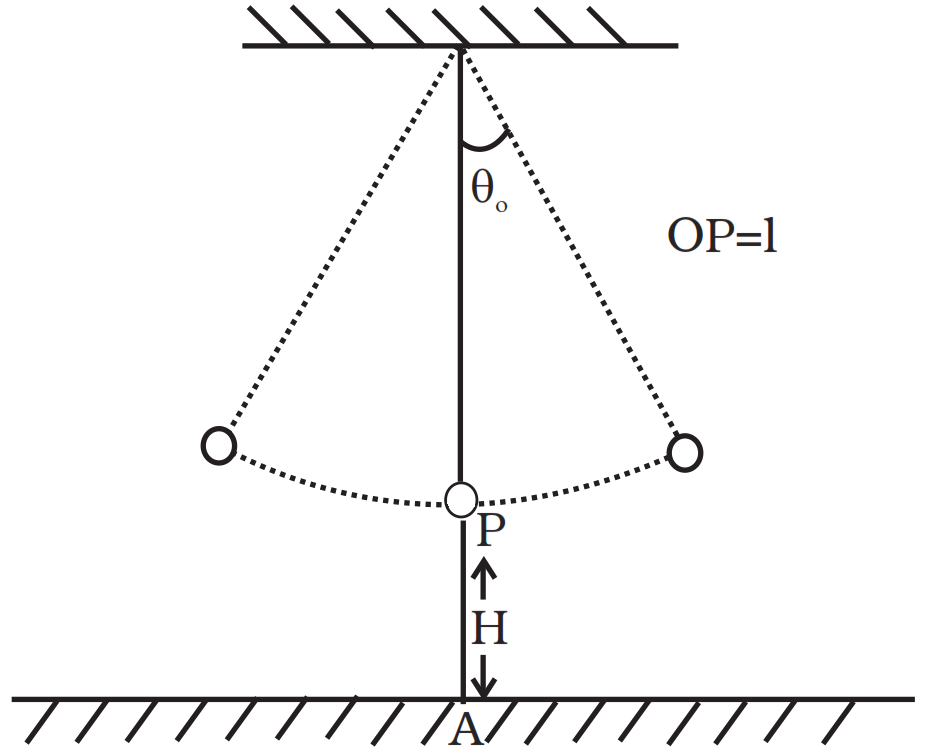
A simple pendulum of time period $1s$ and length l is hung from a fixed support at O, such that the bob is at adistance H vertically above A on the ground The amplitude is $\theta$ The string snaps at $\theta=\frac{\theta_0}{2}$ Find the time taken by the bob to hit the ground. Also find distance from A where bob hits the ground. Assume θ to be small so that $\sin\theta_0\ \text{and}\ \cos\theta_0=1.$
A truck starts from rest and accelerates uniformly at $2.0ms^{-2}$. At $t = 10s$, a stone is dropped by a person standing on the top of the truck ($6m$ high from the ground). What are the (a) velocity, and (b) acceleration of the stone at $t = 11s$? (Neglect air resistance.)
Particles of masses $1g, 2g, 3g, ........, 100g$ are kept at the marks $1cm, 2cm, 3cm, ........, 100cm$ respectively on a metre scale. Find the moment of inertia of the system of particles about a perpendicular bisector of the metre scale.
Suppose the space between the two inner shells of the previous problem is filled with a dielectric of dielectric coastant K. Find the capacitance of the system between A and B.
Define simple harmonic motion. Derive the differential equation of its motion and find the solution.
You may have seen in a circus a motorcyclist driving in vertical loops inside a ‘deathwell’ (a hollow spherical chamber with holes, so the spectators can watch from outside). Explain clearly why the motorcyclist does not drop down when he is at the uppermost point, with no support from below. What is the minimum speed required at the uppermost position to perform a vertical loop if the radius of the chamber is 25m?