Question
Establish the kinematic equation $\text{s}=\text{ut}+\frac{1}{2}\text{at}^2$ from velocity-time graph for a uniformly accelerated motion.

Answer

Let AB be a velocity-time graph for uniformly accelerated motion with initial velocity u at time t = 0 and acceleration of the particle under motion being given by $\text{a}=\tan\theta =\frac{\text{BD}}{\text{AD}}$ We know that area under the v-t graph gives the value of displacement during that time. $\therefore$ Displacement of particle in time t will be s = area under v-t graph = area OABC = Area of rectangle OADC + area of triangle ADB $=\text{OA}\times\text{OC}+\frac{1}{2}\text{AD}\times\text{DB}\\=\text{u}\times\text{t}+\frac{1}{2}(\text{AD})\times\Big(\frac{\text{AD}\times\text{DB}}{\text{AD}}\Big)$ $=\text{ut}+\frac{1}{2}(\text{AD})^2\times\Big(\frac{\text{DB}}{\text{AD}}\Big)\text{s}=\text{ut}+\frac{1}{2}\text{t}^2\text{a}$ $\therefore \text{s}=\text{ut}+\frac{1}{2}\text{at}^2$

Need a full question paper?

Generate a complete, print-ready paper with questions like this in minutes — across 16+ boards, with answer keys.
Start Generating Free

Similar questions

A force of $10^6 \mathrm{Nm}^{-2}$ is required for breaking a material. If the density of the material is $3 \times 10^3 \mathrm{~kg} / \mathrm{m}^{-3}$, then what should be the length of the wire made of material so that it breaks by its own weight?
A block of mass $100g$ is moved with a speed of $5.0m/s$ at the highest point in a closed circular tube of radius $10cm$ kept in a vertical plane. The cross-section of the tube is such that the block just fits in it. The block makes several oscillations inside the tube and finally stops at the lowest point. Find the work done by the tube on the block during the process.
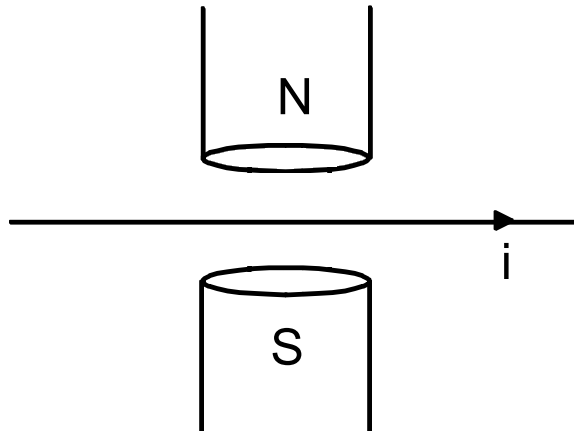
A magnetic field of strength 1.0T is produced by a strong electromagnet in a cylindrical region of radius 4.0cm, as shown in the figure. A wire, carrying a current of 2.0A, is placed perpendicular to and intersecting the axis of the cylindrical region. Find the magnitude of the force acting on the wire.
The displacement of a progressive wave is represented by $\text{y} = \text{A} \sin(\omega \text{t} – \text{k x} ),$ where $x$ is distance and $t$ is time. Write the dimensional formula of $(i) \omega$ and $(ii) k$.
Two principal thrusts in physics are unification and reduction. Justify by giving illustrations.
An electric field of $20NC^{-1}$ exists along the $x-$axis in space. Calculate the potential difference $V_B - V_A$ where the points $A$ and $B$ are given by,
  1. $A = (0, 0); B = (4m, 2m)$
  2. $A = (4m, 2m); B = (6m, 5m)$
  3. $A = (0, 0); B = (6m, 5m)$
Do you find any relation between the answers of parts $(a), (b)$ and $(c)\ ?$
An average emf of 20V is induced in an inductor when the current in it is changed from 2.5A in one direction to the same value in the opposite direction in 0.1s. Find the self-inductance of the inductor.
What is meant by the term 'Molar specific heat of a gas? The molar specific heat of hydrogen in the temperature range of about 250K to 750K is about $\Big(\frac52\Big)\text{R}.$ At lower temperatures, the value of molar specific heat of hydrogen decreases to the value typical of monoatomic gases $\Big(\frac32\Big)\text{R}$ while at higher temperatures, it tends to the value $\Big(\frac72\Big)\text{R.}$ Explain.
State and prove the perpendicular axis theorem.
What is an elastic collision? What will happen, when
  1. A heavy body collides with a light mass at rest.
  2. A light body collides with a heavy mass at rest.