Question
Establish the relation between electric field and potential gradient.

Answer

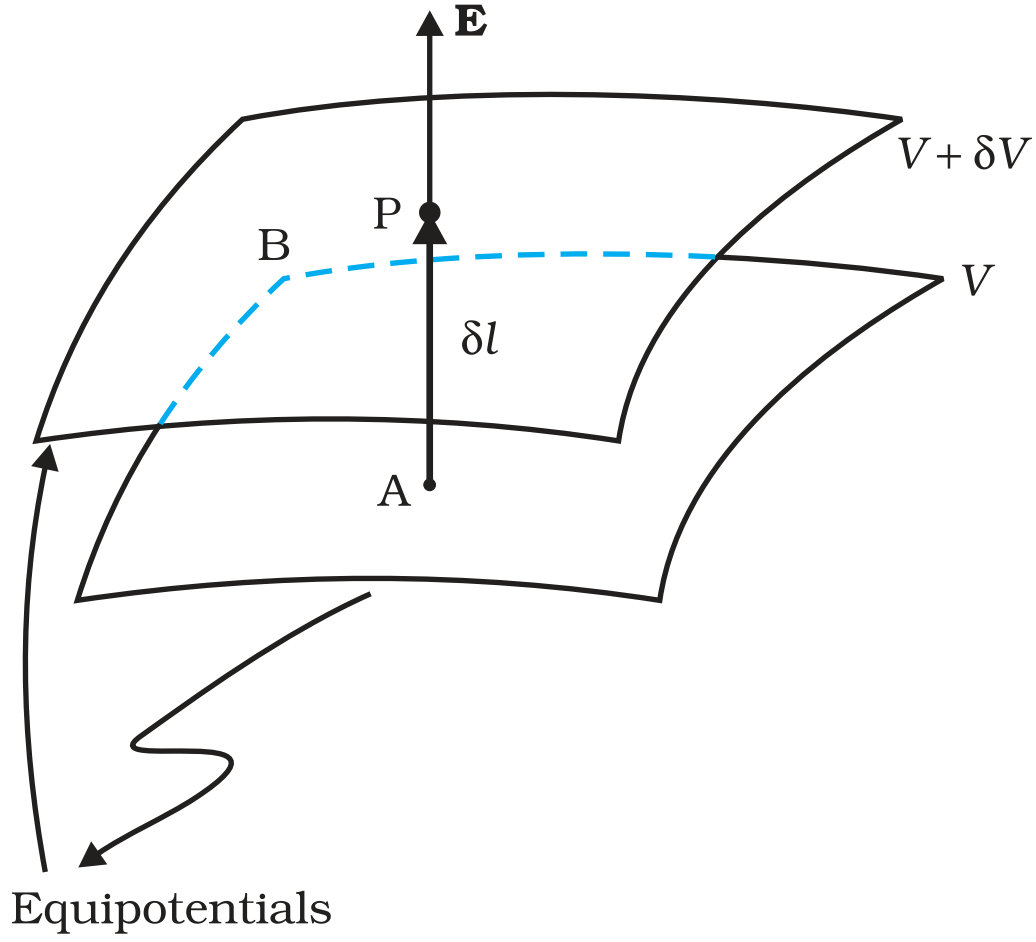
Let us consider two closely spaced equipotential surfaces A and B as shown in figure.

Let the potential of A be $V_A = V $ and potential of B be $V_B = V - dV$
where dV is decrease in potential in the direction of electric field $\vec{\text{E}}$ normal to A and B.
Let dr be the perpendicular distance between the two equipotential surfaces.
When a unit positive charge is moved along this perpendicular from the surface B to surface A against the electric field,
the work done in this process is: $\text{W}_{\text{BA}}=-\vec{\text{E}}(\text{dr})$
This work done equals the potentail difference $V_A - V_B,$
$\therefore\text{W}_{\text{BA}}=\text{V}_{\text{A}}-\text{V}_{\text{B}}=\text{V}-(\text{V}-\text{dV})=\text{dV}$
$\therefore-\vec{\text{E}}=\text{dV}$ Or, $\vec{\text{E}}=-\frac{\text{dV}}{\text{dr}}$
= negative of potential gradlant.

Need a full question paper?

Generate a complete, print-ready paper with questions like this in minutes — across 16+ boards, with answer keys.
Start Generating Free

Similar questions

Draw a phasor diagram for series LCR circuit joined with ac voltage source and obtain an expression for impedance of the circuit.
A boy riding on his bike is going towards east at a speed. of $4\sqrt{2}\text{m/s}$ At a certain point he produces a sound pulse of frequency 1650Hz that travels in air at a speed of 334m/s. A second boy stands on the ground 45° south of east from him. Find the frequency of the pulse as received by the second boy.
Two cells of emf 1V, 2V and internal resistances $2\Omega$ and $1\Omega$ respectively are connected in (i) series. (ii) Parallel. What should be the external resistance in the circuit so that the current through the resistance be the same in the two cases? In which case is more heat generated in the cells?
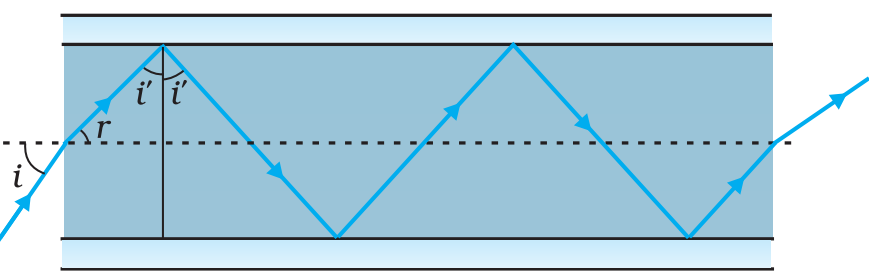
  1. a cross - section of a ‘light pipe’ made of a glass fibre of refractive. The outer covering of the pipe is made of a material of refractive. What is the range of the angles of the incident rays with the axis of the pipe for which total reflections inside the pipe take place, as shown in the figure.
  2. What is the answer if there is no outer covering of the pipe?
State Soddy-Fajan’s displacement laws for radioactive transformations.
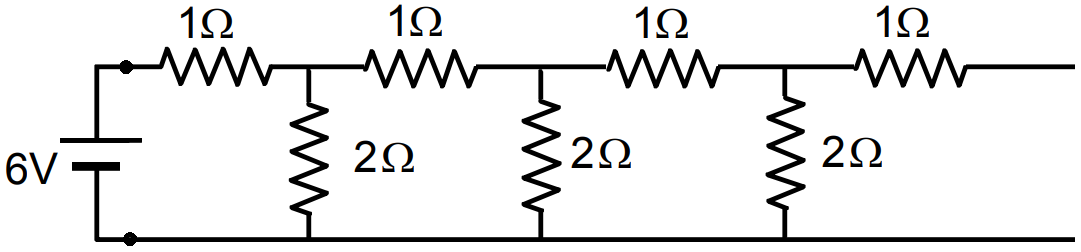
An infinite ladder is constructed with $1\Omega$ and $2\Omega$ resistors, as shown in the figure. (a) Find the effective resistance between the points A and B. (b) Find the current that passes through the $2\Omega$ resistor nearest to the battery.
  1. An electron moves along a circle of radius 1m in a perpendicular magnetic field of strength 0.50T. What would be its speed? Is it reasonable?
  2. If a proton moves along a circle of the same radius in the same magnetic field, what would be its speed?
Two coils A and B have inductances 1.0H and 2.0H respectively. The resistance of each coil is $10\Omega.$ Each coil is connected to an ideal battery of emf 2.0V at t = 0 Let $i_A$  and $i_B$ be the currents in the two circuit at time t. Find the ratio $\frac{\text{i}_\text{A}}{\text{i}_\text{B}}$
  1. t = 100ms
  2. t = 200ms
  3. t = 1s.
Find the wavelength of the radiation emitted by hydrogen in the transitions (a) n = 3 to n= 2, (b) n = 5 to n = 4 and (c) n = 10 to n = 9.
When a circuit element ‘X’ is connected across an a.c. source, a current of $\sqrt{2}\text{A}$ flows through it and this current is in phase with the applied voltage. When another element ‘Y’ is connected across the same a.c. source, the same current flows in the circuit but it leads the voltage by $\frac{\pi}{2}$ radians.
  1. Name the circuit element X and Y.
  2. Find the current that flows in the circuit when the series combination of X and Y is connected across the same a.c. voltage.
  3. Net impedance.