Question
Explain: Acquired Immunity.
Answer

Acquired immunity, on the other hand, is pathogen specific. It is characterised by memory.
This means that our body, when encounters a pathogen for the first time, produces a response called primary response which is of low intensity.
Subsequent encounter with the same pathogen elicits a highly intensified secondary or anamnestic response.
The primary and secondary immune responses are carried out with the help of two special types of lymphocytes present in our blood, i.e., B-lymphocytes and T- lymphocytes.
Image
There are two type of acquired immune response.
→(i) Antibody Mediated Immune response or / Humoral Immune response."
The B-lymphocytes produce an army of proteins in response to pathogens into our blood to fight with them. These proteins are called antibodies.
The T-cells themselves do not secrete antibodies but help B cells produce them.
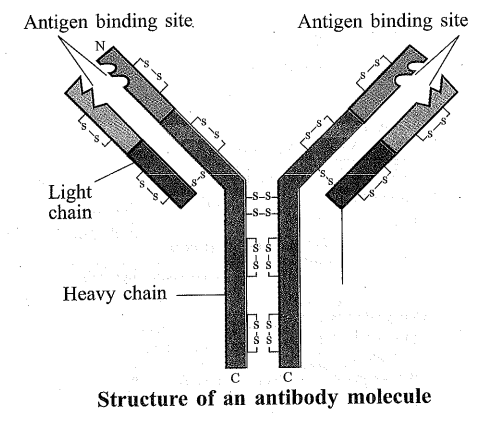
Each antibody molecule has four peptide chains, two small called light chains and two longer, called heavy chains."
Hence, an antibody is represented as H2L2. Different 22 types of antibodies are produced in our body
IgA, IgM, IgE, IgG are some of them. A structure of an antibody is given in Figure 7.4. Because these antibodies are found in the blood, the response is also called humoral immune response.
(ii) Cell Mediated Immune response
The second type is called cell-mediated immune response or cell- mediated immunity (CMI). The T-lymphocytes mediate CМІ.

Need a full question paper?

Generate a complete, print-ready paper with questions like this in minutes — across 16+ boards, with answer keys.
Start Generating Free

Similar questions

Read the following and answer any four questions from (i) to (v) given below:

Embryo develops at the micropylar end of the embryo sac, where the zygote is situated. Most zygotes divided only after certain amount of endosperm is formed. The early stages of embryo development are similar in both monocotyledons and dicotyledons. The zygote gives rise to the proembryo and subsequently to the globular heart-shaped and mature embryo. A typical dicotyledonous embryo consists of an embryonal axis and two cotyledons. Embryo of monocotyledons possess only one cotyledon.

  1. True embryo develops as a result of fusion of:
  1. Two polar nuclei of embryo sac.
  2. An egg cell and a male gamete.
  3. Synergid and male gamete.
  4. A male gamete and antipodals.
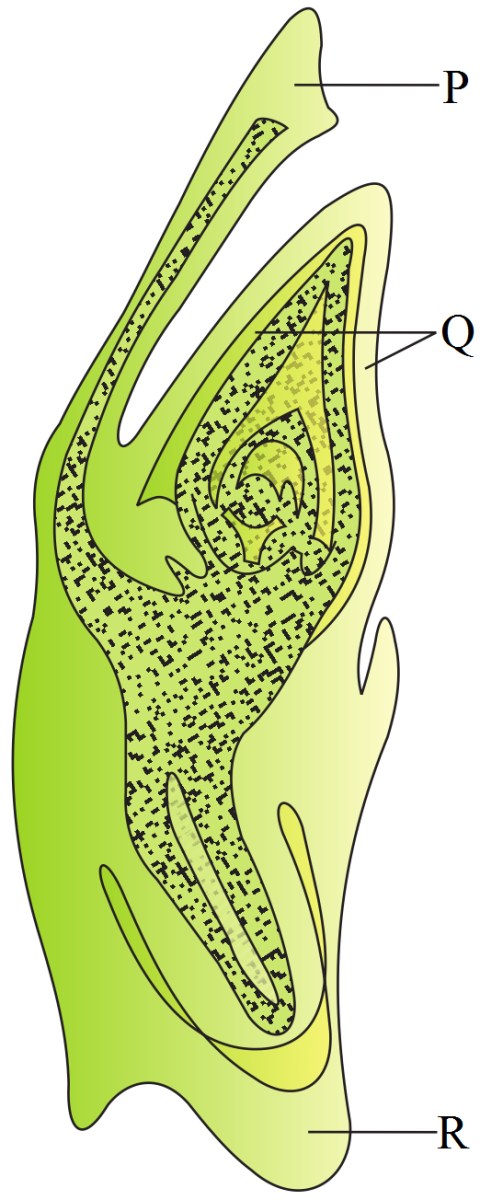
  1. Refer to the given diagram of the embryo of an angiospermous plant with parts labelled P, Q and R. Select the correct statement(s) regarding this.

  1. Part 'P' supplies nutrition to the developing embryo.
  2. Part 'Q' is the protective sheath of radicle and root cap.
  3. Part 'R' is the protective sheath of shoot apex and leaf primordia.
  4. The embryo shown in the diagram is present in members of Family Poaceae.
  1. (IV) only.
  2. (II) and (III) only.
  3. (I) and (IV) only.
  4. (I), (II), (III) and (IV).
  1. Which of the given statements are true?
  1. During the development of a dicot embryo, heart-shaped embryo is followed by globular embryo.
  2. The part of embryonal axis above the level of cotyledons is epicotyl, while the part below the level of cotyledons is hypocotyl.
  3. Monocot seeds possess a single cotyledon, represented by scutellum.
  1. (I) and (II).
  2. (II) and (III).
  3. (I) and (III).
  4. (I), (II) and (III).
  1. Consider the following parts of an embryonal axis of a dicot seed.
  1. Hypocotyl.
  2. Epicotyl.
  3. Radicle.
  4. Plumule.

In which of the following the above parts are correctly arranged from top to base?

  1. (III) → (I) → (II) → (IV).
  2. (II) → (I) → (III) → (IV).
  3. (IV) → (II) → (I) → (III).
  4. (III) → (IV) → (II) → (I).
  1. In grass family, the cotyledon, is called:
  1. Epiblast.
  2. Plumule.
  3. Scutellum.
  4. Perisperm.
What is chromosomal disorder? Explain any two aneuploidy with characters in humans.###Mention any two autosomal genetic disorders with their symptoms.
Differentiate between Monohybrid & Dihybrid Cross.
Read the following and answer any four questions from (i) to (v) given below:

DNA replication is a complex multistep process that requires enzymes, protein factors and metal ions. DNA replication in eukaryotes occurs in the nucleus during the S-phase of the cell cycle. It is semidiscontinuous in eukaryotes. in prokaryotes, replication takes place in the cytoplasm. DNA replication in bacteria occurs prior to fission. Nucleoid or viral chromosome is a single molecule of nucleic acid, it may be linear of circular. Nucleic acid in a virus is either DNA or RNA but never both.

  1. In viral DNA, how many origin of replication are present?
  1. Single
  2. Twice
  3. Multiple
  4. None
  1. Select the main enzyme involved in DNA replication.
  1. DNA ligase
  2. DNA dependent DNA polymerase
  3. Topoisomerase
  4. Helicase
  1. Read the given statement and select the option that correctly fill in the blanks. Enzyme (i) acts over the Ori site and unwinds the two strands of DNA by destroying (ii) bonds.
  1. (i)-Helicase (ii) Glycosidic
  2. (i)-Helicase (ii)-Hydrogen
  3. (i)-Unwindase (ii)-Phosphodiester
  4. (i)-Unwindase (ii)-Glycosidic
  1. DNA strand, built up of Okazaki fragments, is called.
  1. Lagging strand.
  2. Leading strand.
  3. Complementary strand.
  4. Parental strand.
  1. Select the incorrect statement about DNA polymerase in eukaryotes.
  1. Polymerase $\alpha$ is required for initiation of replication.
  2. When the RNA primer gets removed the gap is filled by DNA polymerase $\beta$ in eukaryotes.
  3. Polymerase $\in$ helps in elongation of lagging strand.
  4. Polymerase $\delta$ is largest and main enzyme for DNA replication in eukaryotes.
What is transgenic animals? How it is useful for man kind?
Describe the process of DNA Fingerprinting in detail.
Read the following and answer any four questions from (i) to (v) given below:

Kangaroo rat seldom drinks water. It has thick coat to minimise evaporative desiccation. TI1e animal seldom comes out of its comparatively humid and cool burrow during the day time. 90% of its water requirement is met from metabolic water (water produced by respiratory breakdown of fats) while 10% is obtained from its food. Loss of water is minimised by producing nearly solid urine and faeces. As the animal faces acute water scarcity, it develops two types of adaptations : reducing water loss and ability to tolerate desert conditions.

  1. Kangaroo rat is a:
  1. Partial regulators
  2. Partial conformer
  3. Regulator
  4. Conformer
  1. Metabolic water refers to:
  1. Water required for metabolic activities.
  2. Water present in intercellular fluid.
  3. Water produced during oxidation of fat or carbohydrate.
  4. Water taken in, to promote metabolism.
  1. Desert animals minimise water loss by:
  1. Producing highly concentrated urine.
  2. Promoting maximum reabsorption of water in kidney tubules.
  3. Possessing one of the longest loop of Henle in kidney tubules.
  4. All of these.
  1. Assertion: Kangaroo rat can tolerate and thrive in wide temperature range and is known as stenothermal.

Reason: Kangaroo rats go into hibernation during winter to escape cold weather.

  1. Both assertion and reason are true and reason is the correct explanation of assertion.
  2. Both assertion and reason are true but reason is not the correct explanation of assertion.
  3. Assertion is true but reason is false.
  4. Both assertion and reason are false.
  1. The adaptations in an organism are meant for:
  1. Optimum primary production.
  2. Optimum life span.
  3. Optimum mobility.
  4. Optimum survival and reproduction.
Explain the methods for making host cell competent to insert the r DNA.
Suggest some methods to assist infertile couples to have children.
Read the following and answer any four questions from (i) to (v) given below:
IUCN maintains a Red Data Book or Red List which is a catalogue of taxa facing risk of extinction. The IUCN Red List (2004) documents the extinction of 784 species in the last 500 years. Some examples of recent extinctions include the dodo, quagga, thylacine and Steller's sea cow. The last twenty years alone have witnessed the disappearance of 27 species. Red List has eight categories of species.
  1. Dodo, an extinct taxon, belongs to which country?
  1. Mauritius
  2. Africa
  3. Australia
  4. Russia
  1. To which of the following categories of IUCN, Berberis nilghiriensis belongs?
  1. Extinct.
  2. Extinct in wild.
  3. Endangered.
  4. Critically endangered.
  1. Steller's sea cow and passenger pigeon became extinct due to:
  1. Alien species invasion.
  2. Over-exploitation.
  3. Coextinctions.
  4. Intensive agriculture.
  1. Bali, Javan and Caspian are:
  1. Species of tiger.
  2. Species of cheetah.
  3. Subspecies of cheetah.
  4. Subspecies of tiger.
  1. Select the correct term for the following definitions (i, ii, iii, iv).
  • The taxon is liable to become extinct if not allowed to realise its full biotic potential by providing protection from exotic species/ human exploitation/habitat deterioration/depletion of food.
  • The taxon has been completely eliminated or died out from earth, e.g., Dodo.
  • The taxon is facing a high risk of extinction in the wild in the near future due to decrease in its habitat, excessive predation or poaching.
  • They are species with naturally small populations, either localised or thinly scattered, which are always at risk from pests/ pathogens/ predators/ exotic species.
 
(i)
(ii)
(iii)
(iv)
(a)
Threatened
Extinct
Endangered
Rare
(b)
Endangered
Extinct
Threatened
Rare
(c)
Extinct
Rare
Threatened
Endangered
(d)
Threatened
Extinct
Rare
Endangered