Question
Explain and derive the work-energy theorem.

Answer

self

Need a full question paper?

Generate a complete, print-ready paper with questions like this in minutes — across 16+ boards, with answer keys.
Start Generating Free

Similar questions

A solenoid of length $20cm$, area of cross-section $4.0cm^2$ and having $4000$ turns is placed inside another solenoid of $2000$ turns having a cross-sectional area $8.0cm^2$​​​​​​​ and length $10cm$. Find the mutual inductance between the solenoids.
A body is in translational equilibrium under the action of coplanar forces. If the torque of these forces is zero about a point, is it necessary that it will also be zero about any other point?
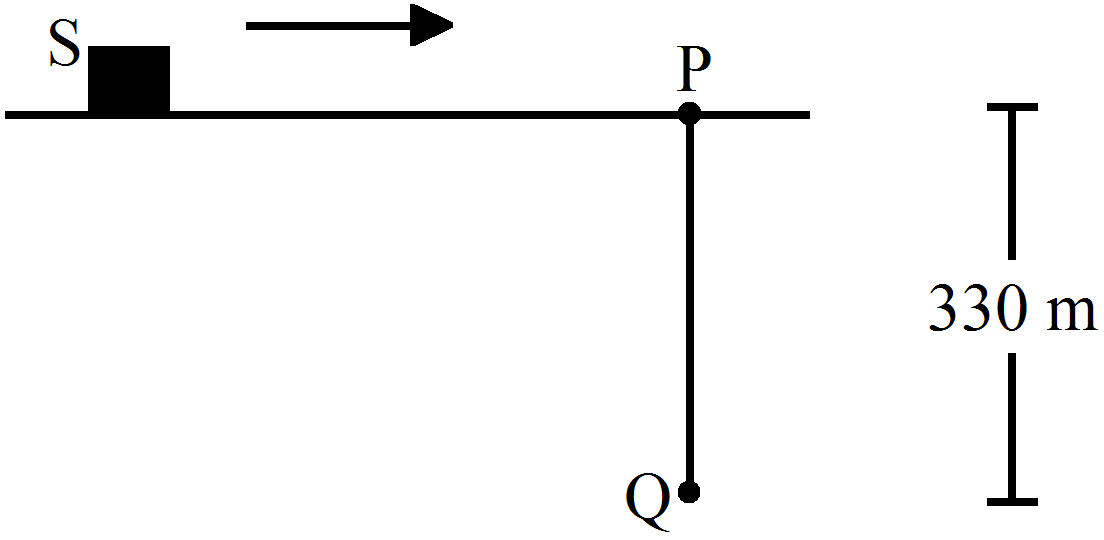
Figure, shows a source of sound moving along the X-axis at a speed of 22m/s continuously emitting a sound of frequency 2.0kHz which travels s in air at a speed of 330m/s. A listener Q stands on the Y-axis at a distance of 330 m from the origin. At t = 0, the source crosses the origin P.
  1. When does the sound emitted from the source at P reach the listener Q?
  2. What will be the frequency heard by the listener at this instant?
  3. Where will the source be at this instant?
Find the time period of small oscillations of the following systems.
  1. A metre stick suspended through the $20cm$ mark.
  2. A ring of mass in and radius r suspended through a point on its periphery.
  3. A uniform square plate of edge a suspended through a corner.
  4. A unifrom disc of mass m and radius r suspended through a point $\frac{\text{r}}{2}$ away from the centre.
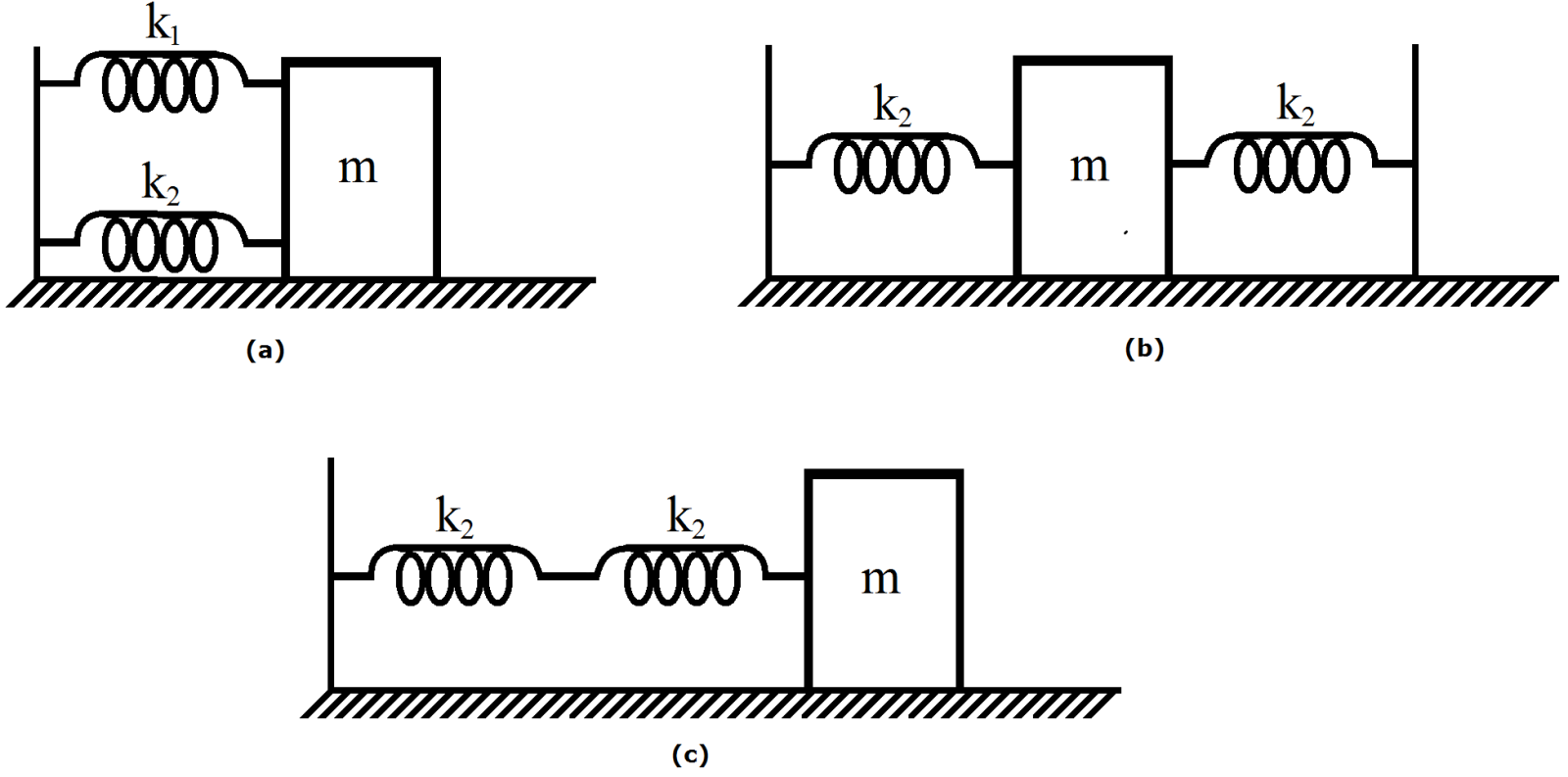
Find the time period of the oscillation of mass m in figure What is the equivalent spring constant of the pair of springs in each case?
A particle of mass 0.8kg is executing simple harmonic motion with amplitude of 1.0 metre and periodic time $\frac{11}{7}\text{sec}$. Calculate the velocity and the kinetic energy of the particle at the moment when its displacement is 0.6 metre.
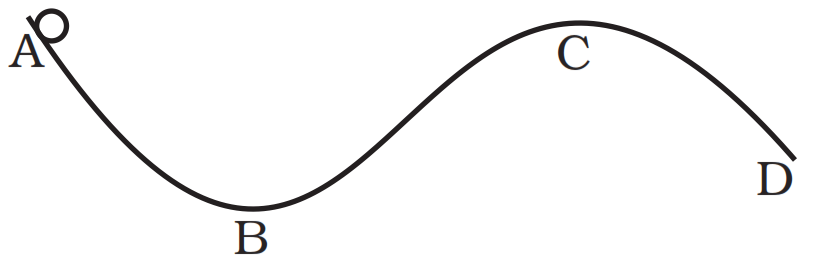
A curved surface is shown in. The portion BCD is free of friction. There are three spherical balls of identical radii and masses. Balls are released from rest one by one from A which is at a slightly greater height than C.
With the surface AB, ball 1 has large enough friction to cause rolling down without slipping, ball 2 has a small friction and ball 3 has a negligible friction.
  1. For which balls is total mechanical energy conserved?
  2. Which ball (s) can reach D?
  3. For balls which do not reach D, which of the balls can reach back A?
Two bodies of masses M, and M, are placed at a distance d apart. Show that at the position, where the gravitational field due to them is zero, the potential is given by $\text{v}=\frac{-\text{G}}{\text{d}}(\text{M}_1+\text{M}_2+2\sqrt{\text{M}_1\text{M}_2}).$
A shell of mass $0.020kg$ is fired by a gun of mass $100kg$. If the muzzle speed of the shell is $80ms^{-1}$, what is the recoil speed of the gun?
A particle moves along the x-axis from $x = 0$ to $x = 5m$ under the influence of a force given by $f(x) = 7 - 2x + 3x^2$​​​​​​​. Calculate the work done.