Question
Explain characteristic X-rays. Calculate minimum wavelength of X-rays emitted from X-ray tube operating at 5 kV.

Answer

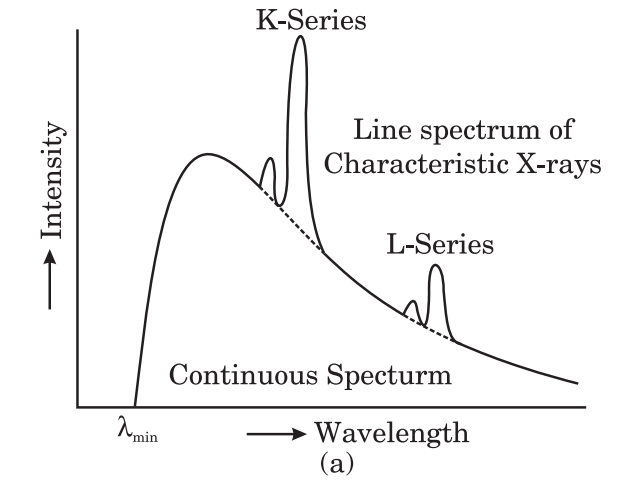
Characteristic X-rays : When the continuous spectrum was examined with Bragg's spectrometer precisely, some sharp peaks were observed in intensity-wavelength curve. The reason for these peaks are some characteristic wavelengths found in continuous spectrum of X-rays and these are the characteristics of the material of the target. The X-rays corresponding to these particular wavelengths are called characteristic X-rays. [Fig. (a)] Most of the elements show in their X-ray spectra two series of lines, known as K-series and L-series. Each series contains a small number of lines designated as $K _\alpha, K _\beta, \ldots \ldots$,$L _\alpha, L _\beta \ldots \ldots .$.The wavelengths of K-series are generally less than 1 Å, while those of L-series are roughly ten times larger. Heavier elements (Z > 66) show further series known as M-, N-, O- series.
Kossel explained the origin of the characteristic X-ray line spectrum on the basis of the shell structure of the atom. An atom is built up of a central positively-charged nucleus with discrete aggregates of electrons, known as K-shell, L-shell, M-shell, N-shell, etc. The maximum number of electrons which the K, L, M, N,......... shells can hold are 2, 8, 18, 32, The electrons in the K-shell are attracted by the positive nucleus with the greatest force, and to eject them from the atom maximum energy is required. Less energy is required to eject an electron from the L-shell, still less from M-shell, and so on.
Image
Now, in an X-ray tube an electron emitted from the cathode strikes the target with a tremendous velocity so that it penetrates well inside the atoms of the target. If it ejects an electron from the K-shell of the atom, a vacancy is created in the K-shell. Immediately an electron from one of the outer shells, say L-shell jumps to the K-shell, emitting an X-ray photon of energy equal to the difference in the binding energies of the electron in the K and L shells. Similarly, if an electron from the M-shell jumps to the K-shell, X-ray photon of higher energy is emitted. The X-ray photons emitted due to the jump of electrons from the L, M, N, ..... shell to the K-shell give $K _\alpha, K _\beta, K _\gamma \ldots \ldots$ lines of the K-series of the spectrum.
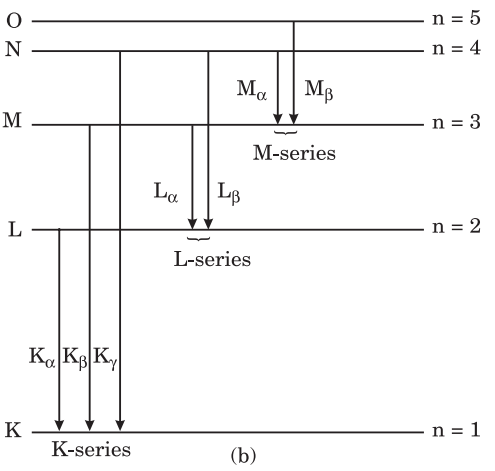
Energy Level Diagram : The formation of spectral series of characteristic X-rays on an energy level diagram is shown in Fig. (b). In X-ray energy levels zero energy level is assigned to the normal state of the atom.
Image
If one of the most firmly bound electrons of the K-shell is removed, the atom is said to be in K-level. An electron from any one of the outer levels L, M, N,...... then falls into the K-level with the emission of a K-series line. Similarly, the formation of other series lines can be explained.
First, second, third, line of each series is assigned the subscript $\alpha, \beta, \gamma, \ldots \ldots$. respectively [Fig. (b)].
Solution of Numerical : Minimum Wavelength of X-ray :
$\lambda_{\min }=\frac{h c}{e V}=\left[\frac{\left(6.6 \times 10^{-34}\right)\left(3 \times 10^8\right)}{\left(1.6 \times 10^{-19}\right)\left(5 \times 10^3\right)}\right] m$
$=2.475 \times 10^{-10} m$ = 2.475 Å

Need a full question paper?

Generate a complete, print-ready paper with questions like this in minutes — across 16+ boards, with answer keys.
Start Generating Free

Similar questions

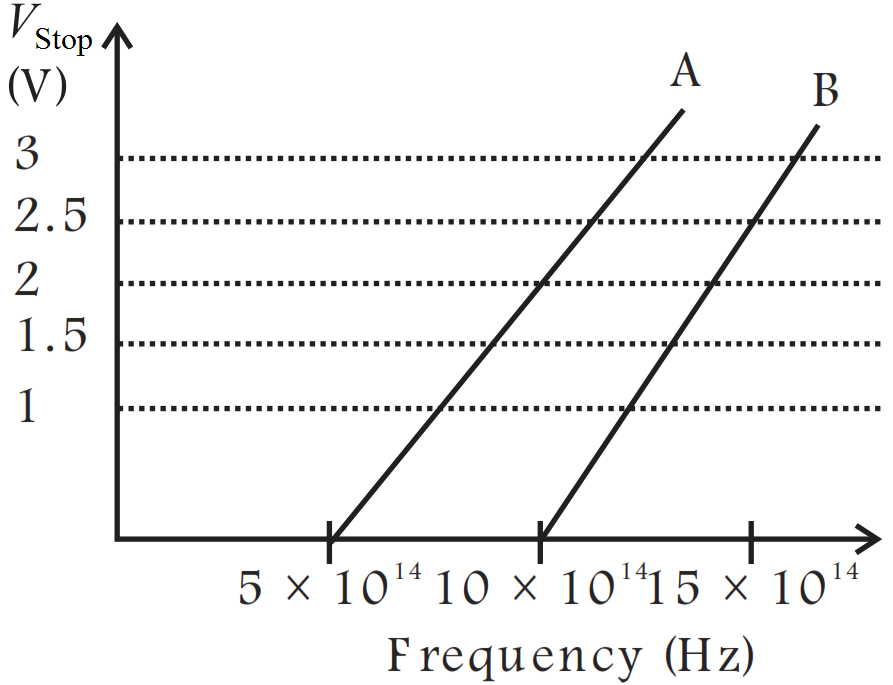
A student performs an experiment on photoelectric effect, using two materials A and B. A plot of Vstop vs ν is given in Fig.

  1. Which material A or B has a higher work function?
  2. Given the electric charge of an electron = 1.6 × 10-19C, find the value of h obtained from the experiment for both A and B.

Comment on whether it is consistent with Einstein’s theory:
A ball is kept at a height h above the surface of a heavy transparent sphere made of a material of refractive index $\mu.$ The radius of the sphere is R. At t = 0, the ball is dropped to fall normally on the sphere. Find the speed of the image formed as a function of time for $\text{t}<\sqrt{\frac{2\text{h}}{\text{g}}}.$ Consider only the image by a single refraction.
A long straight horizontal cable carries a current of 2.5 A in the direction 10° south of west to 10° north of east. The magnetic meridian of the place happens to be 10° west of the geographic meridian. The earth’s magnetic field at the location is 0.33 G, and the angle of dip is zero. Locate the line of neutral points (ignore the thickness of the cable). (At neutral points, magnetic field due to a current-carrying cable is equal and opposite to the horizontal component of earth’s magnetic field.)
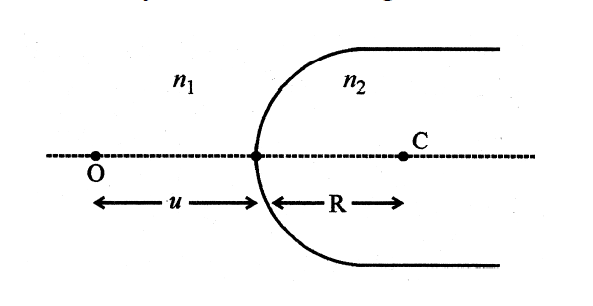
A point object 'O' is kept in a medium of refractive index n1 in front of a convex spherical surface of radius of curvature R which separates the second medium of refractive index n2 from the first one, as shown in the figure. Draw the ray diagram showing the image formation and deduce the relationship between the object distance and the image distance in terms of n1, n2 and R.

  1.  

  1. hen the image formed above acts as a virtual object for concave spherical, surface separating the medium n2 from n1 (n2> n1), draw this ray diagram and write the similar (similar to (a) relation. Hence obtain the expression for the lens maker's formula.
How is a zener diode fabricated so as to make it a special purpose diode? Draw I-V characteristics of zener diode and explain the significance of breakdown voltage.

Explain briefly, with the help of a circuit diagram, how a p-n junction diode works as a half wave rectifier.
Two particles A and B having charges q and 2q respectively are placed on a smooth table with a separation d. A third particle C is to be clamped on the table in such a way that the particles A and B remain at rest on the table under electrical forces. What should be the charge on C and where should it be clamped?
  1. State Huygen’s principle. Using this principle draw a diagram to show how a plane wave front incident at the interface of the two media gets refracted when it propagates from a rarer to a denser medium. Hence verifiy Snell’s law of refraction.
  2. When monochromatic light travels from a rarer to a denser medium, explain the following, giving reasons:
    1. Is the frequency of reflected and refracted light same as the frequency of incident light?
    2. Does the decrease in speed imply a reduction in the energy carried by light wave?
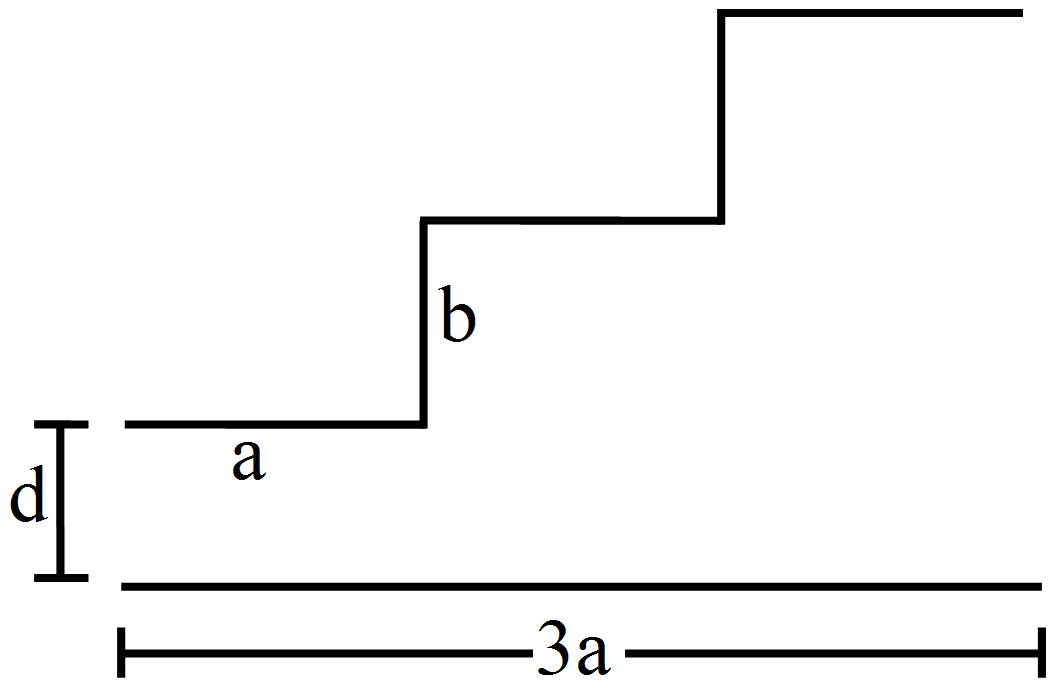
A capacitor is made of a flat plate of area A and a second plate having a stair-like structure as shown in figure. The width of each stair is a and the height is b. Find the capacitance of the assembly.

  1. Compare the individual dipole moment and the specimen dipole moment for H2O molecule and O2 molecule when placed in:
  1. Absence of external electric field.
  2. Presence of external eclectic field. Justify your answer.
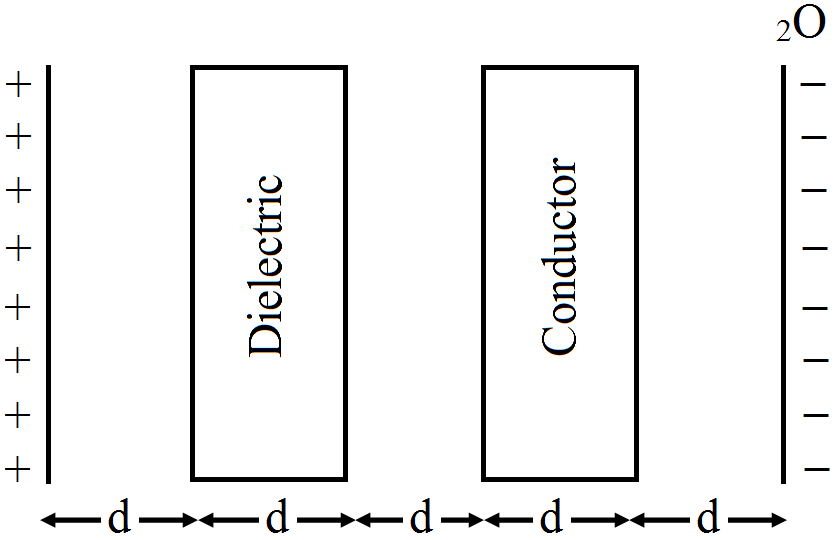
  1. Given two parallel conducting plates of area A and charge densities $+\sigma$ and $-\sigma.$ A dielectric slab of constant K and a conducting slab of thickness d each are inserted in between them as shown.

  1. Find the potential difference between the plates.
  2. Plot E versus x graph, taking x = 0 at positive plate and x = 5d at negative plate.
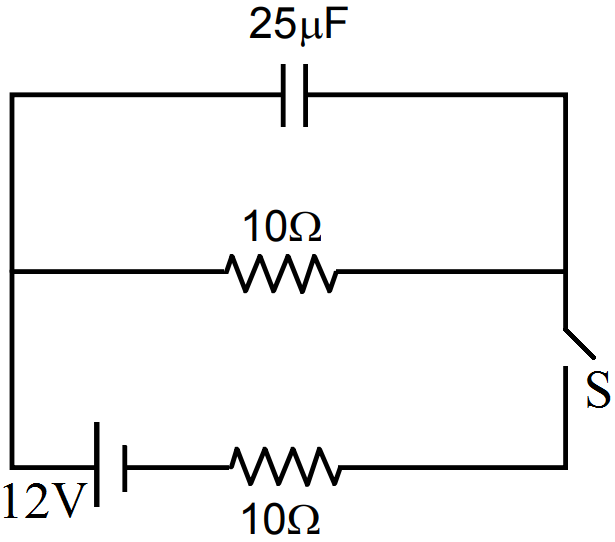
The switch S shown in figure. is kept closed for a long time and is then opened at t = 0. Find the current in the middle $1.0\Omega$ resistor at t = 1ms.