Question
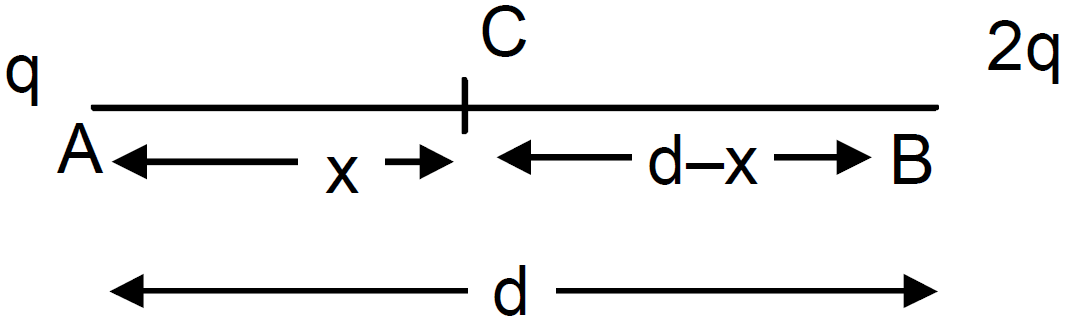
Two particles A and B having charges q and 2q respectively are placed on a smooth table with a separation d. A third particle C is to be clamped on the table in such a way that the particles A and B remain at rest on the table under electrical forces. What should be the charge on C and where should it be clamped?

Answer


Let the charge on C = q

So, net force on c is equal to zero

So, $\text{F}_{\overline{\text{AC}}}+\text{F}_{\overline{\text{BA}}}=0,$

But $\text{F}_{\overline{\text{AC}}}=\text{F}_{\overline{\text{BC}}}$

$\Rightarrow\frac{\text{kqQ}}{\text{x}^2}=\frac{\text{k}2\text{qQ}}{(\text{d}-\text{x})^2}$

$\Rightarrow2\text{x}^2=(\text{d}-\text{x})^2$

$\Rightarrow\sqrt{2}\text{x}=\text{d}-\text{x}$

$\Rightarrow\text{x}=\frac{\text{d}}{\sqrt{2}+1}$

$=\frac{\text{d}}{\big(\sqrt{2}+1\big)}\times\frac{\big(\sqrt{2}-1\big)}{\big(\sqrt{2}-1\big)}$

$=\text{d}\big(\sqrt{2}-1\big)$

For the charge on rest, $\text{F}_\text{AC}+\text{F}_\text{AB}=0$

$(2.414)^2\frac{\text{kqQ}}{\text{d}^2}+\frac{\text{kq}(2\text{q})}{\text{d}^2}=0$

$\Rightarrow\frac{\text{kq}}{\text{d}^2}\big[(2.414)^2\text{Q}+2\text{q}\big]=0$

$\Rightarrow2\text{q}=-(2.414)^2\text{Q}$

$\Rightarrow\text{Q}=\frac{2}{-\big(\sqrt{2}+1\big)^2}\text{q}$

$=-\Big(\frac{2}{3+2\sqrt{2}}\Big)\text{q}$

$=-(0.343)\text{q}$

$=-\big(6-4\sqrt{2}\big)$
Need a full question paper?

Generate a complete, print-ready paper with questions like this in minutes — across 16+ boards, with answer keys.

Start Generating Free

Similar questions

Sometimes a radioactive nucleus decays into a nucleus which itself is radioactive. An example is:
$^{38}\text{Sulphur}\xrightarrow[=2.48\text{h}]{\text{half-life}}\ \ ^{38}\text{Cl}\ \xrightarrow[=0.62\text{h}]{\text{half-life}}\ ^{38}\text{Ar}(\text{stable})$
Assume that we start with 1000 38S nuclei at time t = 0. The number of 38Cl is of count zero at t = 0 and will again be zero at t = ∞. At what value of t, would the number of counts be a maximum?
Write four properties of $\gamma$-rays. What will be the difference between velocity of $\gamma$-ray of wavelength 0.01 Å and X-ray of wave-length 3 Å.
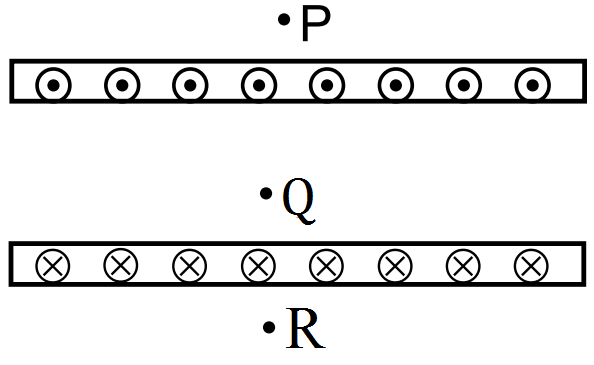
Two large metal sheets carry surface currents as shown in figure. The current through a strip of width dl is Kdl where K is a constant. Find the magnetic field at the points P, Q and R.

Classically, an electron can be in any orbit around the nucleus of an atom. Then what determines the typical atomic size? Why is an atom not, say, thousand times bigger than its typical size? The question had greatly puzzled Bohr before he arrived at his famous model of the atom that you have learnt in the text. To simulate what he might well have done before his discovery, let us play as follows with the basic constants of nature and see if we can get a quantity with the dimensions of length that is roughly equal to the known size of an atom (~ 10–10m).
  1. Construct a quantity with the dimensions of length from the fundamental constants e, me, and c. Determine its numerical value.
  2. You will find that the length obtained in (a) is many orders of magnitude smaller than the atomic dimensions. Further, it involves c. But energies of atoms are mostly in non-relativistic domain where c is not expected to play any role. This is what may have suggested Bohr to discard c and look for ‘something else’ to get the right atomic size. Now, the Planck’s constant h had already made its appearance elsewhere. Bohr’s great insight lay in recognising that h, me, and e will yield the right atomic size. Construct a quantity with the dimension of length from h, me, and e and confirm that its numerical value has indeed the correct order of magnitude.
The benches of a gallery in a cricket stadium are 1m wide and 1m high. A batsman strikes the ball at a level one metre above the ground and hits a mammoth sixer. The ball starts at 35m/s at an angle of 53° with the horizontal. The benches are perpendicular to the plane of motion and the first bench is 110m from the batsman. On which bench will the ball hit?
The image of a small electric bulb fixed on the wall of a room is to be obtained on the opposite wall 3 m away by means of a large convex lens. What is the maximum possible focal length of the lens required for the purpose?
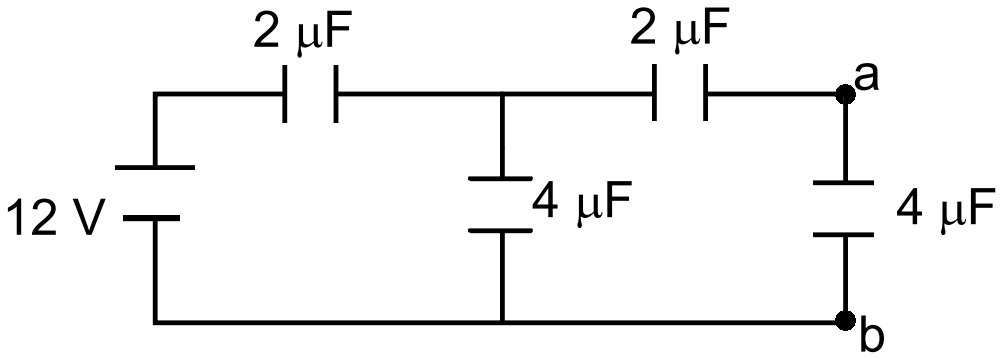
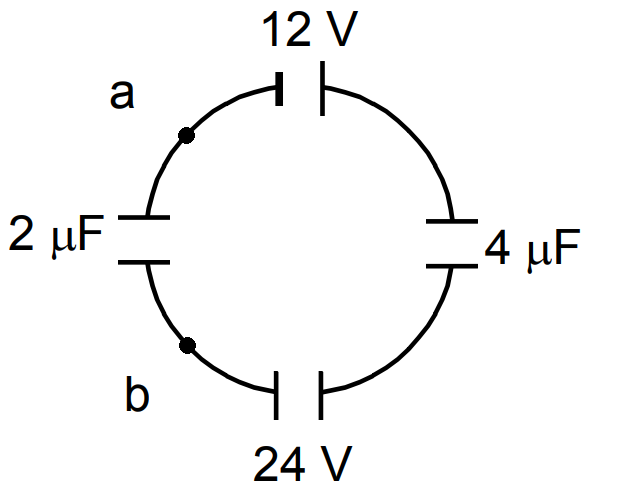
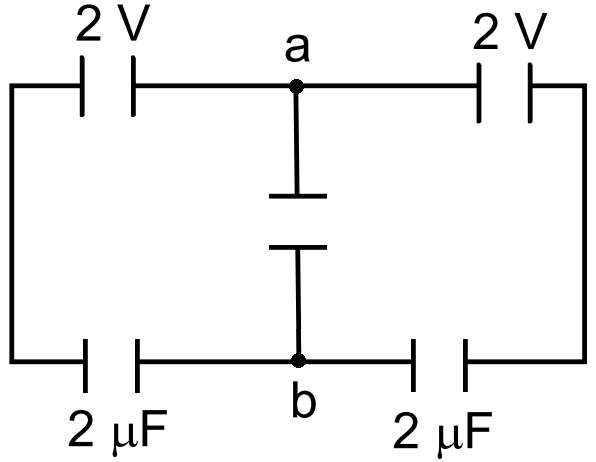
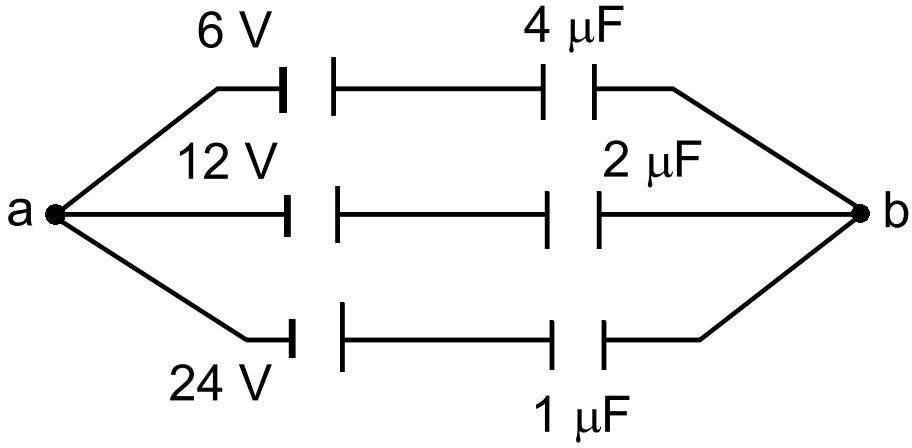
Find the potential difference Va - Vb between the points a and b shown in each part of the figure.


  1. Draw the ray diagram showing refraction of light through a glass prism and hence obtain the relation between the refractive index $\mu$ of the prism, angle of prism and angle of minimum deviation.
  2. Determine the value of the angle of incidence for a ray of light travelling from a medium of refractive index $\mu_1=\sqrt{2}$ into the medium of refractive index $\mu_2=1$, so that it just grazes along the surface of separation.
The left end of a copper rod (length = 20cm area of cross section = 0.20cm) is maintained at 20°C and the right end is maintained at 80°C. Neglecting any loss of heat through radiation, find,
  1. The temperature at a point 11cm from the left end
  2. The heat current through the rod. Thermal conductivity of copper $=385\text{Wm}^{-1}{^{\circ}}\text{C}^{-1}.$
What are intrinsic semiconductor and extrinsic semiconductor ? Explain.