$(n - 1)$ equal point masses each of mass m are placed at the vertices of a regular n-polygon. The vacant vertex has a position vector a with respect to the centre of the polygon. Find the position vector of centre of mass.
Download our app for free and get started
Key concept: poaition vector of center of mass for n particle system. If a system consists of n particles of masses $m_1, m_2, m_3, ......., mn,$ whose positions vectors are $\vec{\text{r}}_1,\vec{\text{r}}_2,\ ...., \vec{\text{r}}_\text{n}$ respectively. then position vector of centre of mass,
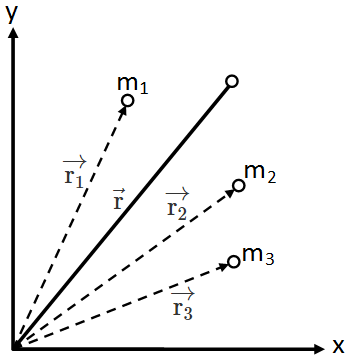
$\vec{\text{r}}=\frac{{\text{m}}_1\vec{\text{r}}_1+\text{m}_2\vec{\text{r}}_2+\text{m}_3\vec{\text{r}}_3+\ ....\ +\text{m}_\text{n}\vec{\text{r}}_\text{n}}{\text{m}_1+\text{m}_2+\text{m}_3+\ ...\ +\text{m}_\text{n}}$ Hence the center of mass of n particles is a weighted average of the position vectors of n particles making up the system. The centre of mass of a regular n-polygon lies at its geometrical centre. Let position vector of each centre of mass or regular n polygon is r. (n - 1) equal point masses each of mass m are placed at (n - 1) vertices of the regular n-polygon, therefore, for its centre of mass, $\vec{\text{r}}_\text{cm}=\frac{(\text{n}-1)\text{mb}+\text{ma}}{(\text{n}-1)\text{m}+\text{m}}=0$
$(\because$ Centre of mass lies at centre$)$ Here, b = distance of (n - 1) masses form centre of the polygon, a = the distance of point mass, placed at the vacant vertex. $\Rightarrow(\text{n}-1)\text{mb}+\text{ma}=0$
$\Rightarrow\text{b}=-\frac{\text{a}}{(\text{n}-1)}$ The negative sign indicates that $\vec{\text{b}}$ is in a direction opposite to $\vec{\text{a}}$
$\vec{\text{r}}=\frac{{\text{m}}_1\vec{\text{r}}_1+\text{m}_2\vec{\text{r}}_2+\text{m}_3\vec{\text{r}}_3+\ ....\ +\text{m}_\text{n}\vec{\text{r}}_\text{n}}{\text{m}_1+\text{m}_2+\text{m}_3+\ ...\ +\text{m}_\text{n}}$ Hence the center of mass of n particles is a weighted average of the position vectors of n particles making up the system. The centre of mass of a regular n-polygon lies at its geometrical centre. Let position vector of each centre of mass or regular n polygon is r. (n - 1) equal point masses each of mass m are placed at (n - 1) vertices of the regular n-polygon, therefore, for its centre of mass, $\vec{\text{r}}_\text{cm}=\frac{(\text{n}-1)\text{mb}+\text{ma}}{(\text{n}-1)\text{m}+\text{m}}=0$
$(\because$ Centre of mass lies at centre$)$ Here, b = distance of (n - 1) masses form centre of the polygon, a = the distance of point mass, placed at the vacant vertex. $\Rightarrow(\text{n}-1)\text{mb}+\text{ma}=0$
$\Rightarrow\text{b}=-\frac{\text{a}}{(\text{n}-1)}$ The negative sign indicates that $\vec{\text{b}}$ is in a direction opposite to $\vec{\text{a}}$

Download our appand get started for free
Experience the future of education. Simply download our apps or reach out to us for more information. Let's shape the future of learning together!No signup needed.*
Similar Questions
- 1View SolutionTorques of equal magnitude are applied to a hollow cylinder and a solid sphere, both having the same mass and radius. The cylinder is free to rotate about its standard axis of symmetry, and the sphere is free to rotate about an axis passing through its centre. Which of the two will acquire a greater angular speed after a given time.
- 2A hollow sphere is released from the top of an inclined plane of inclination $\theta.$View Solution
- What should be the minimum coefficient of friction between the sphere and the plane to prevent sliding?
- Find the kinetic energy of the ball as it moves down a length 1 on the incline if the friction coefficient is half the value calculated in part (a).
- 3A uniform cube of mass m and side a is placed on a frictionless horizontal surface. A vertical force F is applied to the edge as shown in match the following (most appropriate choice):View Solution
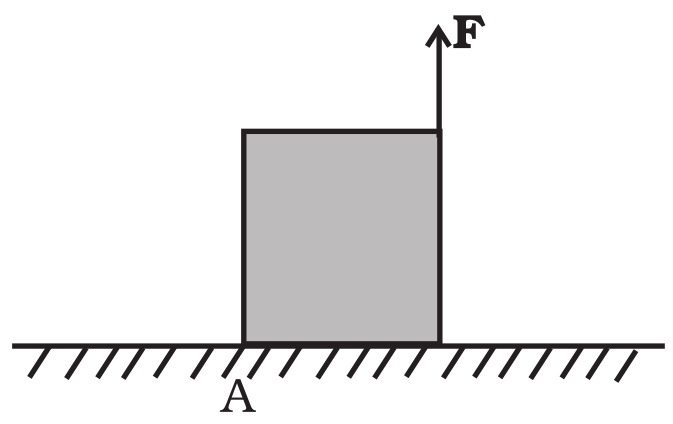
a. $\frac{\text{mg}}{4}<\text{F}<\frac{\text{mg}}{2}$ i. Cube will move up. b. $\text{F}>\frac{\text{mg}}{2}$ ii. Cube will not exhibit motion. c. $\text{F}>\text{mg}$ iii. Cube will begin to rotate and slip at A. d. $\text{F}=\frac{\text{mg}}{4}$ iv. Normal reaction effectively at $\frac{\text{a}}{3}$ - 4View SolutionFind the components along the x, y, z axes of the angular momentum l of a particle, whose position vector is r with components x, y, z and momentum is p with components px, py and pz. Show that if the particle moves only in the x-y plane the angular momentum has only a z-component.
- 5View SolutionA uniform rod of mass m and length l is struck at an end by a force F perpendicular to the rod for a short time interval t. Calculate:
- The speed of the centre of mass.
- The angular speed of the rod about the centre of mass.
- The kinetic energy of the rod.
- The angular momentum of the rod about the centre of mass after the force has stopped to act. Assume that t is so small that the rod does not appreciably change its direction while the force acts.
- 6View SolutionDiscuss the rolling motion of a cylinder on an inclined plane.
- 7Separation of Motion of a system of particles into motion of the centre of mass and motion about the centre of mass: Show $\text{p}=\text{p}'_\text{i}+\text{m}_\text{i}\text{V}$ where $p_i$ is the momentum of the ith particle (of mass $m_i$ ) and $p′_i = m_iv′_i.$ Note: $v′_i$ is the velocity of the ith particle relative to the centre of mass. Also, prove using the definition of the centre of mass.View Solution
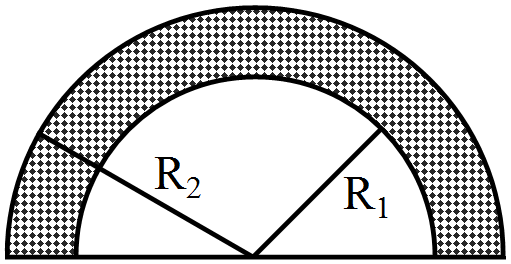
- 8Find the centre of mass of a uniform plate having semicircular inner and outer boundaries of radii $R_1$ and $R_2$.View Solution
- 9View SolutionThe door of an almirah is 6ft high, 1.5ft wide and weighs 8kg. The door is supported by two hinges situated at a distance of 1ft from the ends. If the magnitudes of the forces exerted by the hinges on the door are equal, find this magnitude.
- 10Separation of Motion of a system of particles into motion of the centre of mass and motion about the centre of mass: Show $\frac{\text{dL}}{\text{dt}}=\sum\text{r}'_\text{i}\times\frac{\text{dp}'}{\text{dt}}$ Further, show that $\frac{\text{dL}'}{\text{dt}}=\tau'_\text{ext}$ where $\tau'_\text{ext}$ is the sum of all external torques acting on the system about the centre of mass.View Solution
(Hint: Use the definition of centre of mass and third law of motion. Assume the internal forces between any two particles act along the line joining the particles)