Question
Explain colour in coordination compounds.

Answer

→ One of the most distinctive properties of transition metal complexes is their wide range of colours.
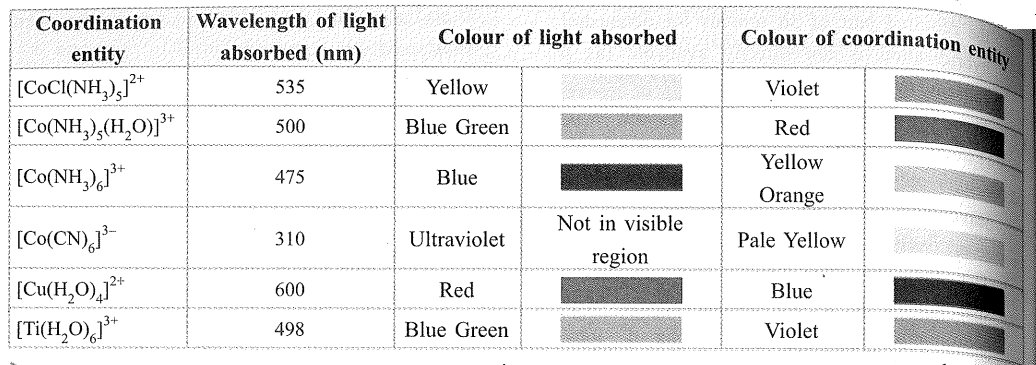
→ This means that some of the visible spectrum is being removed from white light as it passes through the sample, so the light that emerges is no longer white.
→ The colour of the complex is complementary to that which is absorbed.
→ The complementary colour is the colour generated from the wavelength left over; if green light is absorbed by the complex, it appears red.
Relationship between the Wavelength of Light absorbed and the Colour observed in some Coordination Entities
Image
→ The colour in the coordination compounds can be readily explained in terms of the crystal field theory.
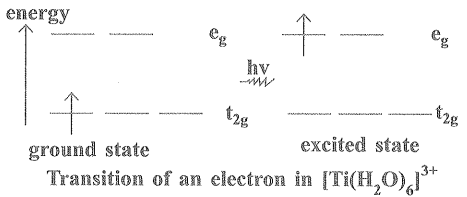
→ Consider, for example, the complex $\left[ Ti \left( H _2 O \right)_6\right]^{3+}$, which is violet in colour.
→ This is an octahedral complex where the single electron $\left( Ti ^{3+}\right.$ is a $3 d^1$ system $)$ in the metal d orbital is in the $t_{2 g}$ level in the ground state of the complex.
→ The next higher state available for the electron is the empty $e _{ g }$ level. If light corresponding to the energy of blue green region is absorbed by the complex, it would excite the electron from $t_{2 g}$ level to the e $e _{ g }$ level $\left( t _{2 g}^1 e _{ g }^{\circ} \rightarrow i _{2g}^{\circ} e _g^1\right)$
→ Consequently, the complex appears violet in colour
Image
→ The crystal field theory attributes the colour of the coordination compounds to d-d transition of the electron.
→ It is important to note that in the absence of ligand, crystal field splitting does not occur and hence, the substance is colourless.
→ For example, removal of water from $\left[ Ti \left( H _2 O \right)_6\right] Cl _3$ on heating renders it colourless.
→ Similarly, anhydrous $CuSO _4$ is white, but $CuSO _4 \cdot 5 H _2 O$ is blue in colour.
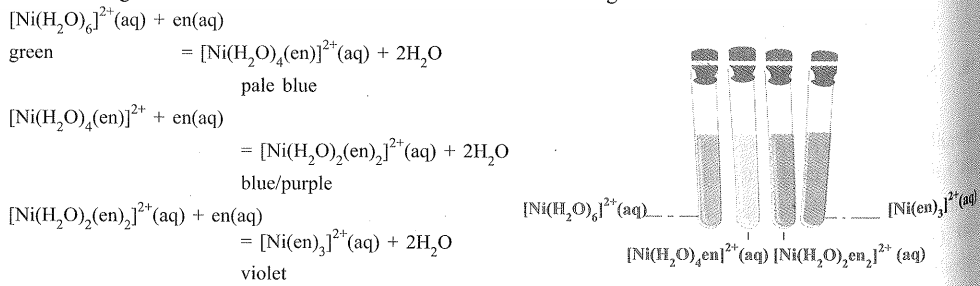
→ The influence of the ligand on the colour of a complex may be illustrated by considering the $\left[ Ni \left( H _2 O \right)_6\right]^{+2}$ complex, which forms when nickel(II) chloride is dissolved in water.
→ If the didentate ligand, ethane-1,2-diamine(en) is progressively added in the molar ratios en:Ni, 1:1, 2:1, 3:1, the following series of reactions and their associated colour changes occur :
Image

Need a full question paper?

Generate a complete, print-ready paper with questions like this in minutes — across 16+ boards, with answer keys.
Start Generating Free