Question
Explain conductors and insulators with example. (This question can also be asked as difference between conductors and insulators.)

Answer

►Those which allow electricity to pass through them easily are called conductors.
►They have electric charges (electrons) that are comparatively free to move inside the material.
►Metals, human and animal bodies and earth are conductors.
►Resistance of a conducting material is small.
►Substances which do not allow electricity to pass through them are called insulators.
►Resistance of a insulator material is very high. Glass, porcelain, plastic, nylon & wood are insulators.
►When some charge is transferred to a conductor, it readily gets distributed over the entire surface of the conductor. In contrast, if some charge is put on an insulator, it stays at the same place.
Need a full question paper?

Generate a complete, print-ready paper with questions like this in minutes — across 16+ boards, with answer keys.

Start Generating Free

Similar questions

An electron beam passes through a region of crossed electric and magnetic fields of strength E and B respectively. For what value of electron-speed the beam will remain undeflected?
An $ \alpha $-particle and a proton are accelerated through the same potential difference. Find the ratio of their de-Broglie wavelength.
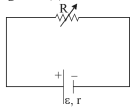
A variable resistor R, electromotive force and internal resistance $r$ are joined as shown in the given figure across the ends of the cell. Draw graph to show (i) terminal voltage and (ii) current $I$ as a function of $R$.
Image
Show diagrammatically the behaviour of magnetic field lines in the presence of (i) paramagnetic and (ii) diamagnetic substances. How does one explain this distinguishing feature?
The contact angle between pure water and pure silver is $90^\circ .$ If a capillary tube made of silver is dipped at one end in pure water, will the water rise in the capillary?
Answer the following questions: Why must both the objective and the eyepiece of a compound microscope have short focal lengths.
A block of mass m is kept on a horizontal table. If the static friction coefficient is $\mu,$ find the frictional force acting on the block.
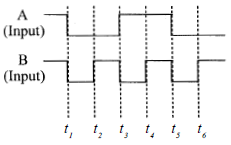
The given inputs A, B are fed to a 2-input NAND gate. Draw the output wave form of the gate. 
Draw the graph of variation of Coulomb force (F) with $(r)$. Where the distance between the two charges of each charge pair is ( $1 \mu C , 2 \mu C$ ) and ( $2 \mu C$, $-3 \mu C$ ). Analyse the graph obtained.
A spherical surface of radius 30cm separates two transparent media A and B with refractive indices 1.33 and 1.48 respectively. The medium A is on the convex side of the surface. Where should a point object be placed in medium A so that the paraxial rays become parallel after refraction at the surface?