Maharashtra BoardEnglish MediumSTD 11 SciencePhysicsElectrostatics4 Marks
Question
Explain Coulomb’s law in vector form.
✓
Answer
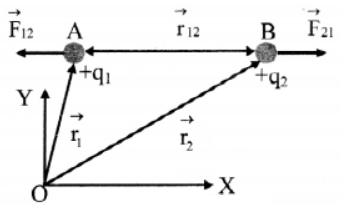
$i.$ Let $q_1$ and $q_2$ be the two similar point charges situated at points $A$ and $B$ and let $\vec{r}_{12}$ be the distance of separation between them.
$ii.$ The force $\vec{F}_{21}$ exerted on $q _2$ by $q _1$ is given by,
$\overrightarrow{ F }_{21}=\frac{1}{4 \pi \varepsilon_0} \frac{ q _1 q _2}{\left| r _{12}\right|^2} \times \hat{ r }_{12}$
where, $\hat{r}_{12}$ is the unit vector from $A$ to $B$.
$\vec{F}_{21}$ acts on $q _2$ at $B$ and is directed along $BA$ , away from $B$.
$iii.$ Similarly, the force $\vec{F}_{12}$ exerted on $q _1$ by $q _2$ is given by, $\vec{F}_{12}=\frac{1}{4 \pi \varepsilon_0} \frac{ q _1 q _2}{\left| r _{12}\right|^2} \times \hat{ r _{21}}$
where, $\hat{r}_{21}$ is the unit vector from $B$ to $A . \vec{F}_{12}$ acts on $q _1$ at $A$ and is directed along $BA ,$ away from $A$.
$iv.$ The unit vectors $\hat{r}_{12}$ and $\hat{r}_{21}$ are oppositely directed i.e., $\hat{r}_{12}=-\hat{r}_{21}$ Hence, $\vec{F}_{21}=-\vec{F}_{12}$
Thus, the two charges experience force of equal magnitude and opposite in direction.
$v.$ These two forces form an action$-$reaction pair.
$vi.$ As $\vec{F}_{21}$ and $\vec{F}_{12}$ act along the line joining the two charges, the electrostatic force is a central force.
Need a full question paper?
Generate a complete, print-ready paper with questions like this in minutes — across 16+ boards, with answer keys.