Question
Explain diamagnetism and diamagnetic material.

Answer

→Simple explanation of dia-magnetism :
Electrons in an atom orbiting around nucleus possess orbital angular momentum. These orbiting electrons are equivalent to current carrying loop and thus possess orbital magnetic moment.
Diamagnetic substances are the ones in which the resultant magnetic moment in an atom is zero. When magnetic field is applied, those electrons having orbital magnetic moment in the same direction slow down and those in the opposite direction speed up.
This happens due to induced current in accordance with Lenz's law.
Thus, the substance develops a net magnetic moment in direction opposite to that of applied field and hence repulsion.
This is a simple explanation of diamagnetism.

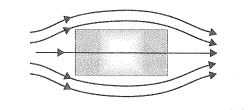
Image
Fig. shows a bar of diamagnetic material placed in an external magnetic field. The field lines in it are repelled and field inside the material is reduced.
In most cases, this reduction is slight, being one part in $10^5$.
When placed in a non-uniform magnetic field, a diamagnetic substance experiences net force from stronger to weaker field and tends to move from high to low field. Which means they experience repulsion.
Some diamagnetic materials are bismuth, copper, lead, silicon, nitrogen (at STP), water and sodium chloride.
Value of $\chi$ (magnetic susceptibility) is negative $(-1 \leq \chi<0)$ for diamagnetic materials.

Need a full question paper?

Generate a complete, print-ready paper with questions like this in minutes — across 16+ boards, with answer keys.
Start Generating Free

Similar questions

Two metallic wires A and B made from same substance have equal lengths and their cross-sections are in the ratio $1: 2$. They are joined in (i) series (ii) parallel. In both the above combinations, compare the drift velocities of electrons in the two wires.
An electric current of 2.0A passes through a wire of resistance $25\Omega$. How much heat will be developed in 1minute?
Explain the reflection of a plane wave using Huygen's principle.
The peak power consumed by a resistive coil, when connected to an AC source, is 80W. Find the energy consumed by the coil in 100 seconds, which is many times larger than the time period of the source.
Explain ground state and ionisation energy of hydrogen atom.
On a hot summer day we want to cool our room by opening the refrigerator door and closing all the windows and doors. Will the process work ?
By explaining the (Electric) current density, derive Ohm's law in vector form.
When three identical capacitors are connected in series, their equivalent (total) capacitance is $1 \mu F$. If they are connected in parallel, what will be their total capacitance? If the capacitors are connected to the same source in both the conditions (combinations), then find the ratio of the stored energy in these two types of combinations.
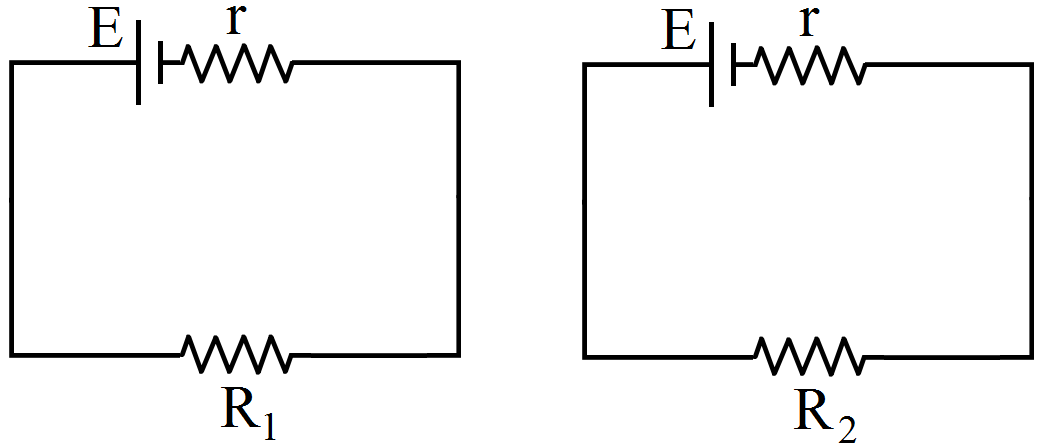
Two unequal resistances $\mathrm{R}_1$ and $\mathrm{R}_2$ are connected across two identical batteries of emf \$ivarepsilon\$ and internal resistance r . Can the thermal energies developed in $R_1$ and $R_2$ be equal in a given time. If yes, what will be the condition?
Given a uniform electric field$\overrightarrow{\text{E}}: 4 \times 10^3  \hat{i}$ N/C, find the flux of this field through a square of 5cm on a side whose plane is parallel to the y-z plane. What would be the flux through the same square if the plane makes a $30^{\circ}$ angle with the x-axis?