Calculate the temperature at which the resistance of a conductor becomes 20% more than its resistance at 27°C. The value of the temperature coefficient of resistance of the conductor is $2.0 \times 10\frac{-4}{\text{K}}.$
Download our app for free and get started
Given, $\text{R}_{27}=\text{R}(\text{say}),\text{R}_\text{T}=\text{R}+\frac{20}{100}\text{R}=1.2\text{R},\text{T}_1=27+273=300\text{K}$
From relation,
$\text{R}\text{T}=\text{R}_{27}[1+\alpha(\text{T}_2-300)]$
$\Rightarrow1.2\text{R}=\text{R}[1+2.0\times10^{-4}(\text{T}_2-300)]$
$\Rightarrow1+2.0\times10^{-4}(\text{T}_2-300)=1.2$
$\Rightarrow2.0\times10^{-4}(\text{T}_2-300)=0.2$
$\text{T}_2-300=\frac{0.2}{2.0\times10^{-4}}$
$\text{T}_2=1000+300=1300\text{K}$
From relation,
$\text{R}\text{T}=\text{R}_{27}[1+\alpha(\text{T}_2-300)]$
$\Rightarrow1.2\text{R}=\text{R}[1+2.0\times10^{-4}(\text{T}_2-300)]$
$\Rightarrow1+2.0\times10^{-4}(\text{T}_2-300)=1.2$
$\Rightarrow2.0\times10^{-4}(\text{T}_2-300)=0.2$
$\text{T}_2-300=\frac{0.2}{2.0\times10^{-4}}$
$\text{T}_2=1000+300=1300\text{K}$

Download our appand get started for free
Experience the future of education. Simply download our apps or reach out to us for more information. Let's shape the future of learning together!No signup needed.*
Similar Questions
- 1The number density of free electrons in a copper conductor estimated in Example $3.1$ is $8.5 \times 10^{28}m^{-3}.$ How long does an electron take to drift from one end of a wire $3.0 m$ long to its other end? The area of cross$-$section of the wire is $2.0 \times 10^{-6} m^2$ and it is carrying a current of $3.0 A.$View Solution
- 2n-identical cells, each of emf $\varepsilon,$ internal resistance r connected in series are charged by a dc source of emf $\varepsilon'$ using a resistance R.View Solution
- Draw the circuit arrangement.
- Deduce expressions for (a) the charging current and (b) the potential difference across the combination of cells.
- 3A wire of length 1m and radius 0.1mm has a resistance of $100\Omega.$ Find the resistivity of the material.View Solution
- 4View Solution
- Define the term ‘conductivity’ of a metallic wire. Write its SI unit.
- Using the concept of free electrons in a conductor, derive the expression for the conductivity of a wire in terms of number density and relaxation time. Hence obtain the relation between current density and the applied electric field E.
- 5View SolutionA (i) series (ii) parallel combination of two given resistors is connected, one by one, across a cell. In which case will the terminal potential difference, across the cell have a higher value?
- 6View Solution
- Three resistors $2\ \Omega,\ 4\ \Omega\ \text{and}\ 5\ \Omega$ are combined in parallel. What is the total resistance of the combination?
- If the combination is connected to a battery of emf 20 V and negligible internal resistance, determine the current through each resistor, and the total current drawn from the battery.
- 7View SolutionTwo heated wires of the same dimensions are first connected in series and then in parallel to a source of supply. What will be the ratio of heat produced in the two cases?
- 8View SolutionTwo wires A and B of the same material and having same length, have their cross sectional areas in the ratio 1 : 6. What would be the ratio of heat produced in these wires when same voltage is applied across each?
- 9A potential difference $V$ is applied across a conductor of length $L$ and diameter $D.$ How is the drift velocity, $V_d,$ of charge carriers in the conductor affected when $(i) \ V$ is halved, $(ii) \ L$ is doubled and $(iii) \ D$ is halved? Justify your answer in each case.View Solution
- 10View Solution
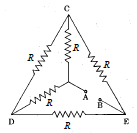
- Calculate the equivalent resistance of the given electrical network between points A and B.
- Also calculate the current through CD and ACB, if a 10 V d.c. source is connected between A and B, and the value of R is assumed as 2 Ω.