Question
Explain end-on position and broad side-on position of a bar magnet.

Answer

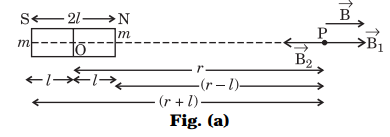
(a) End-on-position of a bar magnet : Let NS be a bar magnet of length $2l$ and 'm' be the pole strength each of its magnetic poles. Suppose P is a point along the axis of the bar magnet at a distance r from the middle point O of the magnet at which the magnetic field intensity due to the bar magnet is to be determined.
This position is called a end on position or longitudinal position. The distance of point P from north pole N is equal to $(r-l)$ and from south pole S is equal to $(r+l)$ [Fig.(a)].
Image
The magnitude of the magnetic field intensity vec $\overrightarrow{ B _1}$ due to north pole N is given by:
$B_1=\frac{\mu_0}{4 \pi}\left[\frac{m}{(r-l)^2}\right]$ ...(1)
Direction of $\overrightarrow{ B _1}$ is away from the magnet along the axis.
The magnitude of the magnetic field intensity $\overrightarrow{ B _2}$ due to south pole S is given by :
$B_2=\frac{\mu_0}{4 \pi}\left[\frac{m}{(r+l)^2}\right]$ ...(2)
Direction of $\overrightarrow{ B _2}$ is towards the magnet along the axis.
From equations (1) and (2) it is obvious that $B _1> B _2$ and $\overrightarrow{ B _1}$ and $\overrightarrow{ B _2}$ both are oppositely directed. Hence the magnitude of the resultant magnetic field $\overrightarrow{ B }$ at P is given by:
$B = B _1- B _2$
$=\frac{\mu_0}{4 \pi}\left[\frac{m}{(r-l)^2}\right]-\frac{\mu_0}{4 \pi}\left[\frac{m}{(r+l)^2}\right]$
$=\frac{\mu_0 m}{4 \pi}\left[\frac{1}{(r-l)^2}-\frac{1}{(r+l)^2}\right]$
or $B =\frac{\mu_0 m}{4 \pi}\left[\frac{(r+l)^2-(r-l)^2}{(r-l)^2(r+l)^2}\right]$
$=\frac{\mu_0 m}{4 \pi}\left[\frac{2 \times 2 r l}{\{(r-l)(r+l)\}^2}\right]$
or $B =\frac{\mu_0}{4 \pi}\left[\frac{2 \times(m \times 2 l) \times r}{\left(r^2-l^2\right)^2}\right]$
But $m \times 2l$ = Magnetic dipole moment of the bar magnet = M
$\therefore \quad B =\frac{\mu_0}{4 \pi}\left[\frac{2 Mr }{\left(r^2-l^2\right)^2}\right]$ ...(3)
If distance r >> $l$ the magnet is called short bar magnet and in this case in equation (3) $l^2$ can be neglected in comparison to r². Hence magnetic field intensity for a short bar magnet is given by :
$B=\frac{\mu_0}{4 \pi}\left[\frac{2 Mr}{\left(r^2\right)^2}\right] \Rightarrow B =\frac{ \mu _0}{ 4 \pi}\left[\frac{ 2 M }{ r ^3}\right] \ldots$(4)
(b) Broad side on position : In this position the point of observation lies on the perpendicular bisector of the bar magnet. This position is called as broad side on position or transverse position.
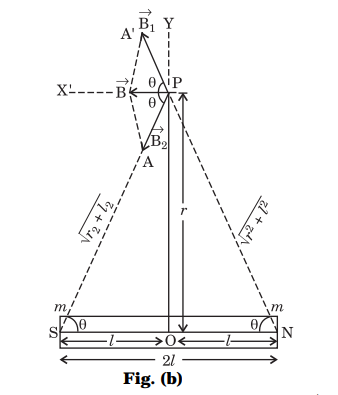
Let in Fig. (b), P be a point in the broad side on position of the bar magnet NS of length $2l$ at a distance $r$ from its centre O and let $m$ be the pole strength of each of its magnetic poles. From Fig. 8.10 it is evident that the distance of the point P from each of the poles N and S is equal and is given as follows :
$NP = SP =\left(r^2+ l ^2\right)^{1 / 2}$
Image
The magnitude of magnetic field intensity $\overrightarrow{ B _1}$ at P due to north pole N is given by :
$B _1=\frac{\mu_0}{4 \pi}\left(\frac{m}{ NP ^2}\right)$
$\Rightarrow \quad B _1=\frac{\mu_0}{4 \pi}\left[\frac{m}{\left(\sqrt{\left.r^2+l^2\right)^2}\right.}\right]$
$\Rightarrow \quad B_1=\frac{\mu_0}{4 \pi}\left[\frac{ m }{\left( r ^2+ l ^2\right)}\right]$... (1)
The direction of $\overrightarrow{ B _1}$ at P is away from the north pole N.
The magnitude of magnetic field intensity $\overrightarrow{ B _2}$ at P due to south pole S is given by :
$B _2=\frac{\mu_0}{4 \pi}\left(\frac{m}{ SP ^2}\right)$
$\Rightarrow \quad B _1=\frac{\mu_0}{4 \pi}\left[\frac{m}{\left(\sqrt{\left(r^2+l^2\right)}\right)^2}\right]$
$\Rightarrow \quad B _2=\frac{\mu_0}{4 \pi}\left[\frac{m}{\left(r^2+l^2\right)}\right]$ ...(2)
The direction of vec $\overrightarrow{ B _2}$ at P is towards the south pole S. From equations (1) and (2) it is obvious that :
$B _1= B _2=\frac{\mu_0}{4 \pi}\left[\frac{m}{\left(r^2+l^2\right)}\right]$
In order to find out the resultant magnetic field at P due to the bar magnet; we have to resolve $\overrightarrow{ B _1}$ and $\overrightarrow{ B _2}$ into two rectangular components: one along equitorial line and the other along axial line.
If $\angle PSO =\theta$, then $\angle SPX ^{\prime}=\theta$ and $\angle ONP =\angle X ^{\prime} PA ^{\prime}$ $=\theta$
The components of vec $\overrightarrow{ B _1}$ and $\overrightarrow{ B _2}$ along equatorial line are $B _1 \sin \theta$ and $B _2 \sin \theta$ respectively. As $B _1= B _2$, hence these components will be equal in magnitude, but are opposite in direction. Therefore these will cancel each other. The components of $\overrightarrow{ B _1}$ and $\overrightarrow{ B _2}$ along axial line will be $B _1 \cos \theta$ and $B _2 \cos \theta$ respectively and these will be added up; because these are in the same direction.
Therefore the resultant magnetic field at P due to bar magnet is given by :
$B = B _1 \cos \theta+ B _2 \cos \theta$
[Along $PX ^{\prime}$ ]
$\Rightarrow \quad B =\frac{\mu_0}{4 \pi}\left[\left(\frac{m}{\left(r^2+l^2\right)}\right) \cos \theta\right]$ $+\frac{\mu_0}{4 \pi}\left[\left(\frac{m}{r^2+l^2}\right) \cos \theta\right]$
or $B =\frac{\mu_0}{4 \pi}\left(\frac{2 m}{r^2+l^2}\right) \cos \theta$
But from right angled triangle $\Delta SOP$, we have
$\cos \theta=\frac{ SO }{ SP }=\frac{l}{\left(r^2+l^2\right)^{1 / 2}}$
$\therefore \quad B =\frac{\mu_0}{4 \pi}\left[\frac{2 m}{\left(r^2+l^2\right)}\right] \times \frac{l}{\left(r^2+l^2\right)^{1 / 2}}$
$\Rightarrow \quad B =\frac{\mu_0}{4 \pi}\left[\frac{2 m l}{\left(r^2+l^2\right)^{3 / 2}}\right]$
$\Rightarrow \quad B =\frac{\mu_0}{4 \pi}\left[\frac{m \times 2 l}{\left(r^2+l^2\right)^{3 / 2}}\right]$
But $m \times 2 l=$ Magnetic dipole moment of the bar magnet = M.
$\therefore \quad B =\frac{\mu_0}{4 \pi}\left[\frac{ M }{\left(r^2+I^2\right)^{3 / 2}}\right]$ ...(3)
Direction of $\overrightarrow{ B }$ is along $PX ^{\prime}$ i.e. from north pole towards south pole parallel to the magnetic axis. Hence its direction is opposite to that of the magnetic dipole moment of the magnet which is directed from south pole towards north pole.
Hence equation in its vector form can be written as follows :
$\vec{B}=-\frac{\mu_0}{4 \pi}\left[\frac{\vec{M}}{\left(r^2+l^2\right)^{3 / 2}}\right]$ ... (4)
For a short bar magnet i.e. a bar magnet of very small length we have $l \ll r$, hence in equations (3) and (4) $l^2$ can be neglected in comparison to $r^2$. Therefore these equations can be written in the following form respectively.
$B=\frac{\mu_0}{4 \pi}\left(\frac{M}{r^3}\right)$ ... (5)
$\overrightarrow{B}=-\frac{\mu_0}{4 \pi}\left(\frac{\overrightarrow{M}}{r^3}\right)$ ... (6)

Need a full question paper?

Generate a complete, print-ready paper with questions like this in minutes — across 16+ boards, with answer keys.
Start Generating Free

Similar questions

What will be the path difference between two light waves $y_1=a_1 \sin \omega t$ and $y_2=a_2 \cos (\omega t+$ $\phi)$ ?
A uniform wheel of radius R is set into rotation about its axis at an angular speed $\omega.$ This rotating wheel is now placed on a rough horizontal surface with its axis horizontal. Because of friction at the contact, the wheel accelerates forward and its rotation decelerates till the wheel starts pure rolling on the surface. Find the linear speed of the wheel after it starts pure rolling.
How many is energy states are present in one mole of sodium vapour? Are they all filled in normal conditions? "How many $3s$ energy states are present in one mole of sodium vapour? Are they all filled in normal conditions?
Suppose the second charge in the previous problem is $-1.0 \times 10^{-6}C.$ Locate the position where a third charge will not experience a net force.
Hari is a student of Class X in a school near his village. His uncle gifted him a bicycle with a dynamo fitted in it. He was thrilled to find that while cycling during night, he could light the bulb and see the objects on the road clearly. He, however, did not know how this device works. He asked this question to his teacher. The teacher considered it an opportunity and explained the working of a dynamo to the whole class.
Answer the following questions:
  1. State the principle and working of a dynamo.
  2. Write two values each displayed by Hari and his Science teacher.
What will be the energy corresponding to the first excited state of a hydrogen atom if the potential energy of the atom is taken to be $10eV$ when the electron is widely separated from the proton? Can we still write $\text{E}_\text{n}=\frac{\text{E}_1}{\text{n}^2}?\text{ r}_\text{n}=\text{a}_0\text{n}^2?$
A ball is dropped from a height of $5m$ onto a sandy floor and penetrates the sand up to $10\ cm$ before coming to rest. Find the retardation of the ball in sand assuming it to be uniform.
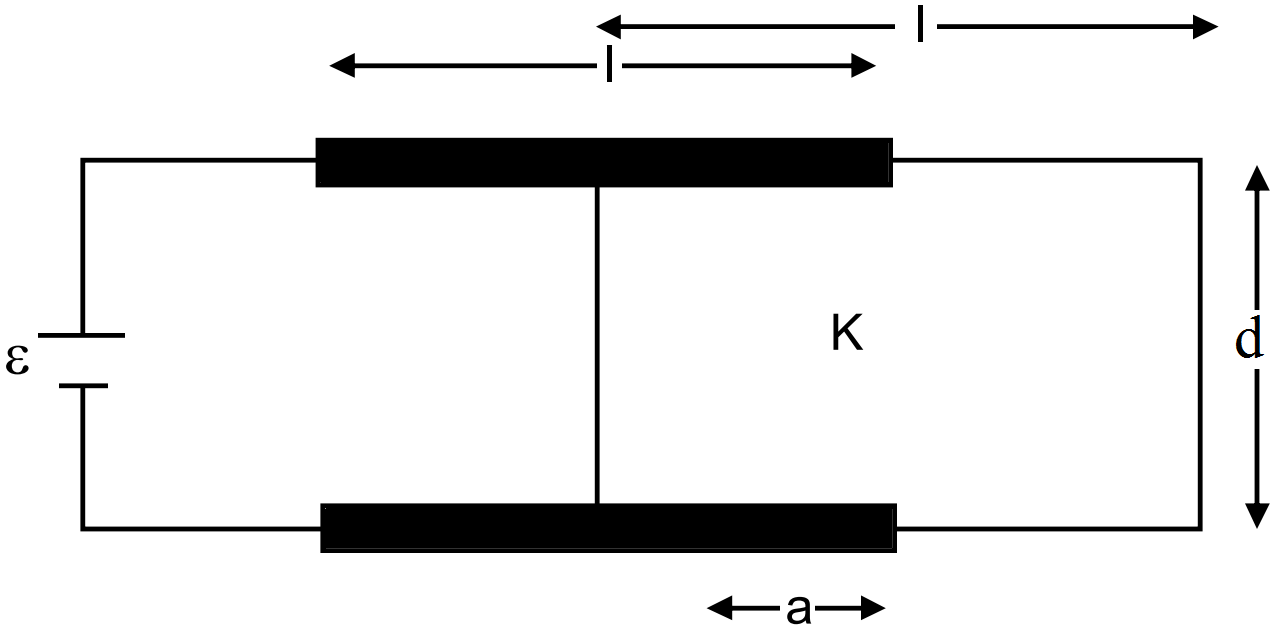
Consider the situation shown in figure. The plates of the capacitor have plate area $A$ and are clamped in the laboratory. The dielectric slab is released from rest with a length a inside the capacitor. Neglecting any effect of friction or gravity, show that the slab will execute periodic motion and find its time period.
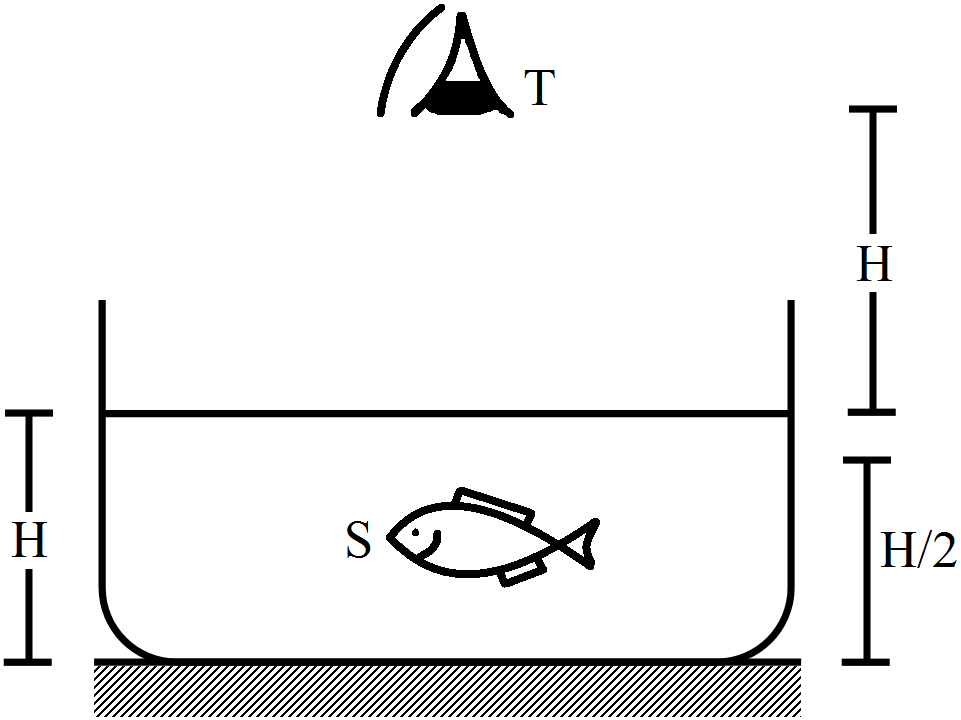
Consider the situation in figure. The bottom of the pot is a reflecting plane mirror, S is a small fish and T is a human eye. Refractive index of water is.
  1. At what distance(s) from itself will the fish see the image(s) of the eye?
  2. At what distance(s) from itself will the eye see the image(s) of the fish.
Suppose all the electrons of $100g$ water are lumped together to form a negatively charged particle and all the nuclei are lumped together to form a positively charged particle. If these two particles are placed $10.0\ cm$ away from each other, find the force of attraction between them. Compare it with your weight.