Question
Explain how Carnot's cycle works with the heat flow diagram. Using the same, explain the working of a refrigerator. Also, give its coefficient of performance.
Answer

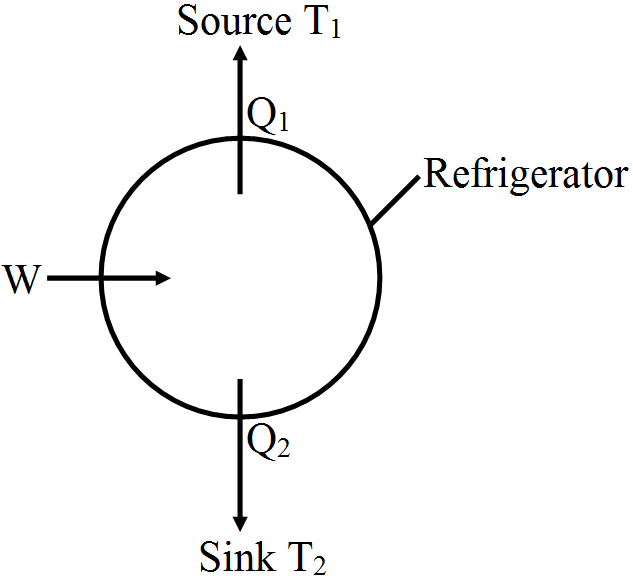
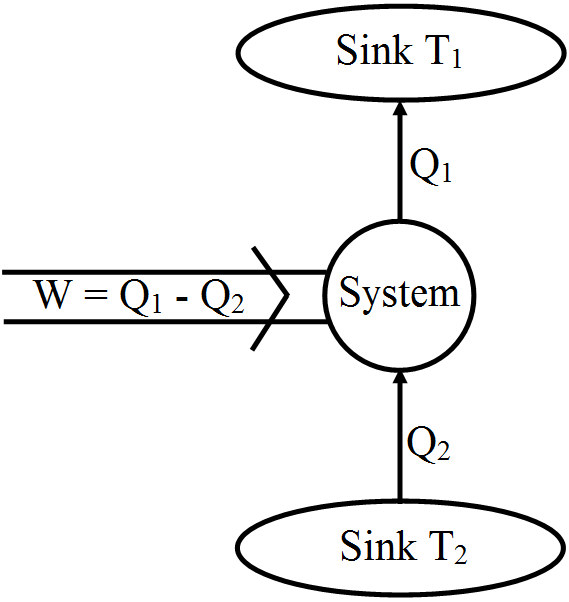
Refrigerator absorbs heat from the body at a low temperature and liberates it to a body at a high temperature by doing work. It can be shown by the given diagram.
Q2→ Energy absorbed from sink.
Q1 → Energy liberated to source.
W → Work done on the system.

Coefficient of performance $=\frac{\text{Q}_2}{\text{Q}_1-\text{Q}_2}$
Q1 – Q2 refers to the work done on the system/refrigerator.
Coefficient of performance (COP) $=\frac{\text{Q}_2}{\text{Q}_1-\text{Q}_2}=\frac{\text{T}_2}{\text{T}_1-\text{T}_2}$
Refrigerator: It works in the reverse Carnot's cycle. Heat is absorbed from sink at low temperature T2 and given to the source at higher temperature T1 with the help of an external agency doing work on the system. (W = Q1 - Q2).

The compressor in the refrigerator uses electrical energy and does work on the system. The coefficient of performance is defined as the heat energy absorbed from low temperature sink Q2 to the amount of work done.
$\text{W}=\text{Q}_1-\text{Q}_2$
$\text{COP}=\frac{\text{Q}_2}{\text{Q}_1-\text{T}_2}=\frac{\text{T}_2}{\text{T}_1-\text{T}_2}$

Need a full question paper?

Generate a complete, print-ready paper with questions like this in minutes — across 16+ boards, with answer keys.
Start Generating Free

Similar questions

A mild steel wire of length 1.0m and cross-sectional area 0.50 × 10⁻²cm2 is stretched, well within its elastic limit, horizontally between two pillars. A mass of 100g is suspended from the mid-point of the wire. Calculate the depression at the midpoint.
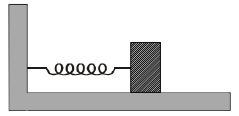
A spring having with a spring constant $1200 N m ^{-1}$ is mounted on a horizontal table as shown in Fig. A mass of 3 kg is attached to the free end of the spring. The mass is then pulled sideways to a distance of 2.0 cm and released.
Image
Determine (i) the frequency of oscillations, (ii) maximum acceleration of the mass. and (iii) the maximum speed of the mass.
A woman starts from her home at 9.00 am, walks with a speed of 5km h–1 on a straight road up to her office 2.5km away, stays at the office up to 5.00 pm, and returns home by an auto with a speed of 25km h–1. Choose suitable scales and plot the x-t graph of her motion.
A projectile is fired horizontally with a velocity of 98ms-1 from the hill 490m high. Find (i) time taken to reach the ground (ii) the distance of the target from the hill and (iii) the velocity with which the body strikes the ground.
Define surface tension and surface energy. Write units and dimensions of surface tension. Also prove that surface energy numerically equal to the surface tension.
A cylinder fitted with a movable piston contains hydrogen at a pressure of 3.5 × 10⁵N-m2 and temperature 366K. Hydrogen expands adiabatically until the pressure in the cylinder falls to 0.7 × 10⁵ N-m-2. The piston is then fixed and the gas is heated until the temperature becomes 366K. The pressure in the cylinder is now found to be 1.1 × 10⁵N-m-2. Determine the specific heats of hydrogen. (R = 8.3 J mol-1 K-1).
State Kepler's laws of planetary motion.
What would be the speed of rotation of the earth in order that a body on the equator has no weight? Determine the apparent weights of the bodies situated at a latitude of 60° and at the poles. The radius of the earth = 6400km and g = 9.8ms-1.
A block of mass m moving with speed v compresses a spring through a distance x before its speed is halved. What is the value of spring constant?
A tunnel is dug through the centre of the Earth. Show that a body of mass ‘m’ when dropped from rest from one end of the tunnel will execute simple harmonic motion.
A rectangular box lies on a rough inclined surface. The coefficient of friction between the surface and the box is $\mu$. Let the mass of the box be m.
  1. At what angle of inclination $\theta$ of the plane to the horizontal will the box just start to slide down the plane?
  2. What is the force acting on the box down the plane, if the angle of inclination of the plane is increased to a $\theta>$?
  3. What is the force needed to be applied upwards along the plane to make the box either remain stationary or just move up with uniform speed?
  4. What is the force needed to be applied upwards along the plane to make the box move up the plane with acceleration a?