Question
Explain how the width of depletion layer in a p-n junction diode changes when the junction is (i) forward biased (ii) reverse biased.

Answer

  1. In forward biasing, the depletion layer decreases.
Reason: Majority charge carriers come closer to junction.
  1. In reverse biasing, the width of depletion layer increases.
Reason: The majority charge carries go farther away from the junction.

Need a full question paper?

Generate a complete, print-ready paper with questions like this in minutes — across 16+ boards, with answer keys.

Start Generating Free

Similar questions

Find the maximum potential difference which may be applied across an X-ray tube with tungsten target without emitting any characteristic K or L X-ray. The energy levels of the tungsten atom with an electron knocked out are as follows.
Cell containing vacancy
K
L
M
Energy in keV
69.5
11.3
2.3
A carrier wave of peak voltage 15 V is used to transmit a message signal. Find the peak voltage of the modulating signal in order to have a modulation of 60%.
A screen is placed 90 cm from an object. The image of the object on the screen is formed by a convex lens at two different locations separated by 20 cm. Determine the focal length of the lens.
Derive the equation of instantaneous power and average power for a purely capacitive? circuit.
Define power of lens, obtain its equation and write its unit.
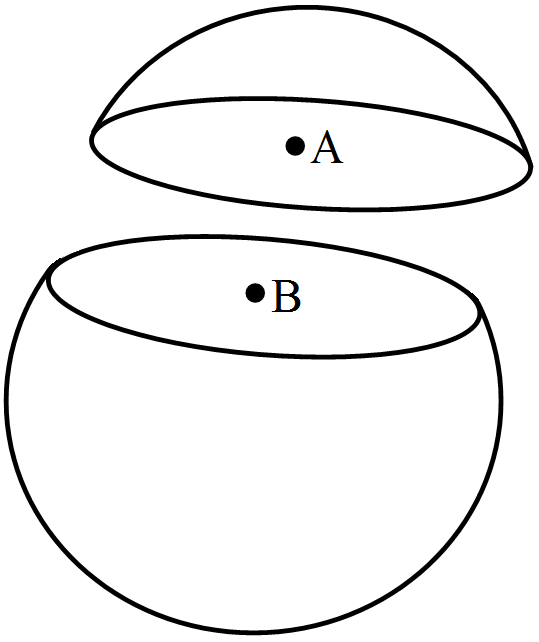
A thin spherical shell having uniform density is cut in two parts by a plane and kept separated as shown in figure $(11-E_3).$ The point $A$ is the centre of the plane section of the first part and $B$ is the centre of the plane section of the second part. Show that the gravitational field at $A$ due to the first part is equal in magnitude to the gravitational field at $B$ due to the second part.
A barometer is constructed with its tube having radius $1.0\ mm$. Assume that the surface of mercury in the tube is spherical in shape. If the atmospheric pressure is equal to $76\ cm$ of mercury, what will be the height raised in the barometer tube. The contact angle of mercury with glass $= 135^\circ$ and surface tension of mercury $= 0.465N/m$. Density of mercury $= 13600\ kg/m^3$.
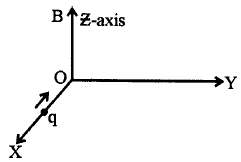
A charge ‘q’ moving along the X-axis with a velocity v is subjected to a uniform magnetic field B acting along the Z-axis as it crosses the origin O.​​​​​​
  1. Trace its trajectory.
  2. Does the charge gain kinetic energy as it enters the magnetic field? Justify your answer.
An atom absorbs a photon of wavelength 500nm and emits another photon of wavelength 700nm. Find the net energy absorbed by the atom in the process.
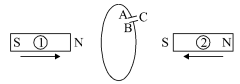
Two bar magnets are moving rapidly towards a metallic loop joined across a capacitor C as shown in the figure. What is the polarity of the capacitor?
Image