Question 12 Marks
Two amplifiers are connected one after the other in series $($cascaded$).$ The first amplifier has a voltage gain of 10 and the second has a voltage gain of $20.$ If the input signal is $0.01$ volt, calculate the output ac signal.
Answer
View full question & answer→Voltage gain of the first amplifier,$ V_1 = 10$
Voltage gain of the second amplifier, $V_2 = 20$
Input signal voltage, $V_i = 0.01 V$
Output AC signal voltage $= V_0$
The total voltage gain of a two$-$stage cascaded amplifier is given by the product of voltage gains of both the stages, i.e.,
$V = V_1 \times V_2$
$= 10 \times 20 = 200$
We have the relation:
$\text{V}=\frac{\text{V}_{0}}{\text{V}_{1}}$
$V_0 = V \times V_i$
$= 200 \times 0.01 = 2 V$
Therefore, the output $AC$ signal of the given amplifier is $2 V.$
Voltage gain of the second amplifier, $V_2 = 20$
Input signal voltage, $V_i = 0.01 V$
Output AC signal voltage $= V_0$
The total voltage gain of a two$-$stage cascaded amplifier is given by the product of voltage gains of both the stages, i.e.,
$V = V_1 \times V_2$
$= 10 \times 20 = 200$
We have the relation:
$\text{V}=\frac{\text{V}_{0}}{\text{V}_{1}}$
$V_0 = V \times V_i$
$= 200 \times 0.01 = 2 V$
Therefore, the output $AC$ signal of the given amplifier is $2 V.$
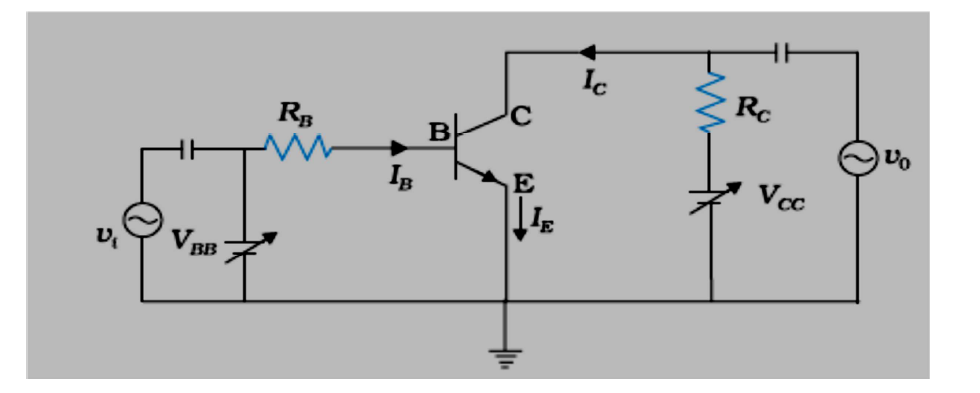 Condition: The transistor must be operated close to the centre of its active region.Alternate Answer
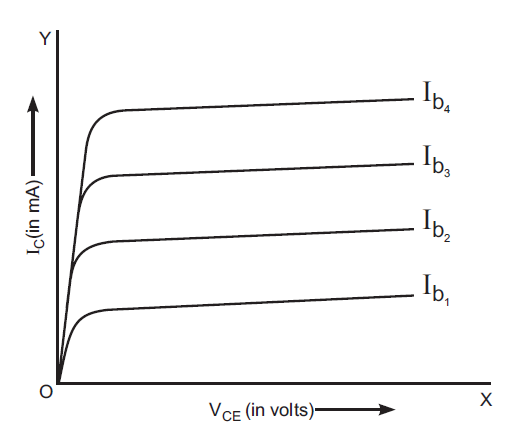 The reciprocal of the slope of the linear part of the output characteristics represents the output resistance.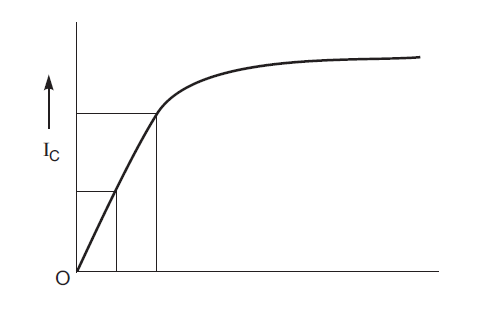

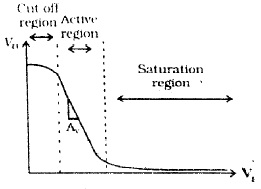 In the active region, a $($small$)$ increase of $V_i$ results in a $($large, almost linear$)$ increase in $I_c,$ This results in an increase in the voltage drop, This results in an increase in the voltage drop cross $R_c.$

.gif)
 or any other difference.



 Current in the circuit = Drift current